12
GB
6.6 Hauling in
Untie the bridle or replace the rode in the gypsy.
If it is safe to do so, operate an ‘Up’ control.
The fallsafe pawl (32) does not need to be disengaged during retrieval as it will act as a ratchet. When the
anchor has been retrieved and is stowed in the bow roller, the fallsafe pawl should be le engaged in the gypsy
to prevent accidental deployment of the anchor whilst underway.
REMEMBER - The fallsafe pawl DOES need to be disengaged from the gypsy before the anchor can be let go
again.
Having retrieved the anchor, ensure it is independently secured to prevent its accidental release.
6.7 Manual recovery
Insert clutch lever supplied into gypsy drive cap (31) and turn clockwise to haul in the anchor.
6.8 Operating tips
When anchoring, it is best to power the rode out, allowing the vessel to take up stern way before full scope is let
out. This helps prevent the rode from becoming tangled on top of your anchor on the seabed.
To aid anchor recovery, we recommend that the vessel’s engine be used to assist by moving the vessel towards
the anchor. We do not recommend that the vessel be motored over and beyond the anchor, as this can cause the
rode to damage your topsides.
As the anchor approaches the stemhead, the last few feet of rode should be inched in by judicious use of
controls to avoid damage to the vessel.
Having retrieved the anchor, ensure the fallsafe pawl is engaged in the gypsy to lock it and prevent accidental
deployment of the anchor whilst underway.
When mooring stern to, at a suitable distance from the jetty, deploy the anchor to prevent the bow from
swinging. Gently pay out the rode under the infl uence of the stern way of the vessel as it approaches the jetty.
Make fast your vessel with warps from the stern.
6.9 Joining rope to chain
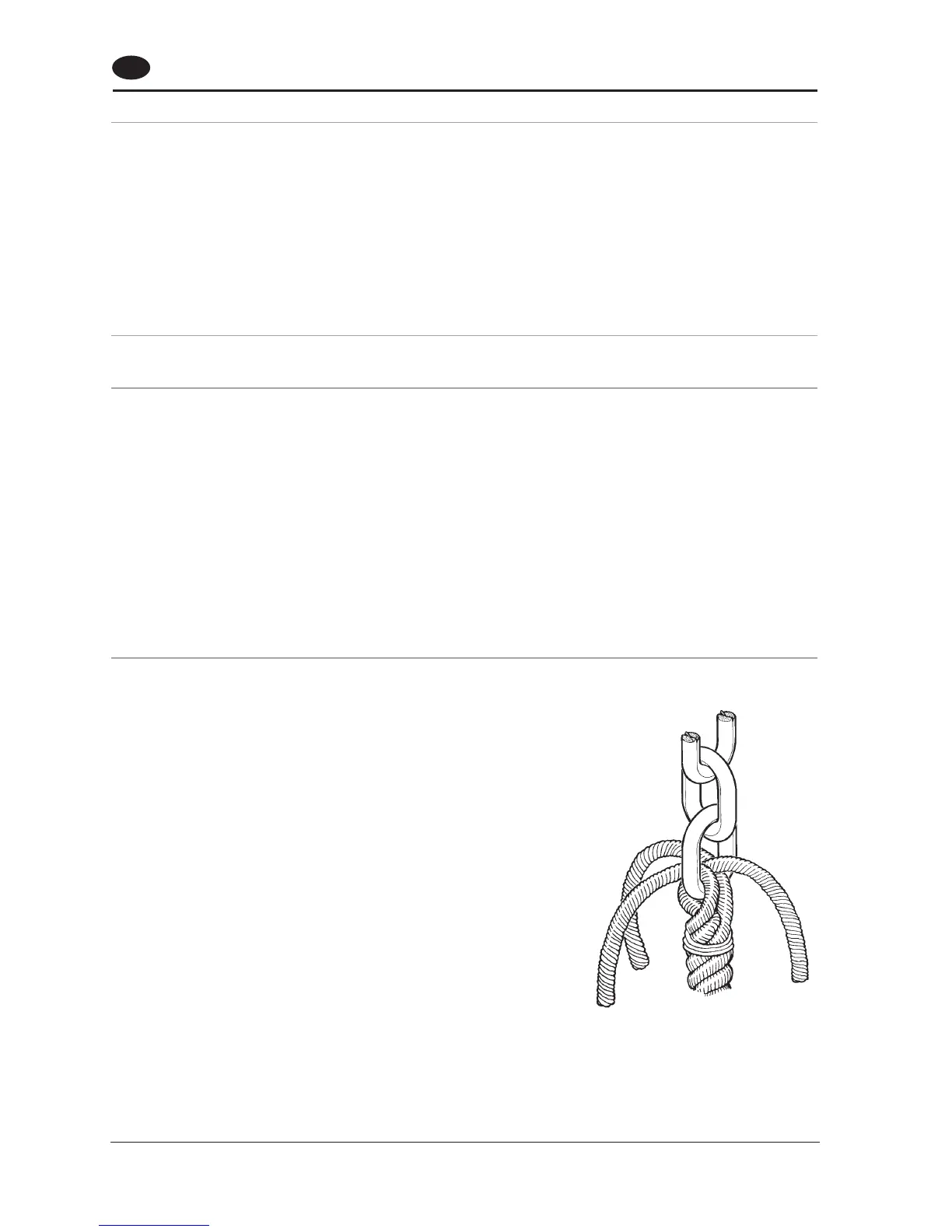
When splicing rope to chain, select a length of chain that will
avoid having the splice positioned in the gypsy when the anchor
comes over the stemhead. Furthermore, ensure that the splice is
no tighter than the rope.
A hard splice is not desired.
• With whipping twine or similar, seize your rope 200 mm (8”)
from the rope’s end and unlay the strands.
• Pass one strand through the chain link from one side and the
other two strands from the opposite side. Remove seizing and
complete a back splice in the normal manner for four full tucks.
• With a hot knife pare down the three strands by one half of
their diameter and continue with two further tucks.
• With a hot knife, carefully melt the ends back into the line.
Because of wide variations in rope type and construction some
experimentation may be required.
• Whip the line with permanent whipping at the beginning of the
taper.
• The method of joining illustrated is designed to minimize
chafe between the rope and chain but as a matter of prudent
seamanship the splice should be checked regularly and remade
if there is any evidence of wear.


 To Next Page