
 Need help?
Do you have a question about the LG ARUM216BTE5 and is the answer not in the manual?
Imminent hazardous situations that can result in death or serious injury.
Details electrical data, including motor amps, MCA, MOCP, and RFA for 208-230V outdoor units.
Provides guidelines and support options for securely mounting and anchoring outdoor units against environmental factors.
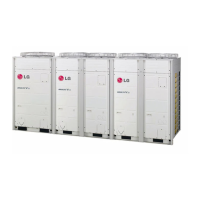
Explains how to mount and anchor heat recovery units, emphasizing proper support and leveling.
Guides on cutting, deburring, flaring, and inspecting pipe ends for flared connections, emphasizing 45° flares for R410A.
Provides specifications and electrical data for LG Multi V Heat Recovery Units.
Details the connections and limitations for heat recovery units, including piping sizes and series connection capacity.
Covers the importance, requirements, and methods for insulating refrigerant piping, including types and thickness.
Identifies the location of PCBs and electrical components within large and small frame outdoor units for installation.
Details routing and termination of power and communication cables for large frame outdoor units, including close-up views.
Provides best practices for making power and communication cable connections using solderless ring or fork terminals.
Specifies requirements for communication cables between outdoor, indoor, and heat recovery units, including wiring and grounding.
Details how to access outdoor unit wiring and cable connections, including panel removal and terminal block locations.
Illustrates typical power wiring and communication cable system schematics for both heat pump and heat recovery operations.
Shows the power supply and wiring configuration for triple frame outdoor units, detailing connections from the power source.
Provides examples of communication cable connections for heat pump and heat recovery systems, including master/slave configurations.
Outlines the procedure for performing a triple leak and pressure test on the refrigerant piping system to ensure leak-free operation.
Details the steps for performing a triple evacuation of the refrigerant system to remove moisture and contaminants.
Guides on starting the pre-commissioning process and setting outdoor unit DIP switches for heat pump or heat recovery systems.
Explains how to perform the Integrated Test Run (ITR) to test all system components and functions, including refrigerant charge input.
Explains how to perform self-diagnostics checks using DIP switches and the SSD display on the outdoor unit PCB.
Details the procedure for indoor unit auto-addressing to establish communication and assign addresses within the system.
Explains how to assign central control addresses to indoor units and heat recovery units for system management.
Guides on assigning unique addresses to heat recovery units for proper system identification and parameter setting.
Explains the auto addressing procedure for pipe detection to automatically set the connection relationship between units.
Guides on performing manual pipe detection addressing for heat recovery units when auto addressing fails or is not required.
Provides tables and instructions for setting external static pressure (ESP) and fan speed values for ducted indoor units.
Lists the required documents for requesting system commissioning, including shop drawings and checklists.
Outlines the process for initiating a commissioning request after all pre-commissioning tasks are completed and documented.
Introduces LG VRF system error codes, their levels, and how they are displayed for troubleshooting.
Checklist items for preparing the refrigerant circuit, including pipe capacity verification, power supply, valve status, and pressure tests.
 General
| Brand | LG |
|---|---|
| Model | ARUM216BTE5 |
| Category | Air Conditioner |
| Language | English |


 To Next Page