The LIBHOF Compressor Car Fridge is a versatile cooling device designed for both refrigeration and freezing of food products. It features a fast-acting and efficient cooling system with a compressor and control module, ensuring maintenance-free cooling performance. This device is built for mobile use and can operate effectively in various harsh conditions and situations.
Function Description:
The cooler device offers several key functions to enhance user experience and protect vehicle batteries:
- 3-level battery monitor: This feature protects the vehicle battery from excessive discharge when the device is connected to the on-board DC supply. If the cooler operates when the vehicle ignition is off, it automatically switches off if the supply voltage drops below a set level. It will switch back on once the battery is recharged to the restart voltage level. The battery monitor has three levels (H1, H2, H3), with H3 responding faster than H1 and H2. For a started battery, H3 is recommended; for a supply battery, H1 suffices.
- Display with temperature gauge: The device includes a display that shows the temperature. This display automatically switches off at low battery voltage.
- Temperature adjustment: Users can adjust the cooling temperature using two buttons, with steps of 1°C or 2°F. The display unit can be switched between Celsius and Fahrenheit.
- Working modes: The fridge offers two working modes:
- HH working mode: This is the normal operating mode, indicated by a red "on" LED light.
- ECO working mode: This is an energy-saving mode, indicated by a green "on" LED light. In ECO mode, the noise level is reduced from 40 dB to 35 dB, and energy consumption is saved, though cooling is slower than in HH mode.
Important Technical Specifications:
The LIBHOF Compressor Car Fridge utilizes R134a refrigerant, which contains fluorinated greenhouse gases and is hermetically sealed. The insulation is made of Polyurethane, and the cooling system is compressor-based.
The device operates on a DC 12/24V connection voltage.
Ambient temperature for operation ranges from +16°C to +43°C (+61°F to +110°F).
Cooling capacity ranges from +20°C to -25°C (+50°F to -13°F).
Here's a summary of current, volume, refrigerant quantity, and power consumption for various models:
| Model |
Volume (L) |
Related Current (12V, A) |
Related Current (24V, A) |
Refrigerant Quantity (g) |
Power Consumption (W) |
| Q-18 |
17 |
3.5 |
1.7 |
24 |
40 |
| Q-22 |
20 |
3.5 |
1.7 |
36 |
40 |
| Q-28 |
27 |
3.8 |
1.9 |
32 |
45 |
| Q-26 |
29 |
3.8 |
1.9 |
32 |
45 |
| Q-36 |
37 |
4 |
2 |
33 |
48 |
| Q-30 |
30 |
3.8 |
1.9 |
32 |
45 |
| Q-40 |
38 |
4 |
2 |
34 |
48 |
| Q-55 |
50 |
4.2 |
2.1 |
35 |
50 |
| Q-65 |
60 |
4.6 |
2.3 |
38 |
55 |
| K-20 |
19 |
3.5 |
1.7 |
35 |
39 |
| K-26 |
23 |
3.5 |
1.7 |
37 |
42 |
| K-30(H) |
31 |
3.8 |
1.9 |
42 |
46 |
| X-18 |
17 |
3.5 |
1.8 |
40 |
42 |
| X-26 |
25 |
3.8 |
1.9 |
40 |
45 |
Climate class for all models is SN, N, ST, T.
Usage Features:
The cooling device is designed to be operated from a DC on-board power supply (vehicle, boat, caravan), a DC external battery, or an AC power supply via an AC adaptor. It is suitable for household and similar applications, including staff kitchen areas, farmhouses, hotels, motels, and bed and breakfast environments.
Safety Precautions:
- Do not operate if visibly damaged.
- Power cable replacement must be done by customer service.
- Repairs should only be carried out by qualified personnel.
- Keep out of reach of children under 8 years old.
- Do not store explosive substances (e.g., spray cans with flammable propellant).
- Disconnect from power before cleaning and after every use.
- Store food in original or suitable containers.
- Ensure voltage matches rating label.
- Connect DC cable to vehicle DC power supply or to an AC adaptor for AC power.
- Never pull the plug by the cable.
- Disconnect from battery before connecting a quick charging device.
- Disconnect or switch off when turning off the engine to prevent battery discharge.
- Not suitable for transporting caustic materials or solvents.
- Dispose of the device at an appropriate recycling facility due to flammable cyclopentane insulation.
- Ensure power supply line and plug are dry before starting.
- Do not use internal electric devices unless recommended by the manufacturer.
- Avoid placing near naked flames or heat sources.
- Ensure sufficient ventilation to prevent overheating; keep clear of walls and objects.
- Do not cover ventilation openings.
- Do not fill with ice or fluid.
- Do not immerse in water.
- Protect from heat and moisture.
Connecting the Device:
- DC connection: Plug the DC cable into the cooling device's DC power supply inlet and then to the DC power supply outlet. The supplied DC cable includes a fuse for protection; do not remove it. The manufacturer does not recommend using DC extension cords or splicing wires. Always unroll or uncoil DC cords to prevent heat retention.
- AC connection: Plug the DC cable into the device's DC power supply inlet, then connect the DC cable to the cigar lighter socket of an AC adaptor (optional sale product), and finally connect the AC cable of the AC adaptor to the AC power supply outlet. Only use the AC adaptor supplied by the manufacturer. Avoid handling plugs with wet hands or on wet surfaces. For boat operation from a 120V AC supply, install a residual current circuit breaker.
Switching On/Off:
- Switch on: Lightly touch the "ON/OFF" button once.
- Switch off: Keep touching the "ON/OFF" button for about five seconds.
Defrosting:
Frost can form inside the device or on the vaporizer, reducing cooling capacity. Defrost in good time by:
- Taking out all contents.
- Placing contents in another cooling device if necessary.
- Switching off the device.
- Leaving the cover open.
- Wiping off defrosted water.
Never use hard or pointed tools to remove ice or loosen frozen objects.
Energy Saving Tips:
- Choose a well-ventilated installation location protected from direct sunlight.
- Allow warm food to cool down before placing it in the device.
- Do not open the device more often or leave it open longer than necessary.
- Defrost once a layer of ice forms.
- Avoid unnecessarily low temperatures.
Storage and Transport:
- Storage: Store in a dry, ventilated room at 0°C to +50°C with relative humidity up to 80%, away from direct sunlight. Factory packaging is recommended for long-term storage.
- Transport: Transport in a horizontal position is recommended. If not possible, allow it to stand for at least 12 hours in a horizontal position without turning it on before use.
Maintenance Features:
- Cleaning:
- Occasionally clean the interior and exterior with a damp cloth.
- Ensure air inlet and outlet vents are free of dust and dirt to allow heat release and prevent damage.
- Always disconnect from power before cleaning.
- Never clean under running water or in a sink.
- Do not use abrasive cleaning agents or hard objects.
- Replacing the DC plug fuse:
- Pull off the adapter sleeve from the DC plug.
- Unscrew the screw from the upper half of the housing.
- Carefully raise the upper half of the housing from the lower half.
- Take out the contact pin.
- Replace the defective fuse with a new fuse of the same type and rating.
- Re-assemble the plug in reverse order.
Troubleshooting (Error Codes):
The display screen may show error codes indicating specific issues:
- E0 (Sensor circuit broken or short): Connect or replace the sensor.
- E1 (Input voltage is low): Check battery voltage or adjust the Battery Monitor Level.
- E2 (Ventilating fan problem): Check if the ventilating fan is blocked or short-circuited.
- E3 (Compressor started self-protection): Disconnect from power for 30 minutes, then restart.
- E4 (Compressor protects itself against unusual running speed): Change the working mode via the device control panel.
- E5 (Control panel's overheating warning): Move the device to a place with a well-ventilated installation environment.

 Need help?
 General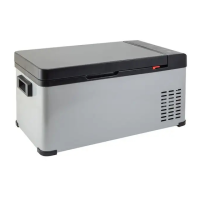

 To Next Page