Need help?
Do you have a question about the LINDR KONTAKT 40 and is the answer not in the manual?
Precautions for handling the device, its components, and ensuring a safe operating environment.
Safety guidelines for maintenance, repairs, and emergency situations, especially with flammable coolant.
Guidance on connecting the device to a power socket according to specifications.
Details how to connect and pressurise using the built-in compressor for a single tap device.
Explains connection and pressurisation with a CO2 bottle for a single tap unit.
Covers connection and pressurisation using the built-in compressor for two-tap units.
Illustrates connection and pressurisation with a classic CO2 bottle for two-tap units.
Specific instructions for connecting KONTAKT 155/R to a CO2 bottle for two taps.
Specific warning and setting guidance for cooling non-alcoholic beverages to prevent freezing.
A guide to common malfunctions, their causes, and recommended removal steps.
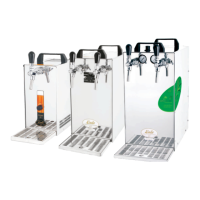
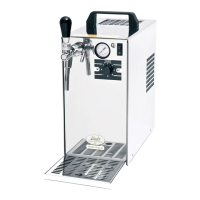
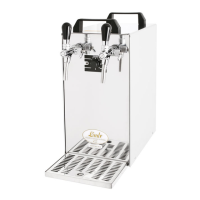
This document provides an instruction manual for the LINDR Flow-Through Contact Cooler, a beverage dispensing system designed for cooling, dispensing, and serving well-cooled beer and other beverages. The manual covers various models, including PYGMY 30/K profi and GREEN LINE models such as PYGMY 20, PYGMY 20/K, PYGMY 25, PYGMY 25/K, KONTAKT 40, KONTAKT 40/K, KONTAKT 40/K profi, KONTAKT 70, KONTAKT 70/K, KONTAKT 155, KONTAKT 155/K, and KONTAKT 155/R.
The LINDR Flow-Through Contact Cooler utilizes a modern compressor cooling unit that efficiently converts input energy directly into cooling, ensuring proper beverage cooling with minimal energy consumption. The device is specifically designed for flow-through cooling of beverages. Any other use is considered impermissible and potentially dangerous, and the supplier is not liable for damage caused by incorrect use.
The cooling system contains flammable coolant R290 (propane). Therefore, emergency maintenance and repair of the cooling system must be performed by trained, authorized technicians familiar with cooling and electrical systems, and who have special training and qualifications for handling flammable substances. Open flames or potential sources of sparks must not be used in the vicinity of a cooler using R290 coolant.
The device is delivered ready for immediate use. The temperature of the cooled beverage is controlled by a mechanical thermostat with a numerical scale of 1-7, allowing for temperature adjustments within a range of 2 °C to 8 °C. For non-alcoholic beverages, the thermostat knob should be set to a maximum of 5 to prevent freezing of the beverage tubing and potential damage to the device.
The cooler can be connected and pressurized either by a built-in compressor (for one-tap and two-tap devices) or by a CO2 bottle (for one-tap and two-tap devices). For models with a built-in air compressor (PYGMY 30/K profi and GREEN LINE models PYGMY 20/K, PYGMY 25/K, KONTAKT 40/K, KONTAKT 70/K, KONTAKT 155/K), the compressor is integrated into the cooling device itself. It features automatic pressure regulation set to 2.8-3.2 bar, while K profi models allow smooth pressure regulation in the 1.0-3.4 bar range, displayed on a pressure gauge. The compressor can be turned off separately with a switch and is zero-maintenance, fitted with a molecule filter for the drawn-in air. Other pressurization options include PUMA 1HP and 1/2HP compressors, LEONARDO 1HP compressor, AIRCRAFT 1HP compressor, classic Biogon, and N2 bottles.
Installation and placement of the cooler require it to be on a stable, level surface (maximum permitted inclination: 2 degrees) with unobstructed air circulation. Sufficient free space for air circulation and heat dissipation, along with a fresh air supply, must be ensured. The device must not be placed in an enclosed space, near heat sources, or exposed to direct sunlight. A minimum distance of 30 cm from obstacles that would limit air circulation is required for vents, and 7 cm for sections without air vents. The device is designed for use in a cool, well-ventilated room at ambient temperatures between 16 °C and 32°C. It must not be used or stored at ambient temperatures lower than 0 °C and should always be under a roof, protected from rain or sunlight.
Electrical connection involves plugging the device into a power socket that meets the specifications on the machine plate (voltage, frequency, input power). Damaged power leads must be replaced by the manufacturer, their service technician, or a similarly qualified person. The device should not be used or turned on if the power lead is damaged.
Tap installation involves securing the compensator lever onto the spline and tightening it with an enclosed wrench. Keg coupler assembly requires screwing speed fittings onto the 5/8" thread, ensuring a lip valve (check valve) is fitted on the air inlet for the delivery medium. For beverage outlets, an F 5/8" x 3/8" (9.5 mm) speed fitting is screwed onto the keg coupler. Speed fittings are installed by inserting the hose all the way into the fitting body (approx. 20 mm), ensuring the hose end is straight. To remove a speed fitting, the grey ring must be held tight against the fitting body while pulling out the hose. Hoses must not be pressurized during removal.
To put the device into operation, interconnect air and beverage supplies, set the thermostat to 0, connect the cooler to the power mains, tap the keg, turn on the air compressor (if applicable) and pressurize to the required level. All joints and connections must be checked for leaks. If a leak is found, the keg must be untapped, the device turned off, and leaks fixed. If a leak is inside the device or the user is unsure how to proceed, a service center should be contacted. After ensuring no leaks, dispense some beverage to check for water remnants; never set the device to maximum cooling if water is present, as this can cause freezing and damage. Finally, set the desired beverage temperature on the thermostat. Cooling takes approximately 5-10 minutes before the first drink can be poured.
The manual emphasizes the importance of using original components for spare parts. When ordering, the product type, production year, serial number, and full name/number of the spare part should be provided.
Sanitation by water is recommended after each use. The beverage tubing should be flushed with pressurized water using a sanitation adapter (not included, but available as an accessory). The maximum water temperature for sanitation must not exceed 25 °C. The sanitation procedure involves connecting the keg coupler to the sanitation adapter, opening the bar tap lever, and keeping it open until clean water flows out. For better sanitation, cleaning balls can be placed into the hose beyond the keg coupler, and pressurized water used to clean the beverage tubing. The tap must be dismounted, and cleaning balls removed afterward. Chemical sanitation by a qualified person is required every 14 days.
Periodic checks are crucial for maintaining the device. A visual check and lead-in cable check should be performed before every use. The condenser cleanliness should be checked monthly, or more frequently if there is excessive pollution, and cleaned with compressed air or wiped off to prevent reduced cooling output or damage. If any defects or malfunctions are found, the device should not be used. Weekly checks include verifying the lead-in cable's integrity, ensuring the plug is firmly in the socket, confirming the device is not exposed to radiant heat, and checking that air circulation is not obstructed. Monthly, the cooling unit's condenser should be checked and cleaned. Annually, an engineering inspector should check the electrical safety of the device.
In case of malfunctions, a table is provided to identify the cause and suggest removal steps. For instance, if beverage does not flow, causes could be an incorrectly tapped keg, the built-in compressor being off, frozen water from sanitation, or a closed compensator. Solutions include checking the keg coupler lever, turning on the compressor switch, turning off the device and waiting for thawing, or moving the compensator lever. If the beverage is insufficiently cooled, causes could be incorrect thermostat setting, poor air circulation, or device overheating. Solutions include adjusting the thermostat, cleaning condenser plates, or placing the device in a colder environment. If tap jerks or sprays out, pressure may be too high, requiring a reduction in delivery medium supply or keg pressure. If the air compressor does not switch on or off, the switch should be pressed, or the air hose pulled out and reinserted, and nuts on the keg coupler tightened. Excessive beer foam may indicate high beverage temperature or flow rate, requiring thermostat adjustment or compensator lever regulation. Speed fittings leaking could be due to poorly inserted or scratched hoses, requiring reinsertion, leveling, or shortening of the hose. If a defect persists after these steps, a service center should be contacted, providing the type of defect, product type, production year, and serial number.
Environmental protection guidelines state that the product must not be disposed of in communal waste. Electrical waste in the Czech Republic is disposed of within the Rema System (www.remasystem.cz). In other countries, waste sorting is subject to local regulations, promoting recycling and reuse of used products and packaging materials to protect the environment and reduce resource consumption. Local regulations may dictate disposal methods at local collection points or points of sale.
 General
| Brand | LINDR |
|---|---|
| Model | KONTAKT 40 |
| Category | Kitchen Appliances |
| Language | English |


 To Next Page