EasyManua.ls Logo

LINDR CWP - User Manual

LINDR CWP
16 pages
Print Icon
To Next Page IconTo Next Page
Loading...
DISPENSE EQUIPMENT FOR WINE
MAKERS
LINDR
Number 008-2020 REV00 Valid 2020-09-01
INSTRUCTION MANUAL
ENGLISH
MODEL CWP 300 V GREEN LINE
Question and Answer IconNeed help?

Do you have a question about the LINDR CWP and is the answer not in the manual?

Summary

General Safety and Operational Guidelines

Electrical Safety and Handling

Covers safe electrical connections, unplugging, and handling of wiring.

Flammable Coolant R290 Precautions

Warnings and safety measures for the R290 coolant and its handling.

Operational Environment and Ventilation

Ensuring proper air circulation, placement, and temperature limits for operation.

Maintenance and Service Safety

Safety instructions for cleaning, maintenance, and repair by qualified personnel.

Installation and Placement

Placement Requirements

Instructions for stable surface, inclination, and unobstructed air circulation.

Electrical Connection and Testing

Connecting to Power Supply

Procedure for connecting the device to a power socket, adhering to specifications.

Device Readiness for Use

Information confirming the product is ready for immediate operation.

Warranty Policy

Warranty Coverage and Claims

Details on warranty period, terms, limitations, and service claims.

Device Components Overview

Component Identification List

A numbered list identifying the main parts of the cooler.

Controls and Temperature Management

Mode Selection and Indicators

Explanation of the cooling/heating mode switch and water level indicator.

Thermostat Operation and Settings

Guide to using thermostats for water temperature and pump regulation.

Operation and Interconnection

Filling Tank and Connecting Exchanger

Procedure for filling the tank and connecting with a heat exchanger.

Putting Device into Operation

Step-by-step instructions for initial operation and checks.

Wiring Diagrams

Connection Configurations

Visual diagrams showing connections with cooling coil and board exchanger.

Thermostat and Speed Fittings

Dixell XR20 CX Thermostat Usage

How to display and change temperature settings on the Dixell thermostat.

Speed Fittings Handling

Instructions for installing and removing speed fittings safely and correctly.

Condenser Maintenance

Condenser Cleaning Procedure

Guidelines for cleaning the condenser using air or a brush.

Inspections and Periodic Checks

Pre-Use Inspection Checklist

Items to check visually and functionally before operating the device.

Scheduled Periodic Checks

Regular checks for water level, cables, air circulation, and electrical safety.

Environmental Protection and Waste Sorting

Waste Disposal Guidelines

Information on proper disposal and recycling of electrical waste.

Troubleshooting Malfunctions

Malfunction Table and Solutions

Common issues, causes, and recommended removal steps for device problems.

Spare Parts and Technical Data

Ordering Spare Parts Information

Required product details for ordering replacement parts.

Technical Specifications Summary

Key technical specifications including power, output, and dimensions.

Overview

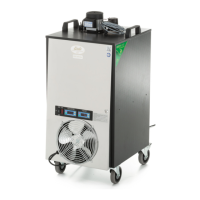
The Lindr CWP 300 V Green Line is a professional flow-through cooler primarily designed for winemaking, though it can also be used for fermenting must. This versatile device not only cools but also features a water heater, allowing for manual switching between cooling and heating modes. Its robust design and specific functionalities cater to the needs of winemakers for chilling or fermenting wine. The unit is equipped with a drain valve for easy water drainage and a water gauge for monitoring the water level, enhancing user convenience and operational control. The cooling system utilizes R290 (propane) as an environmentally friendly refrigerant.

Important Technical Specifications:

  • Model: CWP 300 V Green Line
  • Power (Hp): 3/4
  • Power (W): 2000
  • Maximum Output (l/hour): 200
  • Continuous Output (l/hour): 180
  • Temperature Difference (Δt °C): 10
  • Coolant Type: R290 (environmentally friendly refrigerant)
  • Voltage (V/Hz~1): 220-240 V 50Hz~1
  • Input Power (W): 1035
  • Current (A): 9.4
  • Frame Dimensions (WxDxH mm): 420x510x900
  • Net Weight (kg): 41.5
  • Water Tank Volume (l): 30
  • Climate Class: N
  • Ambient Temperature Range: Designed for use at ambient temperatures between 16 °C and 32 °C. The device MUST NOT be used or stored at ambient temperatures lower than 0 °C.

Usage Features:

The CWP 300 V Green Line is designed for ease of use and precise control over temperature.

  • Controls and Adjustment:
    • Cooling/Heating Mode Switch: A three-position switch (0 = off, I = cooling, II = heating) allows users to select the desired operational mode. In cooling mode, it's recommended to set a lower temperature on the cooling thermostat (no. 3) than on the pump control thermostat (no. 4). Conversely, in heating mode, a higher temperature is recommended on the heating thermostat (no. 3) than on the pump control thermostat (no. 4).
    • Low Water Level Indicator: A red warning light on the front of the device indicates low water level in the tank, automatically turning off the device for safety. The device restarts automatically once water is refilled.
    • Dixell XR20CX Thermostat (no. 3): Used for setting the water temperature within the cooler.
    • Dixell XR20CX Thermostat + External Sensor (no. 4): This thermostat regulates the pump and can measure the temperature of the cooled product. The circulation pump activates if the temperature deviates from the set value and switches off automatically once the target temperature is achieved within the specified range.
    • Antifreeze Recommendation: If setting the thermostat (no. 3) within the -6 to 0°C range, the cooling circuit must be filled with an eco-friendly antifreeze mixture based on monopropylene glycol, suitable for all heating and cooling systems.
  • Installation and Placement:
    • The cooler should be placed on a stable, level surface with a maximum permitted inclination of 2 degrees.
    • Unobstructed air circulation is crucial for proper operation and maximum output. Minimum required distance of vents from an obstacle is 50 cm; in places without vents, 7 cm.
    • The device must not be placed in an enclosed space, near heat sources, or exposed to direct sunlight.
    • Ensure sufficient free space for air circulation, heat dissipation, and fresh air supply.
    • The power socket must be easily accessible for immediate unplugging in case of emergency.
  • Filling the Tank and Interconnecting with Exchanger:
    • Fill the plastic tank up to the MAX mark with clean water or antifreeze.
    • Interconnect the appliance with the heat exchanger (not included) using speed fittings.
    • After connecting the heat exchanger and starting the pump, check and top up the water level as it may drop.
    • Do not tamper with or move the device while it contains water to prevent overflowing.
  • Putting into Operation:
    • Fill the tank with clean water (or antifreeze).
    • Connect the water inlet and outlet to the heat exchanger.
    • Set the desired mode (cooling – heating) using the switch.
    • Set the target water temperature and the target temperature for pump regulation.
    • Check all connections for leaks. If a leak is found, turn off the device and fix it, or contact a service center if unsure.
  • Speed Fittings:
    • Installation: Grasp the rapid coupling and insert the hose all the way (approx. 20 mm) into the speed fitting body. The hose end must be straight; moisten it if it doesn't go in easily.
    • Removal: Hold the grey ring tight against the speed fitting body and pull out the hose. Do not pull the hose without holding the ring, as this can damage the hose. Hoses must not be pressurized during removal.

Maintenance Features:

Regular maintenance is essential for the device's longevity and optimal performance.

  • Inspection Before Every Use:
    • Perform a visual check of the device.
    • Check the lead-in cable for damage.
    • Inspect the condenser for cleanliness; clean more frequently than once a month if excessively polluted.
    • Check the water level in the tank.
    • Do not use the device if any defects or malfunctions are found.
  • Periodic Checks:
    • Daily: Check the water level in the tank.
    • Weekly: Check the lead-in cable for damage and ensure the plug is firmly in the socket. Verify that the device is not exposed to radiant heat and that air circulation is not obstructed.
    • Monthly: Check and regularly clean the cooling unit's condenser. Check water purity in the chiller tank; change if necessary.
    • Annually: Have an engineering inspector check the electrical safety of the device.
  • Cleaning the Condenser:
    • The condenser must be cleaned at least once a month by professional personnel, using compressed air or a brush.
    • ALWAYS disconnect the appliance from the power supply before any intervention to prevent electrical injury.
  • General Maintenance:
    • The condenser must be checked for cleanliness every month. Any dirt found must be cleaned with compressed air or wiped off to prevent reduced cooling output or damage to the cooler.
    • Wipe the device only with a soft, lightly moistened cloth.
  • Troubleshooting (Table of Malfunctions):
    • Device too noisy: Check for contact with foreign objects or sunken objects in the fan compartment. Remove obstructions.
    • Device does not work: Check if the power cable is plugged in and undamaged. Ensure the main switch is on and the thermostat is correctly set.
    • Device turned on but does not cool: Check for obstructed air vents and a dirty condenser. Clear obstructions and clean the condenser.
    • Speed fittings issues: If the hose is poorly inserted, unplug it, check for sharp edges, and reinsert correctly. If scratches are on the hose, shorten it with a knife if necessary.
    • If issues persist after these steps, contact a service center, providing details such as type of defect, product type, production year, and serial number.
  • Spare Parts: Always use original components. When ordering, provide the product type, production year, and serial number. The manufacturer is not responsible for non-original or non-recommended components.
  • Environmental Protection: The product must not be disposed of in communal waste. Electrical waste in the Czech Republic is handled via the Rema System (www.remasystem.cz). In other countries, waste sorting is subject to local regulations, promoting recycling and reuse to protect the environment.

LINDR CWP Specifications

General IconGeneral
BrandLINDR
ModelCWP
CategoryKitchen Appliances
LanguageEnglish

Related product manuals