Document No LM0670 Issue A Rev 2 November 2017 Page 11 of 15
Measurement Principle:
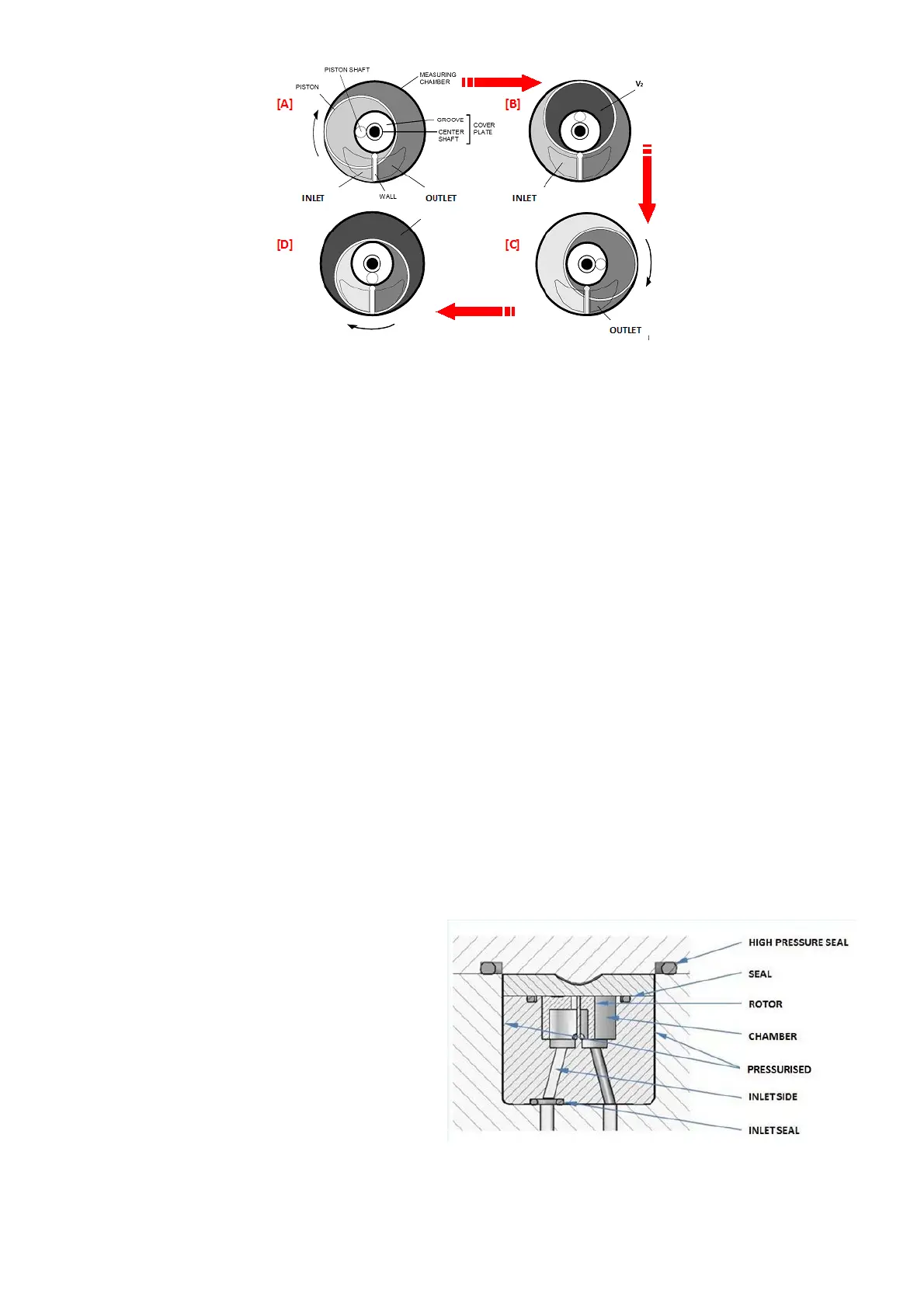
Figure 1 Measurement Principle
The flow causes the rotor to move within the measuring chamber. This movement is sensed, giving an output
representing an increment of volume flow. The rotor is basically a disc shape with an annular groove on its
underside capable of holding and transporting flow from the chamber inlet to the outlet. Some fluid is also
transported in a cavity formed between the rotor outside wall and the chamber wall. A centre 'peg' under the rotor is
constrained to run in a circular groove in the body. A web (or plate) in the body is engaged with a slot in the rotor
and this modifies the rotation to that of an oscillation as flow passes. It is this oscillation that produces the
compartmentation of the fluid into 'positively displaced pockets'. The top of the rotor is equipped with a powerful
magnet directly above the 'peg' that is on the underside and so this also has a circular path which allows it to
engage and disengage a reed switch sensor located in the top cap above. A volt-free contact closure output signal is
given for each oscillation which represents a volume increment. The fluid is transported in a 'positive' manner
always. The typical metering repeatability is better than 0.2% and a meter accuracy of 1% actual reading is usually
obtained over a substantial flow range. For lowest flows the meter will under-read the actual flow in a consistent
manner. This allows an improved wide-range system accuracy to be gained using a linearising electronics
instrument such as the Litre Meter FlowPod.
What’s a pressure balanced chamber?
Extensive testing by Litre Meter in 2005 proved that leaks occur over the top of the rotor at higher
pressures. This is due to minute distortions of the cap. For example, at 700bar the cap moves by just
0.02mm in the centre. Increasing the bulk of the cap still produces this movement. The effect on meter
performance was the creation of a leak path for fluid that avoided the positive displacement of the rotor.
This was equivalent to about a 3% inaccuracy at 700bar. Because of this Litre Meter designed a special
pressure balance chamber for its VFF flowmeter so it could operate at extreme pressure and at low-flow
rates. The pressure balance chamber acts as a barrier, protecting the internal measurement components
of the instrument from the high pressure conditions, preventing them from expanding and contracting
under the immense pressure. All VFFs over 414bar are fitted with this technology. It is identified by the
letters PBC in the calibration certificate.
Key Benefits:
w No distortion of the chamber at higher
pressures.
w No measurement inaccuracy due to
pressure.
w Enables selection of optimal materials
for the chamber to match the rotor i.e.
PVD coated stainless steel.
w Enables selection of optimal materials
for the pressure vessel. i.e. super
duplex stainless steel
w Enables construction of a duplex
bodied flowmeter – duplex material does not lend itself to the tolerances required in machining
the chamber
.



 To Next Page