
 Need help?
Do you have a question about the Logitech Harmony 659 and is the answer not in the manual?
View activities and select one to start.
Change to a different activity by pressing a button.
Troubleshoot activity issues by using the remote's help feature.
Access all commands for a specific device, useful for direct control.
Control sound features of a selected device, such as volume and EQ.
Control picture features of a selected device, like brightness and contrast.
Assign specific activities to dedicated buttons on the remote.
Modify button functions to control specific device actions within an activity.
Add custom buttons with specific labels to devices or activities.
Teach the remote new commands from original device remotes.
Utilize search, FAQs, user manual, and help button for support.
Use the troubleshoot tool for system control issues.
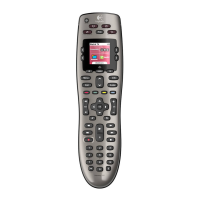
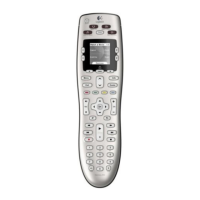
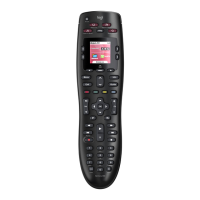
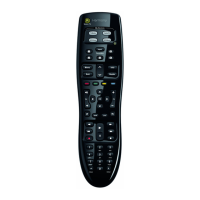
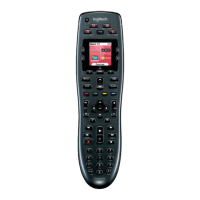
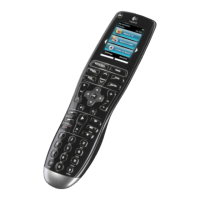
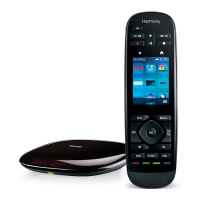
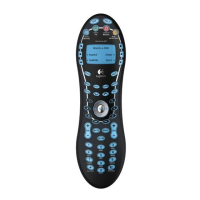
The Logitech 600-Series Harmony Remote is an Internet-powered universal remote control designed to simplify the control of your home entertainment system. It can control most devices that understand infrared (IR) signals, offering a streamlined experience for managing multiple entertainment components.
The Harmony remote's primary function is to consolidate the control of various entertainment devices into a single, easy-to-use remote. Instead of juggling multiple remotes for your TV, DVD player, stereo receiver, and other components, the Harmony remote allows you to control them all from one device. It achieves this by using an online setup process where you provide information about your entertainment devices and how they are configured.
A key feature of the Harmony remote is its "Activities" concept. An Activity is a set of commands that the remote sends to your entertainment system to turn on and configure the necessary devices for a specific task, such as "Watch Television" or "Watch a DVD." When you select an Activity, the Harmony remote automatically sends the appropriate power-on, input selection, and other commands to all the devices involved in that Activity. For example, in the "Watch a DVD" Activity, the remote might turn on your TV, DVD player, and stereo receiver, set the TV to the correct input for the DVD player, and configure the stereo receiver for surround sound.
The remote's buttons are dynamically configured based on the selected Activity. This means that when you're in "Watch a DVD" mode, the volume buttons might control your stereo receiver, while the channel buttons might be inactive or control a different device if applicable. This intelligent button mapping eliminates the need to manually switch between device modes for common functions.
The Harmony remote also includes a "Help" feature, which is designed to assist you when your entertainment system gets "out of sync." If, for instance, one device fails to turn on or switch inputs correctly during an Activity, the Help button can guide you through a re-synchronization process. This is particularly useful if an IR signal was blocked or missed during the Activity startup.
Beyond Activities, the remote offers "Device Mode," which allows you to directly control individual devices. While the Harmony remote is designed to minimize the need for Device Mode through Activity customization, it provides a way to access all possible commands for a specific device. Similarly, "Sound Mode" and "Picture Mode" allow you to focus on controlling the sound or picture features of your chosen audio or video display device, respectively, within any Activity.
Using the Harmony remote involves a straightforward online setup process. After installing the Logitech Harmony remote software, you connect your remote to your computer via a USB cable. The software then guides you through a series of questions about your entertainment devices, their brands, models, and how they are connected. This information is used to build a personalized configuration for your remote.
The setup process includes:
Once configured, selecting an Activity is as simple as pressing one of the dedicated Activity buttons or navigating through the "More Activities" menu on the remote's display. The remote's display buttons, located at the side of the screen, are used to select corresponding commands or Activities shown on the display.
The remote features several standard and specialized buttons:
Customization is a core aspect of the Harmony remote. Through the Harmony remote software, you can:
The primary maintenance for the Harmony remote involves keeping its software configuration up-to-date and ensuring its battery is charged (for models with rechargeable batteries). The "Update Remote" function in the Harmony remote software is crucial for applying any changes you make to your configuration, such as adding new devices, Activities, or customizing button behaviors. Regular updates ensure the remote operates with your latest settings.
Troubleshooting is facilitated by the remote's "Help" button and the Harmony remote software. If your devices are not responding consistently, the Help button on the remote can guide you through a series of questions to diagnose and fix common synchronization issues. This often involves ensuring line-of-sight between the remote and your devices, removing obstructions, or confirming that the remote is pointed correctly.
For more in-depth troubleshooting or if you encounter persistent issues, the Harmony remote software provides additional resources:
If all self-help options are exhausted, the manual directs users to contact the Harmony Support Team for further assistance.
The Harmony remote's design emphasizes ease of use and adaptability, making it a powerful tool for managing complex home entertainment systems with minimal effort. Its ability to learn new commands and its customizable Activity-based control system ensure that it can evolve with your entertainment setup.
 General
| Brand | Logitech |
|---|---|
| Model | Harmony 659 |
| Category | Remote Control |
| Device Type | Universal Remote Control |
| Display | LCD |
| Programmable Buttons | Yes |
| Macro Support | Yes |
| Backlit Buttons | Yes |
| Compatible Devices | TV, DVD, Cable, Satellite |
| Control Method | Infrared (IR) |
| Battery Type | AA |



 To Next Page