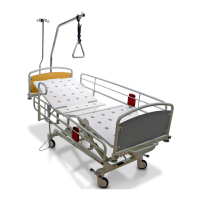
Instructions for use Lojer Modux nursing bed / Version 2.5
Copyright © Lojer Oy, 2022 50
12.3 Electromagnetic immunity
Guidance and manufacturers’ declaration
This product is intended for use in electromagnetic environments that are
specified below. The user should ensure that the product is used in an
appropriate environment.
Immunity test Compliance level Electromagnetic environment -guidance
Electrostatic
discharge (ESD)
IEC 61000-4-2
±8 kV contact
±2 kV, ±4 kV, ±8 kV, 15 kV
air
Floors must be made of wood, concrete, or ceramic
tiles. If the floor is covered with synthetic material,
the relative humidity of the air should be at least
30%.
Electrostatic
transient/burst
IEC 61000-4-4
±2 kV power cords; 100 Hz
repetition frequency
±1 kV input/output wires;
100 Hz repetition frequency
Mains power quality should be that of a typical
commercial or hospital environment.
Overvoltage
IEC 61000-4-5
±1 kV (line to line)
±2 kV (line to earth)
Mains power quality should be that of a typical
commercial or hospital environment.
Voltage drops,
short-term
disturbances and
voltage variations in
the electrical
network
IEC 61000-4-11
< 0% U(T) for 0.5 phase with
45° increments
0% U(T) for 1 phase
70% U(T) for 25/30 phases
< 5% U(T) for 250/300
phases
Mains power quality should be that of a typical
commercial or hospital environment. If the device
user requires the device to operate even during
power failures, it is recommended that the device is
powered by a UPS power source.
U(T) is the mains voltage (AC) before entering the
test level.
Current frequency
(50/60 Hz)
magnetic field
IEC 61000-4-8
30 A/m
Current frequency magnetic fields should
correspond with a typical commercial or hospital
environment.
Conductive radio
frequency
IEC 61000-4-6
Radiating radio
frequency
IEC 61000-4-3
3V
150 kHz - 80 MHz
6V
ISM frequency range &
amateur radio frequencies.
10 V/m
80 MHz - 2,7 GHz
385 MHz – 5785 MHz test
definitions related to
immunity to wireless
communication devices using
radio frequency (reference:
Table 9, IEC 60601-1-
2:2014)
Field strengths from fixed transmitters, such as
base stations for radio (AM/FM), mobile phones,
wireless phones, and land mobile service, amateur
radio, and TV broadcasts, cannot be theoretically
calculated with accuracy. To assess the impact of
fixed radio transmitters on the environment,
electromagnetic surveys should be considered for
the environment. If the measured field strengths in
the operating environment of this device exceed the
compliant limits (as shown in this section), the
operation of the device should be monitored to
ensure that it is functioning properly. If abnormal
behaviour or changes in performance are observed,
measures may need to be taken, such as relocating
or repositioning the device.
Interference may occur in the proximity of devices
marked with the following symbol:
Portable and mobile radio frequency
communication devices (such as a mobile phones)
may not be used closer than 30 cm away from any
part of this device, including wires.
Table 3. Electromagnetic immunity


 To Next Page
 Loading...