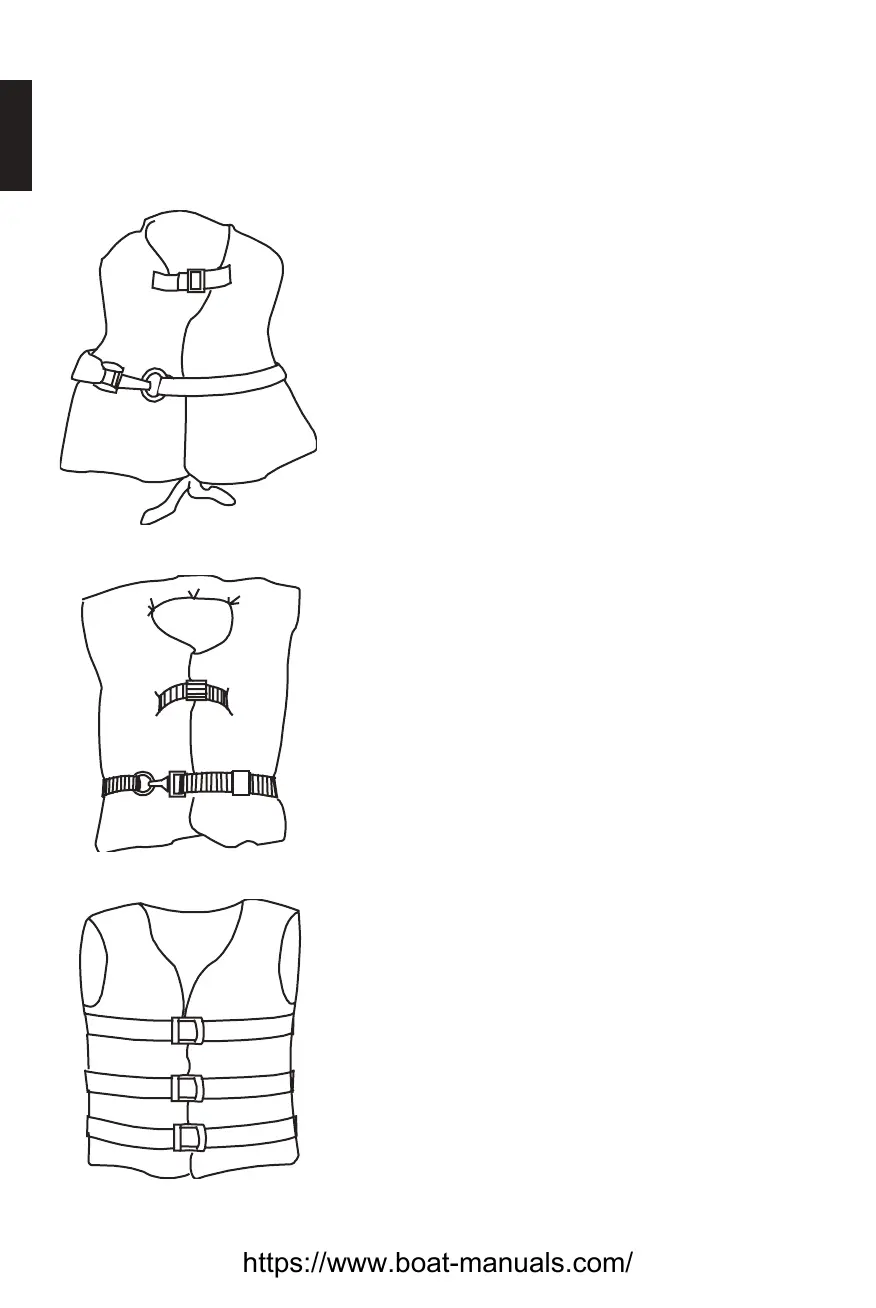
Five types of PFDs have been approved by the U.S. Coast Guard.
PFD Type I, Wearable (Figure 2-1) has the greatest
required buoyancy. Its design allows for turning
most unconscious persons in the water from face
down position to a vertical or slightly backward,
face-up position. It can greatly increase the chances
of survival. Type I is most effective for all waters,
especially offshore when rescue may be delayed. It
is also the most effective in rough waters.
PDF Type II, Wearable (Figure 2-2) turns its wearer
in the same way as Type I, but not as effectively. The
Type II does not turn as many persons under the
same conditions as a Type I. You may perfer to use
this PDF where there is a probability of quick rescue
such as in areas where other people are commonly
involved in water activities.
PFD Type III, Wearable (Figure 2-3) allows wearers
to place themselves in a vertical or slightly back-
ward position. It does not turn the wearer. It main-
tains the wearer in a vertical or slightly backward
position and has no tendency to turn the wearer face
down. It has the same buoyancy as a Type II PFD
and may be appropriate in areas where other people
are commonly involved in water activities.
Lund-02.indd 4 7/9/10 1:46 PM
https://www.boat-manuals.com/


 To Next Page