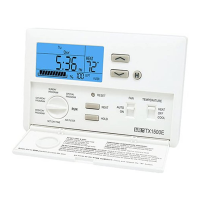
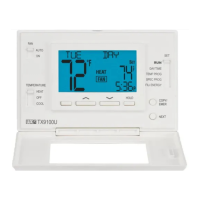
Set unit to heat mode. Adjust set temperature to at
least 5 degrees below room temperature. Then
adjust set temperature upward one degree at a
time. Listen carefully for a soft click from the
thermostat. This click should be heard near room
temperature.
Refer to your unit's manual to decrease the units
swing setting to a narrower setting.
Verify that your unit's placement and mounting are
optimum per the installation section of its manual.
Refer to wiring to verify that it is according to the
wiring diagram for your system.
No heat or cooling when
expected.
Note that in Cool Mode the thermostat may not
activate a cooling stage until its compressor
protection time has elapsed this may be a long as 5
minutes.
Refer to thermostat manual to verify that your
temperature set point is what you expect it to be.
Replace the batteries with fresh Duracell® or
Energizer® alkaline batteries. Press reset with small
Phillips screw driver. It may be necessary to
reconfigure some settings after a reset.
Set unit to heat mode. Adjust set temperature to at
least 5 degrees below room temperature. Then
adjust set temperature upward one degree at a
time. Listen carefully for a soft click from the
thermostat. This click should be heard near room
temperature. Adjust set temperature down one
degree at a time. Again listen carefully for a soft
click from the thermostat near room temperature.
The brass contacts in your thermostat may need to
be cleaned and/or tightened. Each contact is
comprised of a pin protruding from the rear of the
thermostats circuit board, and two V shaped two
contacts on its wall plate. These contacts are
located above each screw terminal. Insert a small
regular screw driver at one side of a "V" contact.
Turn the screw driver to slightly bend the top of
each "V" contact toward it's mate.
Refer to wiring to verify that it is according to the
wiring diagram applicable to your system.
Advanced Trouble Shooting
If your system is a low voltage system having
24VAC or less, and you are technically inclined, you
may jump terminals as given below out to detect a
malfunction in your system.
FAN TEST: If your system has a fan, test it first.


 To Next Page
 Loading...