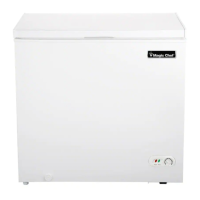
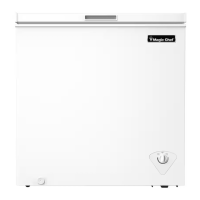
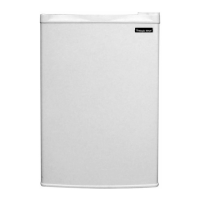
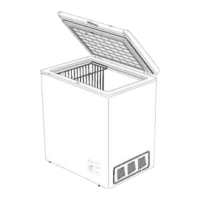
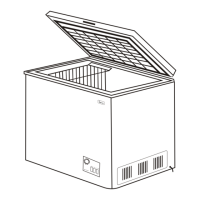
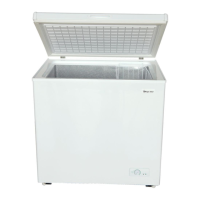
This document is a user's manual for a Magic Chef 6.8 Cu. Ft. Chest Freezer, Model HMCF7W1. It provides comprehensive instructions for installation, operation, and maintenance, ensuring safe and efficient use of the appliance.
Function Description
The Magic Chef Chest Freezer is designed for the long-term storage of frozen food, capable of maintaining items for up to three months. It operates by cooling an internal chamber to preserve food at freezing temperatures. The freezer features a temperature control dial that allows users to select from seven different temperature settings, with "1" being the coldest and "7" being the warmest. A "0" setting turns off the cooling cycle, but does not completely shut off power to the unit. The appliance includes a compressor that works to transfer heat from inside the freezer cabinet to the outside, maintaining the desired internal temperature. It is equipped with a power-on indicator (red light) to show when the unit is connected to an electrical source, and a compressor-on indicator (green light) that illuminates when the compressor is actively running. For convenience, a vinyl-coated wire basket is provided for organizing odd-shaped items, which can be slid aside or lifted out to access other packages. The freezer also includes an exterior drain dial and an interior drain plug to facilitate the defrosting process.
Usage Features
Before initial use, the freezer requires approximately 4 hours to stand upright after transportation to allow the cooling system to stabilize. After plugging it into a dedicated, properly grounded wall outlet, it should be allowed to cool for 2-3 hours before placing food inside. The temperature control dial, located on the front of the unit, is used to adjust the internal temperature. For first-time use, it is recommended to set the dial to "4" and allow 24 hours for the cabinet to thoroughly chill before adding food. If the unit is unplugged or loses power, a 3 to 5 minute delay is necessary before restarting to prevent malfunction. When adjusting the thermostat, it is advised to change the setting by one numerical increment at a time and allow several hours for the temperature to stabilize. The freezer is designed for freestanding use and should not be recessed or built-in. Proper air ventilation is crucial, requiring 5 inches of space around the back and sides. It should be located away from direct sunlight and heat sources, and not in moist areas or outside installations, as ambient temperatures below 50°F or above 85°F can hinder performance. The power cord is a three-prong grounded plug, and it is critical not to cut or remove the third ground prong. Extension cords are not recommended as they can negatively affect performance. Users are warned not to touch the interior of the freezer chamber or frozen foods with wet hands to avoid frostbite. The storage life of frozen foods varies, and users should adhere to manufacturers' instructions for pre-packed items. Placing frozen food into the freezer as quickly as possible after purchase helps maintain quality.
Maintenance Features
Regular cleaning and defrosting are essential for optimal performance and energy efficiency. The freezer should be defrosted when the frost on the walls becomes excessive, typically 1/4 to 1/2 inch thick, or approximately every 3 months. It is best to defrost when the stock of frozen food is low. To defrost, first remove all frozen food and place it in a cooler. Unplug the freezer, which will turn off both the "Power" and "Run" lights. During defrosting, the ice will melt into the cabinet. The exterior drain dial should be unscrewed and removed, and a shallow pan placed outside the drain outlet to collect the defrost water. The pan should be checked occasionally to prevent overflow. After defrosting, the interior of the freezer should be cleaned with a damp warm cloth soaked in a solution of lukewarm water and baking soda (about 2 tablespoons per quart of water). The storage basket should be washed with a mild detergent solution. The door gasket (seal) must be kept clean to ensure efficient operation. The exterior of the freezer can be cleaned with mild detergent and warm water, and all parts should be dried with a soft cloth. It is recommended to clean the unit each time it is defrosted to keep it odor-free and running efficiently. When going on short vacations (less than three weeks), the freezer can remain operating. For long vacations (several months), all food should be removed, the power cord unplugged, and the interior thoroughly cleaned and dried. To prevent odor and mold growth, the door should be left slightly open, blocked if necessary, or removed. When moving the freezer, it should be unplugged, all food removed, loose items securely taped down, and the doors taped shut. The freezer must remain in an upright position during transportation. Energy-saving tips include locating the freezer in the coolest area of the room, allowing hot foods to cool before placing them inside, ensuring proper food wrapping to reduce frost build-up, avoiding lining the storage bin with foil or paper, and organizing food to minimize door openings and search times. Users are cautioned against using boiling water or sharp/metallic instruments for defrosting, as this can damage plastic parts or cooling coils and void the warranty.


 To Next Page
 General