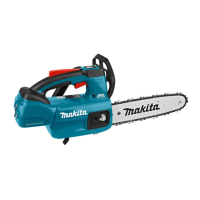
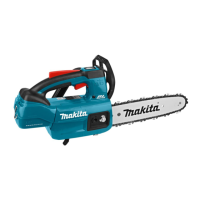
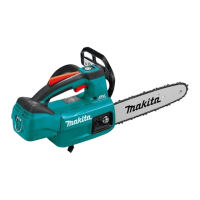
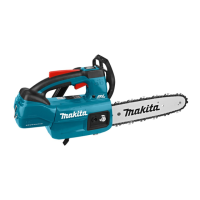
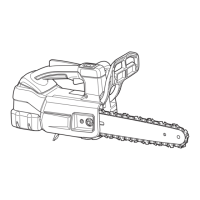
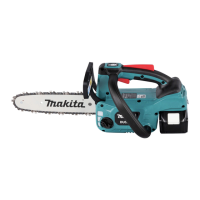
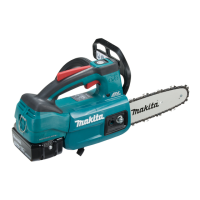
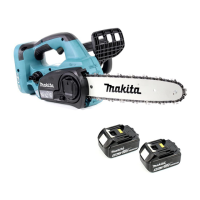
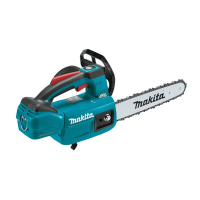
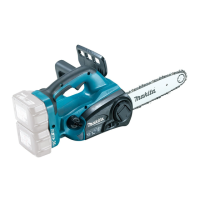
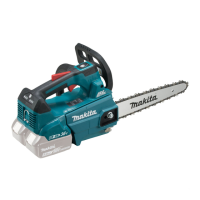
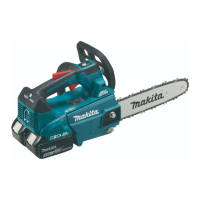
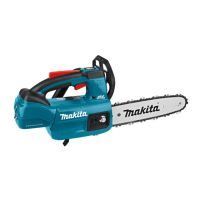
The Makita Cordless Chain Saw, models DUC204, DUC254, and DUC254C, is a battery-operated power tool designed for cutting branches, pruning trees, and general tree service. It is intended for use by properly trained operators.
Function Description
The chain saw operates on a D.C. 18V battery system, providing cordless convenience. It features a main power switch to turn the tool on and off, indicated by a main power lamp that lights up green when active. The tool also incorporates a lock-off lever to prevent unintentional starting, requiring the operator to depress the lever before pulling the switch trigger. The speed of the saw chain increases with pressure on the switch trigger and stops when released.
For enhanced cutting performance on thick or hard branches, the tool offers a Torque Boost mode, which can be activated by pressing the main power switch for a few seconds until the main power lamp lights up yellow. This mode provides increased power for up to 60 seconds, though its duration may vary depending on usage conditions. The tool is equipped with electronic functions for easy operation, including a soft-start feature that minimizes start-up shock and ensures a smooth start.
Safety is a key aspect of the chain saw's design. It includes a chain brake that can be activated by pushing the front hand guard forward, bringing the saw chain to an immediate standstill. A run-down brake ensures the saw chain stops within two seconds of releasing the switch trigger. The tool also has a tool/battery protection system that automatically cuts off power to the motor under conditions of overload, overheating, or overdischarge, indicated by the main power lamp lighting up or blinking red.
The saw chain is automatically lubricated during operation, with an oil tank and an oil inspection window for monitoring oil levels. The oil pump feed rate can be adjusted in three steps using an adjusting screw and a universal wrench. For cutting thick branches, a spike bumper (optional accessory) can be installed to provide better leverage and control.
Usage Features
To operate the chain saw, ensure the battery cartridge is fully installed and the main power switch is turned on. Always hold the chain saw firmly with both hands – the right hand on the top handle and the left hand on the front handle – to maintain control. Before starting a cut, ensure the saw chain is not contacting any object.
When cutting, bring the chain saw body into contact with the branch before switching it on to prevent the guide bar from wobbling. For pruning, saw the wood by moving the chain saw down using its weight. For thick branches, make a shallow undercut first, then complete the cut from the top. When cutting wood under tension, always cut the pressured side first to prevent the bar from becoming trapped.
For bucking (cutting felled timber), rest the chain saw body on the wood. With the saw chain running, saw into the wood, using the top handle to raise the saw and the front handle to guide it. Continue the cut by applying slight pressure to the top handle and easing the saw back slightly. When making multiple cuts, switch the chain saw off between cuts.
Limbing, or removing branches from a felled tree, should only be performed by trained persons due to the risk of kickback. Support the chain saw on the trunk if possible and avoid cutting with the tip of the bar. Pay close attention to branches under tension and avoid cutting unsupported branches from below. Never stand on the felled trunk while limbing.
When transporting or storing the chain saw, always apply the chain brake, remove the battery cartridges, and fit the guide bar cover. The battery cartridge should also be covered with its own cover. For convenience, the tool features a carabiner (rope attachment point) for hanging.
Maintenance Features
Regular maintenance is crucial for the safety, reliability, and longevity of the chain saw. Before performing any inspection or maintenance, always ensure the tool is switched off and the battery cartridge is removed. It is also recommended to wear gloves when handling the saw chain.
Saw Chain Maintenance:
The saw chain should be sharpened when it produces mealy sawdust, penetrates wood with difficulty, has obviously damaged cutting edges, or pulls to one side. Sharpen the chain frequently with two or three strokes of a suitable round file (optional accessory) per tooth. The file should only engage on the forward stroke. Ensure all cutters are sharpened to the same length and a consistent sharpening angle of 30°. The distance between the cutting edge and depth gauge should be checked using a chain gauge tool (optional accessory), with recommended distances of 0.65 mm for 90PX and 91PX chains, and 0.65 mm for 25AP chains. If the cutter length reaches 3 mm or shorter, the chain must be replaced.
Guide Bar Maintenance:
The guide bar groove should be cleaned of chips and sawdust every time the saw chain is sharpened or replaced, as debris can impair oil flow.
Sprocket Maintenance:
The sprocket cover should be removed, and chips and sawdust cleaned from inside the cover. The sprocket should be checked for wear, and a worn sprocket must be replaced to prevent damage to a new saw chain. Always fit a new locking ring when replacing the sprocket.
Lubrication System Maintenance:
Periodically check the oil level through the oil inspection window. To refill, lay the chain saw on its side, remove the oil tank cap, and add 140 ml of saw chain oil. Ensure the oil tank cap is securely tightened. The oil discharge hole should be cleaned if poor chain oil delivery is observed at the guide bar tip. This involves removing the sprocket cover and saw chain, then using a slotted screwdriver to clear any dust or particles. After cleaning, insert the battery cartridge and pull the switch trigger to discharge chain oil and clear any remaining debris.
General Maintenance:
Regularly inspect the chain brake and run-down brake for proper functionality. Check the tightness of the oil tank cap and inspect all screws and nuts. If the equipment experiences heavy impact or falls, check its condition and the functionality of controls and safety devices before continuing work. Any maintenance work not described in the manual should be performed by an authorized service center.
Battery Maintenance:
Charge the battery cartridge before it is completely discharged and stop operation when tool power decreases. Avoid overcharging. Charge the battery cartridge at room temperature (10 °C - 40 °C). If not used for a long period, charge the battery cartridge every six months. Do not store the tool and battery cartridge in locations where the temperature exceeds 50 °C.


 To Next Page
 General