6
The FET output limiter is a powerful, high-rao, peak limiter. It can
be used for many creave eects, as well as for seng a maximum
output ceiling to avoid overloading the next piece of gear in the
chain.
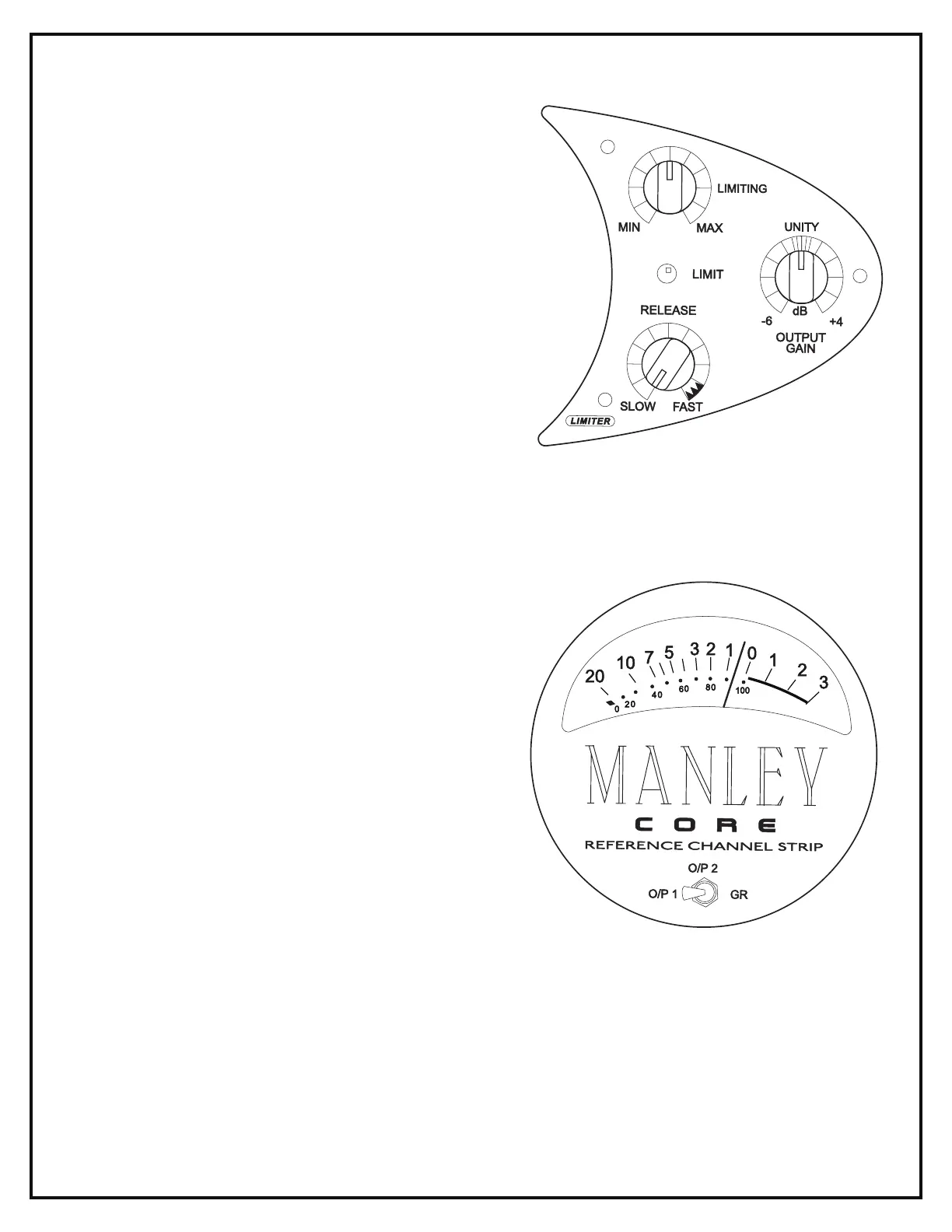
The LIMITING knob controls the amount of liming. The LIMIT LED
lights when the signal crosses the threshold, and goes o when the
signal is both below the threshold and the release me is completed.
The RELEASE controls how FAST or SLOW the limiter returns to
full volume. The RELEASE me control has purposely been made
with a very wide control range. Very fast release mes can create a
distoron eect, this area of the RELEASE control is highlighted with
a zig-zag on the dial.
The Final OUTPUT GAIN control has a range of 10dB. This is an
acve gain stage following the FET limiter that can both aenuate
and amplify the Main Output. This output is available from MAIN
OUTPUT (2). The UNITY gain posion will be within the hash marks
around the 12 o’clock area. Due to component tolerances there may
be slight variaons from unit to unit.
When Liming is set to “Minimum” the LIMIT light acts as a general
overload indicator at +20 dBu.
LIMITER
Three posions are selectable on the analog VU meter selector
switch.
O/P 1- shows the audio level of the DIRECT OUTPUT of the
preamplier and compressor secon.
O/P 2 - shows the MAIN OUTPUT audio level of the CORE.
GR - indicates the amount of COMPRESSOR gain reducon
in decibels. This posion stays at “0 VU” when there is no
gain reducon and moves to the le to show the amount of
compression.
Because the VU meter is mechanical and really just shows the
average level, it can’t follow every signal exactly. In fact, things
like snare drums are not displayed very accurately at all. The VU
meter might only be cking over at -10, but the actual peak level
may be 20dB higher. This is OK, as every workstaon has a digital
peak meter. And it’s a good idea to keep all of your peak levels in
the DAW to around - 6dBFS anyway. There is no reason to go to
0dBFS on the individual tracks, and the nal result will sound beer
and actually combine beer if the tracks are recorded with some
headroom below zero.
Also, it’s a good general pracce to look at the VU meter occasionally when recording and try to keep the majority of the track
on the scale of the meter – not a hard and fast rule – but if you are pinning it all the me (unless for an intenonal eect) or the
needle isn’t moving at all, you might need to adjust the input gain of the CORE.
VU METER


 To Next Page