EasyManua.ls Logo

Marantz SD9000 - Page 10

Marantz SD9000
69 pages
Print Icon
To Next Page IconTo Next Page
To Previous Page IconTo Previous Page
Loading...
3.
Circuit
This
Section
is
intended
to
explain
the
functions
of
the
motors,
solenoids
and
related
circuits.
3.1
Motor
and
solenoid
(1)
Play
motor
(M001)
This
FG
servo
DC
motor
is
always
rotating
while
a
cassette
is
loaded
and
drives
the
capstan,
i.e.
the
tape,
at
a
constant
speed.
Winding
torque
is
applied
to
the
right
reel
disk
during
the
PLAY
or
REC/PLAY
mode.
(2)
Reel
motor
(M002)
This
FG
servo
DC
motor
is
used
to
set
the
tape
in
FF,
REW
or
CUE/REVIEW
mode
(CUE
and
REVIEW
are
performed
in
the
fast
forward
and
rewind
modes
res-
pectively
while
programs
are
being
played).
In
each
mode,
the
tape
speed
is
maintained
constant
by
means
of
the
servo
control
system
of
the
motor.
The
reel
motor
rotates
in
the
reverse
direction
when
the
deck
is
changed
from
the
fast
forward
mode
to
the
rewind
mode.
Either
the
left
or
right
reel
disk
is
driven
according
to
the
direction
of
the
motor.
The
reel
motor
is
also
used
to
remove
slack
in
tape.
(3)
Play
solenoid
(LOO1)
This
solenoid
functions
when
the
deck
is
in
the
PLAY
or
REC/PLAY
mode.
a.
The
head
base
is
lifted
and
the
head
contacts
the
tape.
b.
The
pinch
roller
contacts
the
capstan
and
the
tape
starts
running.
c.
Slight
braking
is
applied
to
the
left
reel
disk
to
pro-
vide
back
tension
to
the
tape.
d.
The
fast
forward
idler
is
set
in
the
neutral
position.
(4)
Brake
solenoid
(LOO2)
;
This
solenoid
functions
when
the
deck
is
in
the
PLAY,
REC/PLAY,
FF,
REW,
or
CUE/REVIEW
mode.
When
it
operates,
the
left
and
right
reel
disks
are
released
to
drive
the
tape.
(5)
CUE/REV
solenoid
(L003)
This
solenoid
functions
when
the
deck
is
in
the
CUE/
REVIEW,
PAUSE
or
REC/PAUSE
mode.
In
the
CUE/REVIEW
mode,
the
head
base
is
lifted
up
to
its
middle
position
to
permit
the
tape
to
contact
the
head.
In
the
PAUSE
or
REC/PLAY
mode,
the
capstan
is
released
from
the
pinch
roller
and,
at
the
same
time,
the
play
idler
is
disengaged
from
the
reel
to
stop
tape
movement.
(6)
Recording/Playback
Mode
Change
Relay
This
relay
is
energized
when
recording
or
playback,
and
recording-pause
mode,
and
connects
the
recording
head
to
the
recording
amplifier,
activating
the
bias
and
erasure
|
circuitry.
When
this
relay
is
deactivated,
the
oscillator
;
circuit
is
switched
off
and
the
recording
head
is
con-
j
nected
to
the
between-program
sensor
for
programming
function.
,
3.2
Back-up
Circuit
When
the
power
switch
is
OFF,
back-up
power
is
sup-
plied
to
the
microcomputer
via
TO02,
rectifier
(0419,
Q424)
and
voltage
regulator
circuit
(0421
~
0423).
In
this
case,
the
voltage
at
Pin
36
of
Q701
is
OV,
thus
time
is
indicated
on
the
display.
During
back-up
operation,
the
programs
stored
in
memory
remain
uncleared.
3.3
Solenoid
drive
voltage
select
circuit
The
SD8000
is
equipped
with
4
solenoids.
To
ensure
proper
operation
of
these
solenoids,
a
sufficient
drive
current
is
required.
If
a
large
current
flows
into
a
solenoid,
the
solenoid
is
overheated
which,
in
turn,
increases
the
winding
resist-
ance
and
reduces
the
force
of
attraction
of
the
solenoid.
However,
once
the
solenoid
has
been
operated
with
a
large
current,
it
operates
stable
even
with
a
relatively
smal!
current.
The
SD8000
employs
a
solenoid
drive
voltage
select
circuit
to
select
the
operating
voltage
according
to
whether
the
solenoid
is
in
the
operating
mode
or
holding
mode.
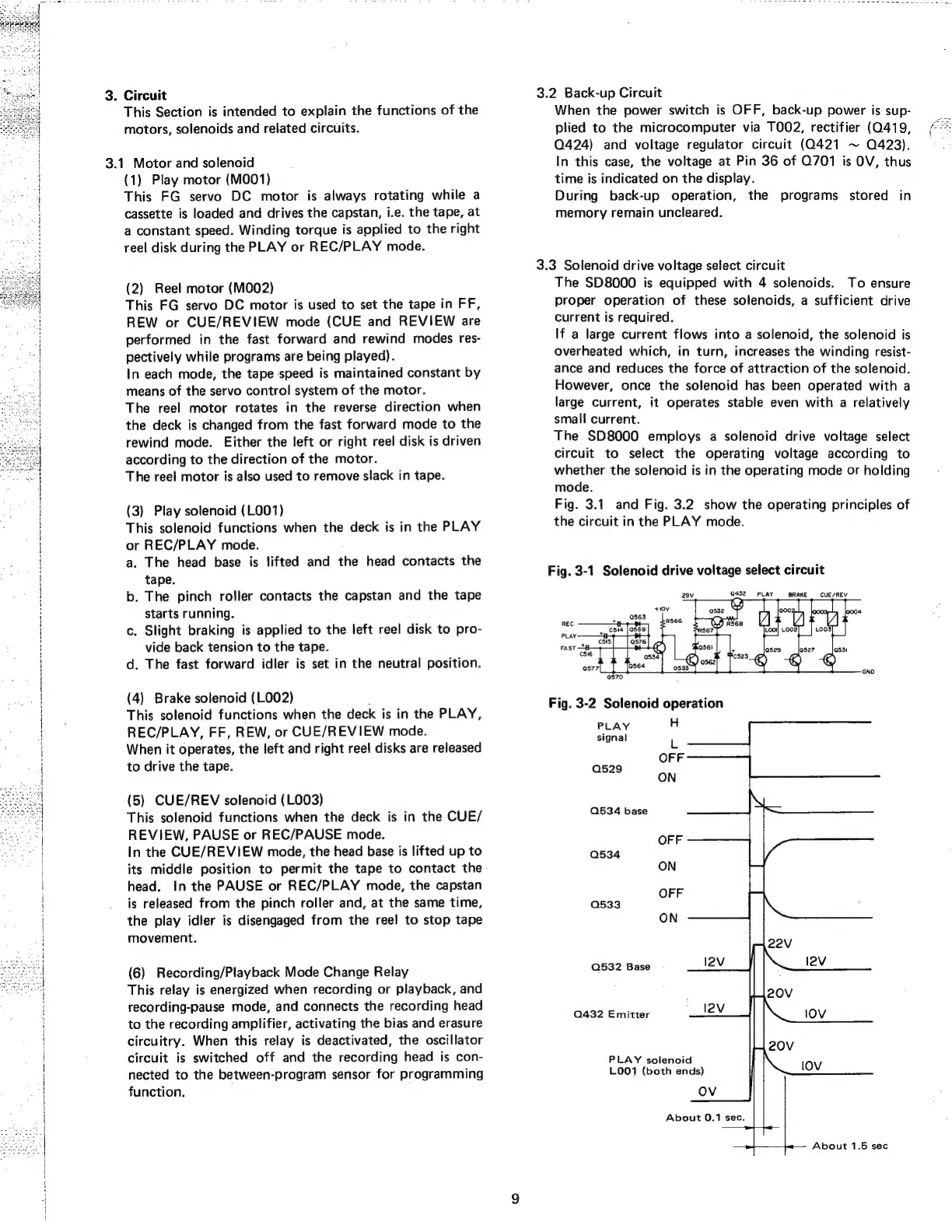
Fig.
3.1
and
Fig.
3.2
show
the
operating
principles
of
the
circuit
in
the
PLAY
mode.
Fig.
3-1
Solenoid
drive
voltage
select
circuit
29v
Q432
PLAY
BRAKE
—_CUE/REV
Fig.
3-2
Solenoid
operation
PLAY
H
signal
L
Q529
me
ON
Q534
base
OFF
Q534
ON
OFF
Q533
ON
Q532
Base
Q432
Emitter
PLAY
solenoid
L001
(both
ends)
OV
lOV
About
0.1
sec.
About
1.5
sec