EasyManua.ls Logo

Marantz SD9000 - Page 11

Marantz SD9000
69 pages
Print Icon
To Next Page IconTo Next Page
To Previous Page IconTo Previous Page
Loading...
.
The
PLAY
signal
level
in
the
output
of
the
micro-
computer
rises
to
‘’H”
(this
signal
turns
on
0529
and
Q527
through
a
circuit
via
a
separate
route).
(Fig.
3-1)
.
The
PLAY
=
signal
is
differentiated,
then
passes
through
Q569
and
turns
ON
Q534
momentarily.
Ras
0533
is
OFF
when
0534
is
ON.
So
c.
When
0533
is
OFF,
a
bias
voltage
of
about
22V
is
-
applied
to
the
base
of
Q532
through
Zener
diode
Q562.
At
this
time,
the
output
of
the
emitter
of
0432
is
about
20V.
Since
Q529
and
0527
are
ON,
a
voltage
of
20V
is
applied
to
the
PLAY
solenoid
L001
and
the
BRAKE
solenoid
LOQ2
and
hence
they
are
driven
by
a
large
current.
d.
When
0534
is
OFF,
0533
is
ON
so
the
base
of
0532
is
biased
by
Q561.
As
a
result,
the
bias
voltage
is
reduced
to
about
12V,
causing
the
voltage
at
the
emitter
of
0432
to
be
reduced
to
about
10V
and
thus
the
solenoid
is
held
closed
at
about
10V
during
the
PLAY
mode.
3.4
Tape
end
detect
circuit
+12v +10V
Fig.
3-3
Tape
end
detect
circuit
Qoo1
Photocoupler
Right
reel
disk
Light
shield
drum
Fig.
3-4
Tapedrive
detect
mechanism
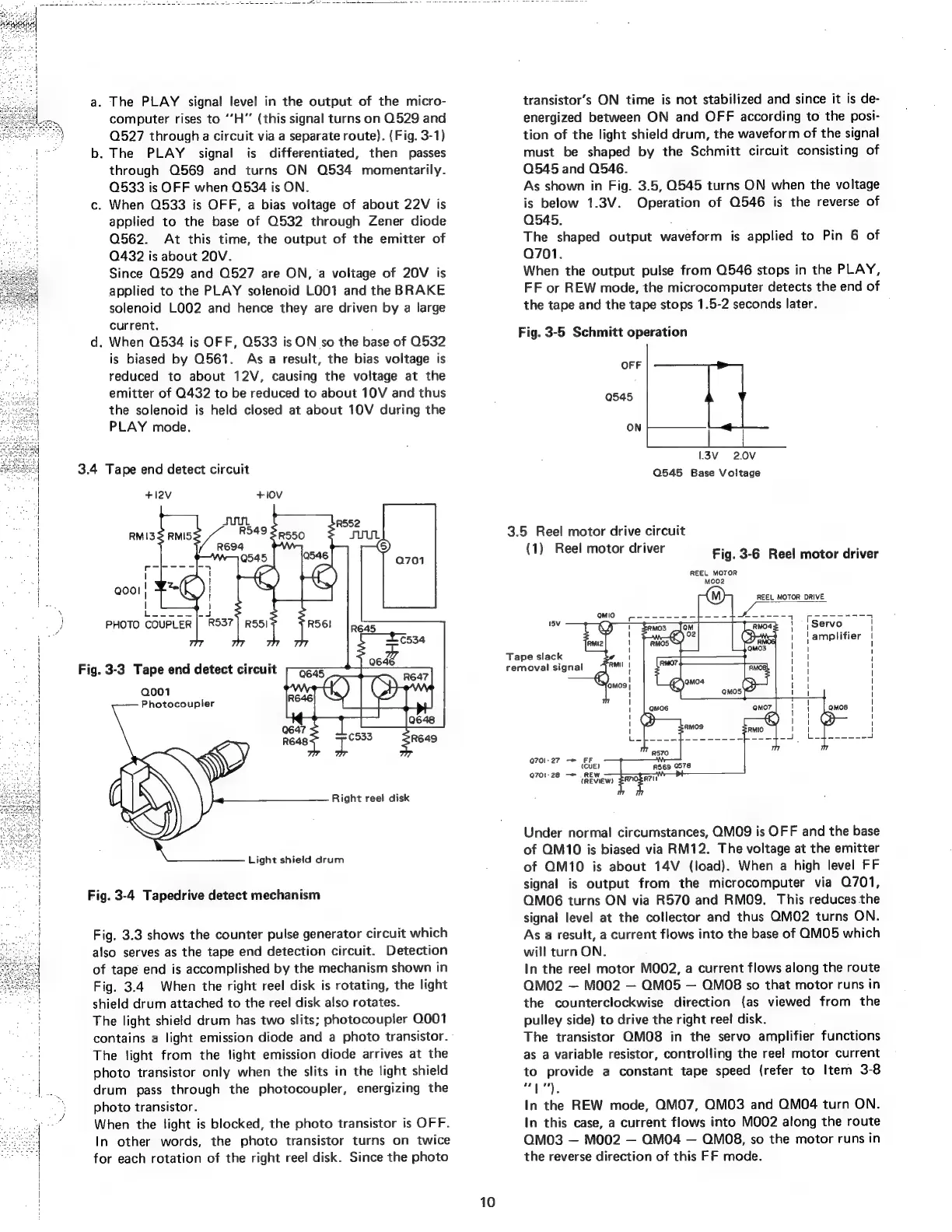
Fig.
3.3
shows
the
counter
pulse
generator
circuit
which
also
serves
as
the
tape
end
detection
circuit.
Detection
of
tape
end
is
accomplished
by
the
mechanism
shown
in
Fig.
3.4
When
the
right
reel
disk
is
rotating,
the
light
shield
drum
attached
to
the
reel
disk
also
rotates.
The
light
shield
drum
has
two
slits;
photocoupler
Q001
contains
a
light
emission
diode
and
a
photo
transistor.
The
light
from
the
light
emission
diode
arrives
at
the
photo
transistor
only
when
the
slits
in
the
light
shield
drum
pass
through
the
photocoupler,
energizing
the
photo
transistor.
When
the
light
is
blocked,
the
photo
transistor
is
OFF.
In
other
words,
the
photo
transistor
turns
on
twice
for
each
rotation
of
the
right
reel
disk.
Since
the
photo
10
Tape
slack
removal
signal
transistor’s
ON
time
is
not
stabilized
and
since
it
is
de-
energized
between
ON
and
OFF
according
to
the
posi-
tion
of
the
light
shield
drum,
the
waveform
of
the
signal
must
be
shaped
by
the
Schmitt
circuit
consisting
of
Q545
and
O546.
As
shown
in
Fig.
3.5,
Q545
turns
ON
when
the
voltage
is
below
1.3V.
Operation
of
0546
is
the
reverse
of
Q545.
The
shaped
output
waveform
is
applied
to
Pin
6
of
Q701.
When
the
output
pulse
from
0546
stops
in
the
PLAY,
FF
or
REW
mode,
the
microcomputer
detects
the
end
of
the
tape
and
the
tape
stops
1.5-2
seconds
later.
Fig.
3-5
Schmitt
operation
OFF
Q545
ON
13V
2.0V
Q545
Base
Voltage
3.5
Reel
motor
drive
circuit
(1)
Reel
motor
driver
Fig.
3-6
Reel
motor
driver
REEL
MOTOR
MOO2
REEL
MOTOR
DRIVE
"Servo
,
amplifier
15V
QMO8
Eset
et
ed
p-----|-------
Q701:27
—~
FF
(CUE)
701-28
.
REW
(REVIEW)
SR7IOSR7II
R569
0578
Under
normal
circumstances,
QMO9
is
OFF
and
the
base
of
QM10
is
biased
via
RM12.
The
voltage
at
the
emitter
of
QM10
is
about
14V
(load).
When
a
high
level
FF
signal
is
output
from
the
microcomputer
via
Q701,
QMO6
turns
ON
via
R570
and
RMO9Y.
This
reduces
the
signal
level
at
the
collector
and
thus
QMOQ2
turns
ON.
As
a
result,
a
current
flows
into
the
base
of
QM0O5
which
will
turn
ON.
In
the
reel
motor
M002,
a
current
flows
along
the
route
QMO02
M002
OQMO5
OMO8
so
that
motor
runs
in
the
counterclockwise
direction
(as
viewed
from
the
pulley
side)
to
drive
the
right
reel
disk.
The
transistor
OMO8
in
the
servo
amplifier
functions
as
a
variable
resistor,
controlling
the
reel
motor
current
to
provide
a
constant
tape
speed
(refer
to
Item
3-8
“ery,
In
the
REW
mode,
QM07,
OMO3
and
OM04
turn
ON.
In
this
case,
a
current
flows
into
M002
along
the
route
QMO03
M002
OM04
OMO8,
so
the
motor
runs
in
the
reverse
direction
of
this
FF
mode.