EasyManua.ls Logo

Marconi Instruments TF 2502 - Chapter 3 TECHNICAL DESCRIPTION; Circuit Analysis

Marconi Instruments TF 2502
26 pages
Print Icon
To Next Page IconTo Next Page
To Previous Page IconTo Previous Page
Loading...
Technical description
3.1
CIRCUIT
ANALYSIS
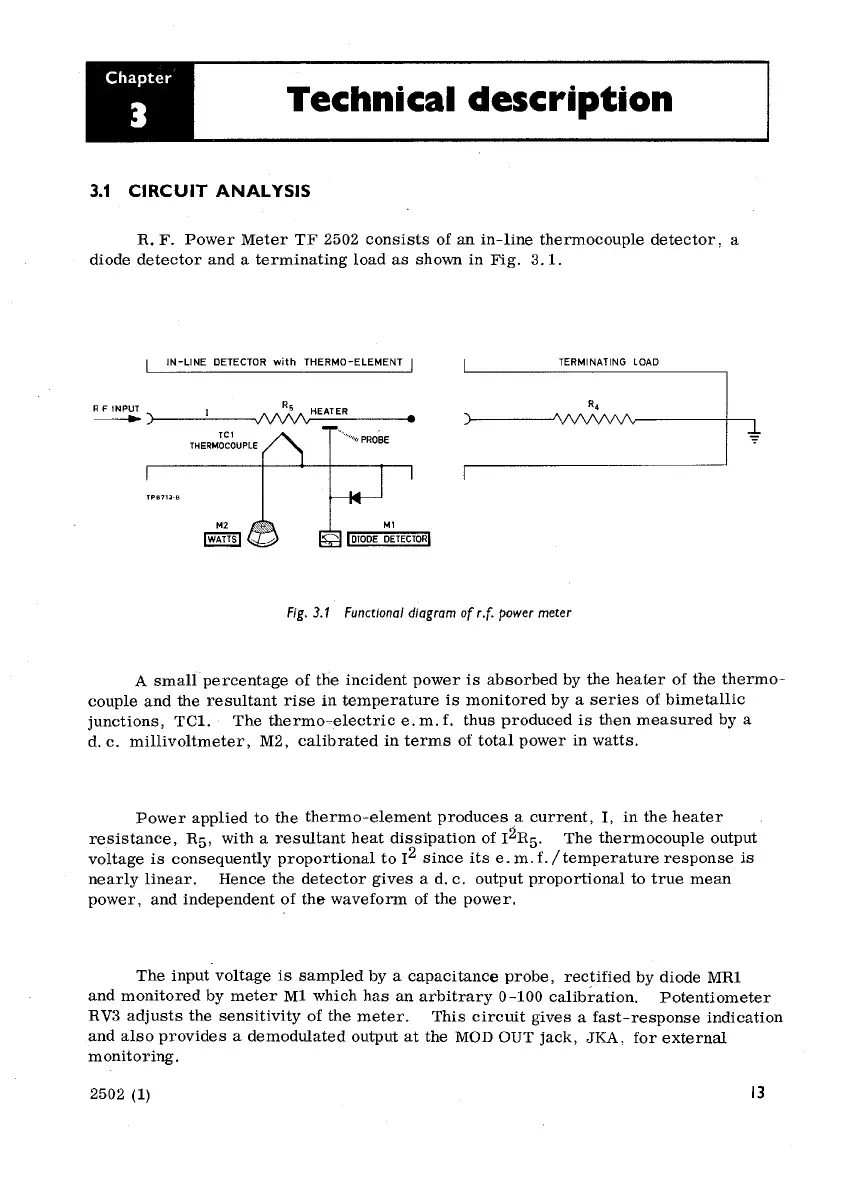
R.
F.
Power
Meter
TF
2502
consists
of
an
in-line
thermocouple
detector,
a
diode
detector
and
a
terminating
load
as
shown
in
Fig.
3.1.
IN-LINE
DETECTOR
with
THERMO-ELEMENT
L~------~~'~"-A_D------~--.
;
~
TC1
THERMOCOUPLE
M2
lWATTSl
Fig.
3.1
Functional
diagram
of
r.f.
power
meter
A
smallpercentage
of
tlie
incident
power
is
absorbed
by
the
heater
of
the
thermo-
couple
and
the
resultant
rise
in
temperature
is
monitored
by
a
series
of
bimetallic
junctions,
TCl.
The
thermo~electric
e.
m.
f.
thus
produced
is
then
measured
by
a
d.
c.
millivoltmeter,
M2,
calibrated
in
terms
of
total
power
in
watts.
Power
applied
to
the
thermo-element
produces
a
current,
I,
in
the
heater
resistance,
R5,
with
a
resultant
heat
dissipation
of I2R5.
The
thermocouple
output
voltage
is
consequently
proportional
to
12
since
its
e.
m.
f./
temperature
response
is
nearly
linear.
Hence
the
detector
gives
a d.
c.
output
proportional
to
true
mean
power,
and
independent
of
the
waveform
of
the
power.
The
input
voltage
is
sampled
by
a
capacitance
probe,
rectified
by
diode
MR1
and
monitored
by
meter
M1
which
has
an
arbitrary
0-100
calibration.
Potentiometer
RV3
adjusts
the
sensitivity
of
the
meter.
This
circuit
gives
a
fast-response
indication
and
also
provides
a
demodulated
output
at
the
MOD
OUT
jack,
JKA.
for
external
monitoring.
2502 (1)
13