11
If you submerge again before the 3-minute
countdown is over, the dive time will resume
from where it left off, including the time spent
on the surface. If you do not submerge before
the end of the countdown, Puck Pro considers
the dive finished, records the data to the
logbook and reverts to the so-called post-dive
mode.
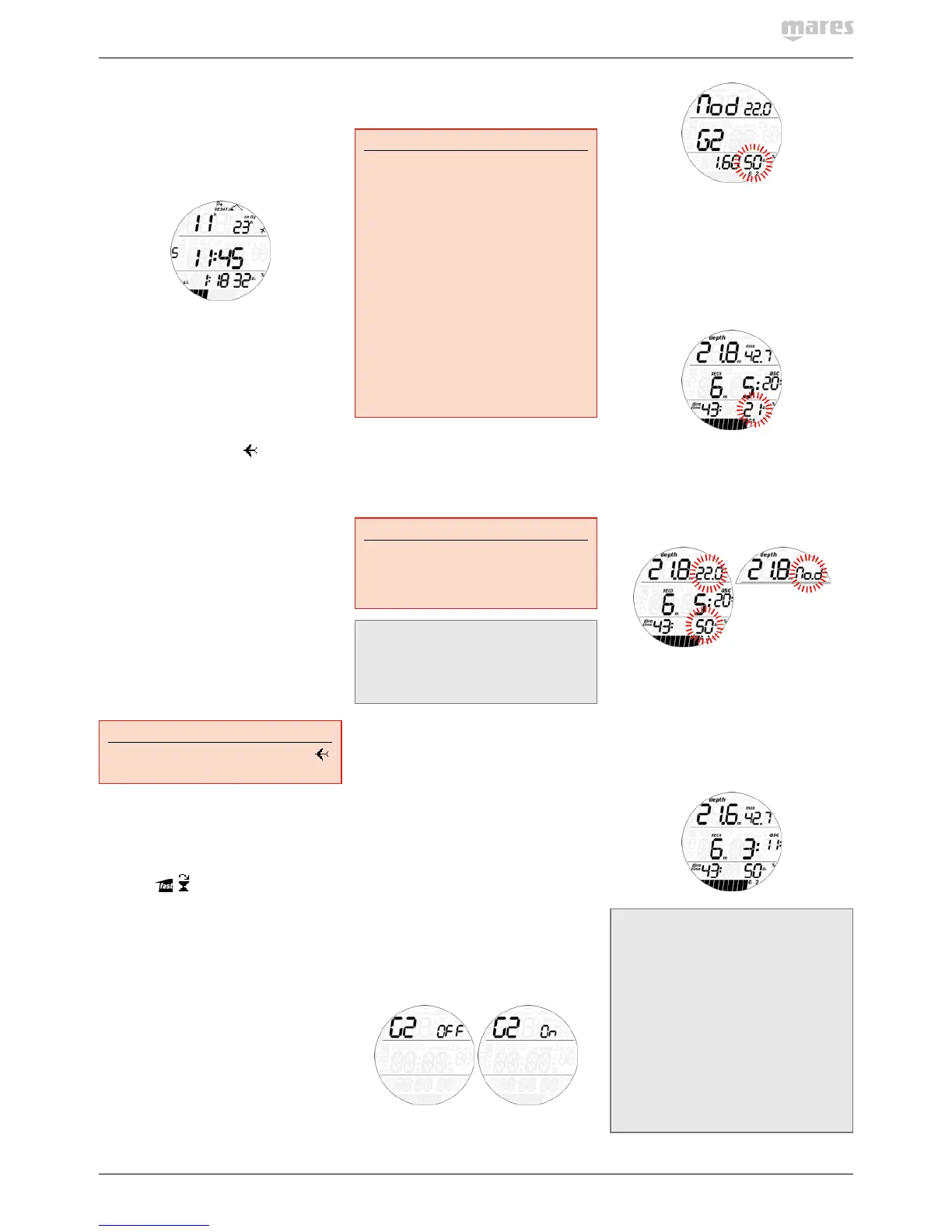
The post-dive screen shows the following
information:
- The remaining desaturation time (DESAT):
this is calculated by the decompression
model in the computer. Any dive started
while there is remaining desaturation on
your computer is considered a repetitive
dive, meaning that Puck Pro accounts for
the pre-existing nitrogen load in your body.
- The no-fly time (NO FLY /
): this is the
time during which an exposure to the
reduced pressure inside the cabin of an
airplane could cause decompression
sickness. Puck Pro employs, as
recommended by NOAA, DAN and other
agencies, a standard 12-hour (no-deco
non-repetitive dives) or 24-hour (deco and/
or repetitive dives) countdown. Hence you
may find a situation in which the
desaturation time is shorter than the no-fly
time. This is simply the consequence of the
desaturation time being calculated by the
algorithm based on the actual dive profile,
while the no-fly time is an accepted standard
in the diving industry. Since the real effect of
flying after diving has never been fully
investigated, this approach fits with our
philosophy.
WARNING
Flying while Puck Pro displays NO FLY /
can result in serious injury or death.
- The surface interval (s.i.): this is displayed
from the moment the dive is closed (3
minutes after surfacing) for as long as there
is remaining desaturation or no-fly time on
the computer.
- In case of a dive violation, the corresponding
symbol (
, ) is shown.
In addition, the bar graph shows the calculated
nitrogen load in the leading tissue. You can use
this to gauge your progress in getting rid of
nitrogen as the surface interval grows. Puck
Pro continues to perform decompression-
related calculations (nitrogen release), for as
long as there is desaturation time left.
3.5 DIVING WITH MORE THAN ONE
GAS MIXTURE
WARNING
- Diving with more than one gas mixture
represents a much higher risk than
diving with a single gas mixture, and
mistakes by the diver may lead to
serious injury or death.
- During dives with more than one gas
mixture, always make sure you are
breathing from the tank that you intend
to breathe from. Breathing from a high
oxygen concentration mix at the wrong
depth can kill you instantly.
- Mark all your regulators and tanks so
that you cannot confuse them under any
circumstance.
- Before each dive and after changing
a tank, ensure that each gas mixture
is set to the correct value for the
corresponding tank.
Puck Pro enables you to use two gas mixtures
during the dive (air and Nitrox only). The two
mixtures are labeled G1 and G2 and must be in
ascending order of oxygen content, i.e. G1 has
the lowest oxygen concentration, and G2 has
the highest oxygen concentration.
WARNING
It is not possible to switch to a gas at a
depth at which the oxygen partial pressure
for that gas is greater than the set
maximum value.
NOTE
- The MOD for G2 is the switch depth for
the corresponding gas. This is what Puck
Pro uses for its calculation, alarms and
suggested switch points.
3.5.1 SETTING MORE THAN ONE GAS
The characteristics of the gases must be
entered in the computer before the dive. It will
then be your responsibility to tell Puck Pro
which gas is currently being used during the
various phases of the dive.
To use multiple gases, you will need to enable
the gases and set the oxygen percentage and
the ppO
2
max for each one. Keep in mind that
the MOD for G2 is the depth at which Puck Pro
will prompt you to perform the gas switch (see
section 3.5.2 below).To enable G2, press the
button instead of pressing and holding it when
bACk is displayed at the end of setting G1. The
display will now show G2 OFF. Press the button
to change from OFF to ON, then press and hold
to confirm. This will lead you to a display in
which you can set the O
2
% and ppO
2
/MOD for
G2 in a manner completely similar to G1.
3.5.2 SWITCHING GAS
Puck Pro always begins the dive with G1,
which has the lowest percentage of oxygen.
When during the ascent you reach the depth
corresponding to the MOD of G2, Puck Pro
sounds an audible signal and the oxygen
concentration of G1 starts to blink in the lower
right corner.
Press the button while this indication is
blinking to initiate the gas switch: the oxygen
percentage of G2 starts to blink in lieu of that
of G1, and in the top right corner the letters
MOD and the value of the MOD for G2 alternate
every 2 seconds.
Press and hold the button to confirm the switch
to G2, or simply press to cancel the gas switch
and stay with G1. In both cases the set oxygen
concentration will be displayed steadily in the
lower right corner of the screen, and within
20 seconds the ascent time is updated to
reflect the higher oxygen concentration in the
breathing gas.
NOTE
- Puck Pro will allow the change only if
the depth is shallower than the MOD
corresponding to the set ppO
2
max.
- Puck Pro will not allow the gas switch if
you are deeper.
- The automatic blinking of the oxygen
concentration of G1 lasts only for 20
seconds. You can however initiate the
gas switch at any time by pressing and
holding the button when the oxygen
concentration is displayed in the lower
right corner, then switch to G2 as long
as your depth allows the gas to be
activated.


 To Next Page
 Loading...