EasyManua.ls Logo

Marshall Amplification DSL40C - User Manual

Marshall Amplification DSL40C
6 pages
Print Icon
To Next Page IconTo Next Page
Loading...
Owner’s Manual
DSL
40C
40 Watt Combo
DSL
100H
100 Watt Head
Dual Super Lead, All-Valve Amps with Reverb
Question and Answer IconNeed help?

Do you have a question about the Marshall Amplification DSL40C and is the answer not in the manual?

Summary

Introduction and Overview

Message from Jim Marshall

Personal welcome from Jim Marshall, founder, about the DSL series amps.

Product Overview

Explains the Dual Super Lead concept and features of the DSL100H and DSL40C.

Safety and Setup Instructions

Crucial warnings and initial setup guidelines for safe and proper amplifier operation.

DSL40 C Front Panel Controls

Input and Classic Gain Channel Controls

Covers input jack, Gain, Volume, Mode Select, LED, and Channel Select for Classic Gain.

Ultra Gain Channel Controls

Details LED, Gain, Volume, and Lead 1/2 mode selection for the Ultra Gain channel.

Equalisation and Tone Shaping

Explains Treble, Middle, Bass controls, and the Tone Shift button for tone shaping.

Presence, Resonance, and Reverb

Describes Presence, Resonance, and Reverb controls for both channels.

Power Section Controls

Details the Standby and Power switches for amplifier operation and valve warm-up.

DSL40 C Rear Panel Features

Mains Input and Fuse

Location for mains power lead and fuse, with voltage compatibility checks.

Output Power Selection

Pentode (full power) and Triode (half power) selection for output wattage and tonal characteristics.

FX Loop and Footswitch Connection

Connections for external effects pedals (Send/Return/Switch) and the footswitch jack.

Loudspeaker Outputs

Details the 16Ω and 8Ω speaker output jacks and impedance matching requirements.

DSL100 H Front Panel Controls

Input and Classic Gain Channel Controls

Covers input jack, Gain, Volume, Mode Select, LED, and Channel Select for Classic Gain.

Ultra Gain Channel Controls

Details LED, Gain, Volume, and Lead 1/2 mode selection for the Ultra Gain channel.

Equalisation and Tone Shaping

Explains Treble, Middle, Bass controls, and the Tone Shift button for tone shaping.

Presence, Resonance, and Reverb

Describes Presence, Resonance, and Reverb controls for both channels.

Power Section Controls

Details the Standby and Power switches for amplifier operation and valve warm-up.

DSL100 H Rear Panel Features

Loudspeaker Outputs

Details the 16Ω and 8Ω speaker output jacks and critical impedance matching requirements.

Footswitch and FX Loop Connections

Connections for the footswitch and external effects pedals (Send/Return/Switch).

Output Power Selection

Pentode (full power) and Triode (half power) selection for output wattage and tonal characteristics.

Mains Input Socket and Fuse

Location for mains power lead and fuse, with voltage compatibility checks.

Overview

The Marshall DSL series comprises two all-valve amplifiers with reverb: the DSL40C 40 Watt Combo and the DSL100H 100 Watt Head. These amplifiers are designed to deliver a wide range of tones, from vintage clean to modern high-gain, building on the legacy of the original JCM2000 Dual Super Lead series.

Function Description:

Both the DSL40C and DSL100H are dual-channel, all-valve amplifiers. They feature two footswitchable channels: "Classic Gain" and "Ultra Gain," each with two selectable modes. The Classic Gain channel offers tones ranging from a 1959 Plexi-style clean to a JCM800 2203-style crunch, accessible via its Clean/Crunch mode button. The Ultra Gain channel provides a hot-rodded 2203 vibe to even higher gain responses with an additional mid-boost, selectable via its Lead 1/Lead 2 mode switch.

Both channels share a passive three-band EQ with controls for Bass, Middle, and Treble. A "Tone Shift" button, when activated, reconfigures the tone network to scoop out mid frequencies, making the amp suitable for brutal, modern metal tones, especially with high-gain settings. Each channel also has its own individual Reverb level control for the built-in studio-quality digital spring reverb, which can be switched on/off via the supplied footswitch.

The power section of both amps includes "Resonance" and "Presence" controls. The Resonance control adds a variable bass boost without muddying the sound, while the Presence control adds high-end crispness and bite. A "Pentode/Triode" switch on the rear panel allows selection between full output power (Pentode mode) and half-power (Triode mode), offering further tonal versatility. Triode mode also produces a smoother, less aggressive sound.

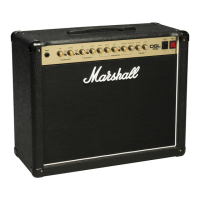
The DSL40C is a 40-watt combo with a 1x12" custom-voiced Celestion speaker, while the DSL100H is a 100-watt head designed to be paired with external speaker cabinets. Both models are designed to be versatile performance tools for demanding playing situations, delivering the renowned Marshall tone.

Important Technical Specifications:

Marshall DSL40C 40 Watt Combo:

  • Power (RMS): 40W
  • Valves: 4 x ECC83 (preamp), 2 x EL34 (power amp)
  • Channels: 2 (Classic Gain, Ultra Gain)
  • Speaker: 1 x 12" custom-voiced Celestion
  • Weight: 22.85 kg
  • Dimensions (mm): 621 (W) x 490 (H) x 252 (D)
  • Peak Inrush Current (Europe Only): 27A
  • Speaker Outputs: One 16Ω output, two 8Ω outputs. Minimum impedance: 8Ω.

Marshall DSL100H 100 Watt Head:

  • Power (RMS): 100W
  • Valves: 4 x ECC83 (preamp), 4 x EL34 (power amp)
  • Channels: 2 (Classic Gain, Ultra Gain)
  • Weight: 24.2 kg
  • Dimensions (mm): 741 (W) x 274 (H) x 242 (D)
  • Peak Inrush Current (Europe Only): 44A
  • Speaker Outputs: Two 8Ω outputs, one 16Ω output. Minimum impedance: 8Ω.

Shared Features:

  • Reverb: Studio-quality digital spring reverb with individual level controls per channel.
  • EQ: Passive three-band EQ (Bass, Middle, Treble) shared between channels.
  • Tone Shift Button: Reconfigures EQ for scooped-mid tones.
  • Presence Control: Adds high frequencies to the guitar tone.
  • Resonance Control: Adds a variable bass boost to the sound.
  • Pentode/Triode Switch: Selects between full power (Pentode) and half power (Triode) modes.
  • FX Loop: Series FX loop with a switch to engage/disengage.
  • Footswitch: Supplied 2-button footswitch (PEDL-00009) for channel switching and reverb on/off.

Usage Features:

  • Input: Standard 1/4" jack for guitar connection.
  • Channel Selection: Front panel buttons for selecting Classic Gain/Ultra Gain and Clean/Crunch or Lead 1/Lead 2 modes. The footswitch overrides front panel channel selection.
  • Gain and Volume Controls: Independent gain and volume controls for each channel to dial in desired distortion and output levels.
  • EQ Controls: Treble, Middle, and Bass knobs to shape the tonal characteristics.
  • Reverb Controls: Separate Reverb level controls for Classic Gain and Ultra Gain channels.
  • Presence and Resonance Controls: Global controls in the power section to fine-tune high and low-end response.
  • FX Loop Send/Return: Allows integration of external effects pedals or processors into the signal chain.
  • Pentode/Triode Switch: Located on the rear panel, this switch allows users to halve the amplifier's output power, providing a different feel and tone, particularly useful for lower volume playing or achieving a smoother sound.
  • Footswitch: The supplied footswitch enables convenient switching between channels and toggling the reverb effect during live performance.

Maintenance Features:

  • Mains Input & Fuse: The amplifier is equipped with either a detachable or fixed mains (power) lead. Users must ensure the amplifier's voltage rating matches their electrical supply. The correct fuse type and value are specified on the rear panel and must never be bypassed or replaced with an incorrect type.
  • Valve Maintenance: The "Standby" switch is crucial for prolonging valve life. It is recommended to switch on the Mains Power Switch approximately 2 minutes before engaging the Standby switch to allow the valves to warm up properly. When powering down, the Standby switch should always be turned off before the Power Switch.
  • Speaker Connection: For valve amplifiers, it is imperative to connect the amplifier to a load (speaker cabinet) whilst in operation. The impedance of the speaker cabinet(s) must match the impedance output selected on the amplifier's rear panel. Failure to do so can cause damage to the amplifier. Screened guitar cables should never be used for speaker connections; proper speaker cables are required.
  • Transporting Equipment: Before moving the amplifier, ensure it is switched off, unplugged from the mains electricity supply, and all removable cables are disconnected.
  • Troubleshooting: In case of any doubt regarding electrical supply compatibility or technical issues, users are advised to seek help from a qualified technician or their Marshall dealer.

Marshall Amplification DSL40C Specifications

General IconGeneral
BrandMarshall Amplification
ModelDSL40C
CategoryMusical Instrument Amplifier
LanguageEnglish

Related product manuals