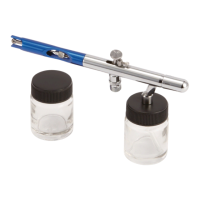
The Mastercraft Air Brush Kit, model no. 058-0051-2, is a versatile tool designed for detail spraying a variety of inks and paints, making it suitable for handymen, craftsmen, hobbyists, and "Do-It-Yourselfer" enthusiasts. This kit enhances the capabilities of precision application, allowing users to achieve intricate designs and consistent finishes on various workpieces.
Function Description
The air brush operates on a siphon feed system, drawing paint from interchangeable glass jars. It utilizes compressed air to atomize the paint, creating a fine mist for smooth and even application. The dual-action finger lever is a key operational feature, allowing users to control both air flow and fluid volume independently. Pressing the lever downward initiates air flow, useful for dusting the work surface, while drawing it back gently releases fluid from the nozzle. This dual control enables precise adjustments to spray volume and pattern, accommodating different spray techniques and desired effects. The air brush is designed to work with clean, dry, regulated compressed air within a specified pressure range, ensuring optimal performance and extending the tool's lifespan.
The kit includes two 22 cc glass jars with lids and fluid connectors, allowing for quick changes between different colors or solvents. An adjustment screw on the air brush allows users to fix the finger lever's position, maintaining a consistent spray volume once the desired setting is achieved. The nozzle and fluid needle are critical components for paint atomization and flow control, and their proper alignment and cleanliness are essential for effective operation.
Usage Features
Before operation, it is crucial to properly set up the air brush. This involves securely attaching a glass jar to the air brush's fluid intake, ensuring a tight connection by inserting the fluid connector and then rotating it slightly. An air hose (not included) connects the air brush's air inlet to an air brush compressor. For best performance, using a Mastercraft air brush compressor is recommended.
Paint preparation is a vital step. Colors can be custom mixed, but compatibility of paints must be ensured. Paints should be free of lumps and strained if necessary, then mixed and softened in a palette before being transferred to the glass jar. Most jar paints require thinning to achieve the correct consistency for spraying. General thinning guidelines are provided, such as mixing water with watercolor/ink or acrylics, and lacquer thinner with lacquer. It's important to note that acrylics and lacquers dry quickly, so the air brush should not be left unattended for extended periods during spraying. Keeping an extra pan or jar of solvent nearby is recommended to prevent paint from clogging the head assembly.
Once the compressor is on and air pressure is regulated, the protective cap is removed. The finger lever is then pressed down to start air flow and drawn back to release fluid. The spray pattern size can be adjusted by varying the distance between the air brush nozzle and the work surface; holding it closer creates a finer spray. For full coverage, multiple light coats are recommended, allowing each coat to dry before applying the next, rather than attempting complete coverage in a single pass.
Triggering exercises are suggested to help users master control. A steady, constant motion, starting before pressing the trigger and following through after releasing it, produces the best results. The air brush should be kept parallel to the work surface to avoid uneven finishes. Exercises for position and density control involve spraying small dots and gradually enlarging them by increasing material flow and distance from the paper. Freehand exercises focus on controlling line width by adjusting the distance from the work surface and creating parallel lines with varying thickness. Even tone exercises involve masking off areas and applying consistent coats, overlapping strokes to avoid line patterns and overspray. Varying shade exercises teach users to create gradients by gradually fading color into white.
Maintenance Features
Immediate and thorough cleaning of the air brush after each use is paramount to prevent damage from dried spray material, which can clog internal paint channels. The cleaning process involves removing any remaining material from the glass jar, washing the inside of the jar with a bristle brush and appropriate solvent or clear water, and then spraying solvent through the air brush until it runs clear.
For deeper cleaning, the valve assembly and head can be removed by turning them counter-clockwise. It is important to remove these components before soaking the air brush in solvent to prevent O-ring damage. The needle should be carefully pulled out after loosening the needle chucking nut. It is then cleaned with solvent or clear water, placed flat on a worktable, and gently rubbed with a pencil eraser along its length to remove particles. Any remaining eraser particles are removed by rubbing the needle between the thumb and forefinger. It is crucial not to bend the needle, as a bent needle will impair proper air brush function. If a needle is bent, it can be carefully straightened on a firm surface by running a fingernail across it from the body towards the tip.
When re-installing the needle, caution is advised to avoid jamming it into the head. The head must be installed before the needle. The adjustment screw should be hand-tightened firmly to prevent the needle from moving, which would otherwise lead to uncontrolled material flow. Regular maintenance, including cleaning and oiling, ensures the air brush's best and safest performance.
The manual also provides a troubleshooting guide to address common issues such as the air brush not spraying, grain spray, buckling paper, flared spray patterns, splattering, curved spray patterns, and spitting material. Solutions often involve checking the finger lever operation, tightening the needle chucking nut, cleaning blocked parts, adjusting air pressure, thinning paint, or correcting spraying technique.
The air brush should be stored in a dry and safe place, out of reach of children, after being thoroughly cleaned and lightly lubricated. Safety guidelines emphasize keeping the work area clean and well-lit, keeping bystanders away, staying alert, dressing properly, avoiding overreach, and using appropriate personal protective equipment like face masks/respirators and safety goggles, especially in well-ventilated areas. It also warns against using oxygen, carbon dioxide, combustible gases, or any bottled gas as an air source, and advises against spraying acids, corrosive materials, toxic chemicals, fertilizers, or pesticides. Regular inspection of air hoses for damage is also recommended.


 To Next Page
 General