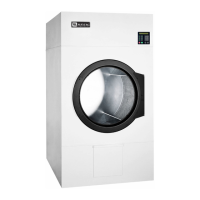
This document is an installation manual for the MDG78PN commercial dryer, providing comprehensive instructions for its safe and efficient setup, operation, and maintenance.
Function Description:
The MDG78PN is a commercial laundry dryer designed for heavy-duty use. Its primary function is to dry clothes and other textile items by tumbling them in a heated air stream. The dryer is equipped with a microprocessor controller that manages various drying cycles and parameters. It is designed to be installed by qualified professionals, ensuring compliance with local, state, and national codes for gas, electrical, and exhaust systems. The dryer also features a S.A.F.E. (fire suppression) system for enhanced safety.
Important Technical Specifications:
- Maximum Capacity (Dry Weight): 75 lb (34.02 kg)
- Tumbler Diameter: 37" (93.98 cm)
- Tumbler Depth: 35-1/2" (90.17 cm)
- Tumbler Volume: 22.09 cu ft (625.52 L)
- Tumbler Motor: 200-208V 60 Hz / All Other, 1 hp / 3/4 hp (0.75 kW / 0.56 kW)
- Blower/Fan Motor: 3/4 hp (0.56 kW)
- Door Opening (Diameter): 27-3/8" (69.53 cm)
- Door Sill Height: 27-5/16" (69.37 cm)
- Water Connection: 3/4"-11.5 NH (for the S.A.F.E. system)
- Voltage Available: 120-240V, 1Ø 2,3W, 50/60 Hz
- Approximate Net Weight: 745 lb (337.93 kg)
- Approximate Shipping Weight: 775 lb (351.53 kg)
- Airflow (60 Hz): 600 cfm (17.00 cmm)
- Airflow (50 Hz): 500 cfm (14.16 cmm)
- Heat Input (60 Hz): 130,000 Btu/hr (32,760 kcal/hr)
- Heat Input (50 Hz): 110,000 Btu/hr (27,720 kcal/hr)
- Exhaust Connection (Diameter): 8" (20.32 cm)
- Compressed Air Connection: N/A
- Compressed Air Volume: N/A
- Inlet Pipe Connection (Gas): 1/2" M.N.P.T.
- Electrical Service (120V, 1Ø): 19.2 Amp Draw (60 Hz), requiring a 25 Amp Circuit Breaker.
- Gas Type: Equipped for natural gas, convertible to L.P. (propane and butane) with kit 887260.
- Gas Manifold Pressure: 4.0 in wc (natural gas).
- S.A.F.E. System Water Pressure: 40 psi +/- 20 psi (2.75 bar +/- 1.37 bar).
Usage Features:
The dryer is designed for ease of use in a commercial setting.
- Microprocessor Control: Features preprogrammed drying cycles. Users can select desired cycles using HIGH or LOW keys and start the dryer with the MED key. The LCD display shows the selected cycle name and approximate remaining minutes.
- Cycle Interruption: The dryer can be stopped at any time by pressing the "PAUSE" key, entering a cycle pause state. Pressing "STOP/CLEAR" again cancels the cycle. Opening the main door also stops the tumbler; closing the door and pressing the desired setting restarts it.
- Cool Down Cycle: After the heat cycle, the dryer automatically enters a cool down cycle, continuing fan and tumbler operation until a set time or temperature is reached.
- Door Handle Installation: The manual provides instructions for installing the door handle using stainless Truss Head Phillips screws.
- Leveling: The dryer is equipped with four leveling legs for optimum performance, ensuring it is level front-to-back and side-to-side.
Maintenance Features:
Routine maintenance is crucial for the dryer's longevity and efficiency.
- Lint Screen Cleaning: The lint screen should be cleaned every third or fourth load to prevent poor dryer performance. Instructions are provided for removing the lint drawer, brushing off lint, and inspecting the screen.
- Weekly Cleaning: Lint accumulation in the lint chamber, thermostat, and microprocessor temperature sensor area should be cleaned weekly.
- 90-Day Cleaning: Lint should be removed from the gas valve burner area and around the motor(s) casing opening. It is important to avoid cleaning or touching the ignitor/flame-probe assembly.
- Every 6 Months Cleaning: Inspect and remove lint accumulation from both customer-furnished exhaust ductwork and the dryer's internal exhaust ducting. Check back draft dampers for lint accumulation that could cause binding or sticking.
- Annual Inspection (7 Days After Installation and Every 12 Months Thereafter): Inspect bolts, nuts, screws, setscrews, grounding connections, and nonpermanent gas connections (unions, shutoff valves, and orifices). The belt should be examined and replaced if cracked or frayed. An operational check of controls, valves, and all safety devices (lint drawer switch, door switches, sail switch, and hi-limit thermostats) should be completed.
- Tumbler Coating Removal: Initial use requires removing an oil coating from the tumbler by tumbling old garments or cloth material dampened with a solution of water and nonflammable mild detergent without heat.
- Exhaust Ductwork Cleaning: Inspection doors should be installed at strategic points in the exhaust ductwork for periodic inspection and cleaning of lint.
- Data Label Information: The data label, located at the lower left rear of the dryer behind the back guard, provides critical information (Model Number, Serial Number, Type of Heat, Heat Input, Orifice Size, Electric Service, Gas Manifold Pressure) necessary for proper service and parts assistance.
Safety Features:
The manual emphasizes several safety warnings and instructions:
- Gas Safety: Warnings against storing or using flammable vapors and liquids near the dryer. Instructions for what to do if gas is smelled, including not lighting appliances, touching electrical switches, or using phones, and immediately evacuating and calling the gas supplier or fire department. Gas leaks cannot always be detected by smell, and a gas detector is recommended.
- Electrical Safety: Warnings about electric shock hazard, emphasizing disconnecting power before servicing and replacing all parts and panels before operating. The dryer must be electrically grounded, and all electrical connections must be made by a qualified electrician using copper wire only.
- Explosion Hazard: Warnings against keeping flammable materials and vapors away from the dryer and not installing it in a garage. For gas models, use a new CSA International approved gas supply line, install a shutoff valve, and securely tighten all gas connections. If connected to LP, ensure gas pressure does not exceed 13" water column.
- Excessive Weight Hazard: Use two or more people and mechanical equipment to lift, move, and install the dryer to prevent injury.
- Fire Hazard: Use a heavy metal vent; do not use plastic or metal foil vents.
- Ventilation: Proper fresh air supply and exhaust ductwork are critical to prevent ignition problems, sail switch "fluttering," premature motor failure, slow drying, and increased energy use. Make-up air must be free of dry cleaning solvent fumes to avoid irreparable damage and voiding the warranty.
- Service and Installation: Installation and service must be performed by a qualified installer, service agency, or gas supplier. The dryer must never be operated with any back guards or service panels removed.
- S.A.F.E. System: The fire suppression system requires a minimum 1/2-inch water pipe with specified pressure. Instructions for connecting the system are provided.
The manual also includes detailed diagrams for dryer dimensions, exhaust venting configurations (single and multiple dryers), and water connection for the S.A.F.E. system. It stresses the importance of adhering to all local, state, and national codes and regulations for installation.

 Need help?

 To Next Page
 General