The McCulloch Eager Beaver Gasoline Chain Saw is a robust and versatile tool designed for a range of cutting tasks, from felling trees to limbing and bucking. This user manual provides comprehensive guidance on its safe operation, maintenance, and troubleshooting, ensuring optimal performance and longevity.
Function Description:
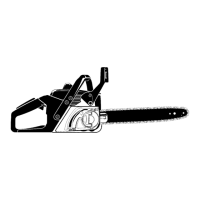
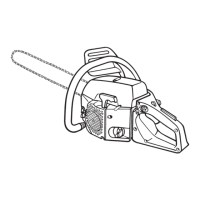
The McCulloch Eager Beaver Gasoline Chain Saw is a powerful, hand-held, engine-driven tool equipped with a cutting chain that rotates around a guide bar. Its primary function is to efficiently cut wood, making it suitable for tasks such as felling small to medium-sized trees, removing branches (limbing), and cutting logs into smaller sections (bucking). The saw is designed with user safety in mind, incorporating features to minimize the risk of kickback and other operational hazards.
Important Technical Specifications:
The manual references two models: MCC1840B and EBC1640BK, with corresponding CA versions (MCC1840B-CA, EBC1640BK-CA). While specific engine displacement is not detailed, the fuel mixing ratio is specified as 40 parts gasoline to 1 part lubricant (40:1). This requires regular grade unleaded gasoline mixed with Genuine McCulloch 2-cycle engine oil or an equivalent premium grade 2-cycle air-cooled engine oil. The fuel tank capacity is given in both U.S. gallons (1 gal) and liters (5 liters), with corresponding lubricant amounts (3.2 oz for 1 gal, 4.3 oz for 5 liters).
The guide bar and chain specifications are provided for both 16-inch and 18-inch bar lengths:
- 16" Bar: 56 drive links, Oregon 91PJ056X chain, Carlton N1C-BL-M-56E SK chain, Oregon 160SDEA041 guide bar, Carlton 16-10-N156-MHC guide bar. Chain gauge is 0.05", pitch is 3/8", and file size is 5/32".
- 18" Bar: 62 drive links, Oregon 91PJ062X chain, Carlton N1C-BL-M-62E SK chain, Oregon 180SDEA041 guide bar, Carlton 18-10-N1-MHC guide bar. Chain gauge is 0.05", pitch is 3/8", and file size is 5/32".
The spark plug type is a Champion RZ7C, with an electrode gap of 0.025 inches (0.635mm). The product has been tested at a computed kickback angle (CKA) and conforms to ANSI B175.1-2000, Annex C, and CAN/CSA-Z62.1-03 standards, indicating its design for reduced kickback.
Usage Features:
- Safety Precautions: The manual heavily emphasizes safety, particularly regarding kickback. Users are instructed to hold the saw firmly with both hands, keep the work area clear of obstacles, and avoid cutting above shoulder height. The saw incorporates a CHAIN BRAKE® system, which is a safety device designed to reduce the possibility of injury from kickback by stopping the chain instantly. It also features a safety throttle lever to prevent unintentional acceleration. Reduced kickback chains and guide bars are standard.
- Starting Procedure: A clear, step-by-step starting process is outlined, including pressing the STOP switch to "ON," pulling out the choke, pressing the primer bulb 10 times, engaging the throttle advance, and pulling the starter cord. The "Easy Start" power assist feature is noted to reduce pulling effort.
- Felling, Limbing, and Bucking: Detailed instructions are provided for various cutting techniques. Felling involves making an undercut and a felling cut, with warnings about falling trees. Limbing focuses on removing branches from a fallen tree, advising against cutting supporting limbs first. Bucking involves cutting logs into lengths, with specific guidance for logs supported along their entire length, on one end, or both ends, and when using a sawhorse.
- Fuel and Lubrication: The saw uses a 40:1 gasoline-to-oil mixture. Users are warned against using straight gasoline or fuel mixtures older than 90 days, as this can cause permanent engine damage and void the warranty. The saw has an automatic oiler system for chain and bar lubrication, and users are instructed to refill the chain oil tank every time the fuel tank is refilled.
Maintenance Features:
- Preventive Maintenance Checklist: A comprehensive checklist is provided for regular maintenance, including inspecting/tightening screws, nuts, and bolts; cleaning/replacing the air filter; replacing the fuel filter/oil filter; cleaning/adjusting/replacing the spark plug; inspecting/replacing the spark arrester screen; inspecting/replacing fuel hoses; and inspecting/replacing chain brake components. These tasks are recommended for "each use," "10 hours of operation," or "20 hours of operation."
- Guide Bar Maintenance: Frequent lubrication of the guide bar sprocket tip is crucial, recommended after 10 hours of use or once a week. Instructions are given for cleaning the guide bar and injecting grease using an optional Lube Gun. Users are advised to rotate the guide bar regularly to ensure even wear and to clean bar grooves and oil passages.
- Chain Maintenance: Regular checking and adjustment of chain tension are essential. A new chain and bar will require readjustment after a few cuts during a break-in period. The manual warns against removing more than 3 links from a chain loop.
- Spark Plug Maintenance: Instructions include checking and adjusting the spark plug electrode gap (0.025 inches) and replacing the spark plug with a Champion RZ7C if necessary.
- Air Filter Maintenance: The air filter should be cleaned or replaced regularly by removing the air filter cover and cleaning the filter housing.
- Fuel Filter Maintenance: The fuel filter should be replaced after every 20 hours of use, requiring the fuel tank to be drained first.
- Spark Arrester Screen Maintenance: The spark arrester screen should be cleaned to prevent reduced engine performance.
- Carburetor Adjustment: The carburetor is factory-set for optimal performance. If adjustments are needed, users are advised to contact an Authorized Service Center.
- Storage: Detailed instructions are provided for storing the chain saw for more than 30 days, including draining fuel from the carburetor, cleaning the spark plug, and lubricating internal components.
The McCulloch Eager Beaver Gasoline Chain Saw is designed to be a reliable and efficient tool for woodcutting, provided that users adhere to the safety guidelines and maintenance schedules outlined in the manual.

 Need help?






 To Next Page
 General