8
4111-0073 — Sept. 2018
©
2018 Systems, LLC
Technical Service at 800-643-5424 or techservices@loadingdocksystems.com
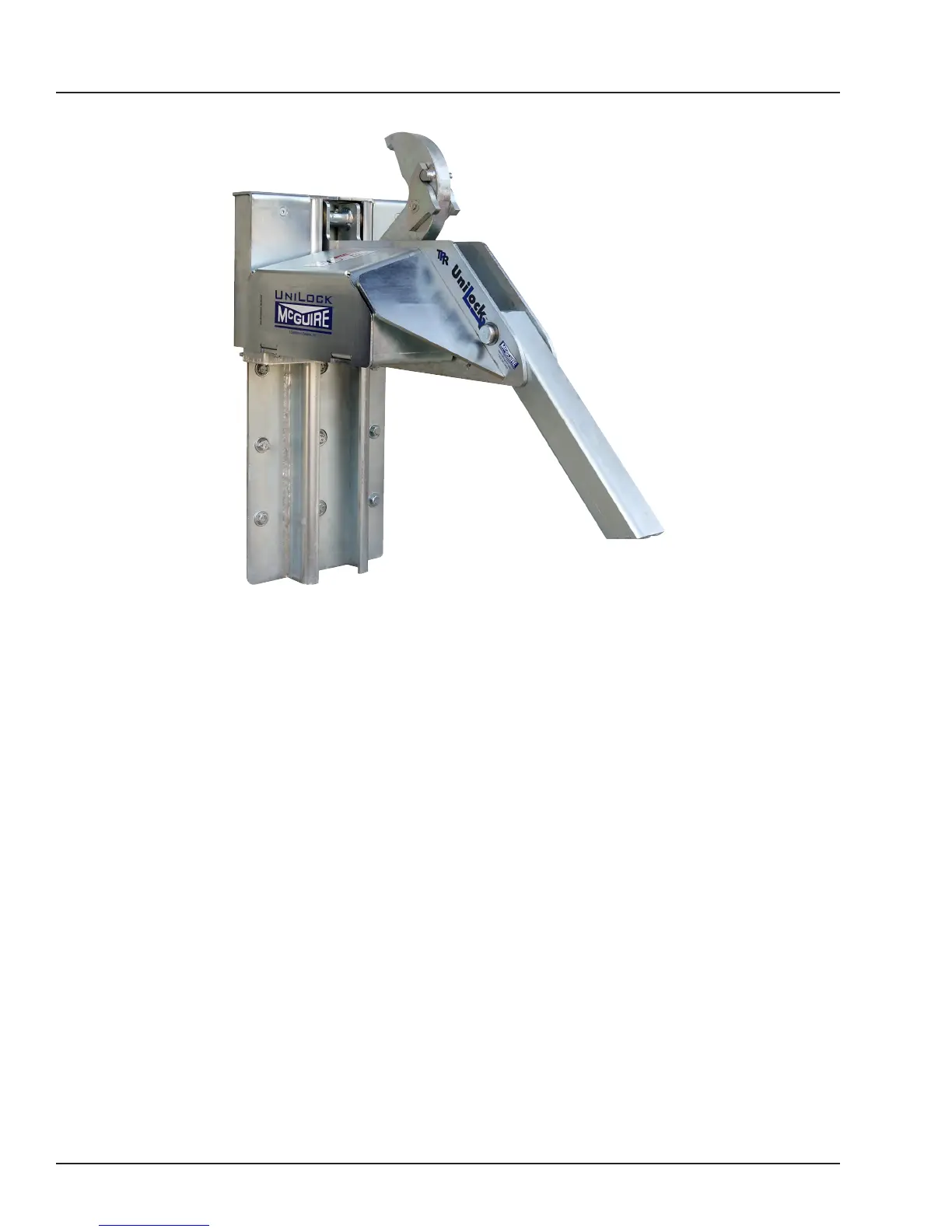
This manual provides current information on the TPR
UniLock® vehicle restraint. Due to ongoing product
improvement, some parts may have changed, along
with operation and troubleshooting methods. This
manual describes these changes where applicable.
The TPR UniLock is the only trailer-postioned vehicle
restraint that can automatically remove “RIG Wedge”
pressure. RIG Wedge is caused when the trailer
is pushed forward during loading/unloading and
the trailer’s Rear Impact Guard (RIG) applies so
much pressure to the restraint’s hook that the truck
driver must reverse the trailer in order to release
the restraint. The UniLock has an advanced cam
design that first rotates the hook away from the RIG
to remove the pressure, and then rotates down to a
stored position.
The UniLock vehicle restraint also has an internal
safety mechanism that locks the restraint’s hook in
place when pressure is applied, maintaining a secure
engagement. This makes it universally effective on
any obstructed Rear Impact Guard (RIG), including
intermodal trailers with cover plates that prevent the
restraint’s hook from latching on top of the RIG.
The UniLock is designed to withstand a pulling force
in excess of 32,000 lbs, and has a service range of 4”
to 10” horizontally from the face of the dock bumpers
and 9” to 30” vertically above drive approach. The
integral motor, gear and brake assembly is specifically
designed for the UniLock. The UniLock vehicle
restraint is highly adaptable to new or existing loading
docks.
To illustrate which connections are to be made in the
field at installation, electrical drawings are included
with each order or by contacting Systems, LLC
Technical Services.
Call Systems, LLC to discuss available options to
meet your specific needs.
General Information
Figure 3
INTRODUCTION



 To Next Page