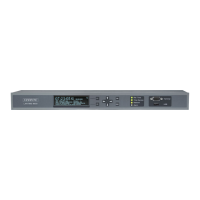
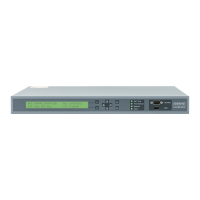
The Meinberg microSync is a product family of high-performance synchronization systems available in 9.5-inch (Half-Rack) and 19-inch (Full-Rack) models, designed for synchronizing time and frequency signals in networks and directly connected systems. All microSync models feature an integrated embedded network processor with the sync-optimized firmware meinbergOS, supporting NTP, common PTP IEEE 1588 profiles, and numerous network protocols for management and monitoring.
Function Description:
The microSync system serves as an NTP/PTP Time Source, providing precise time and frequency signals. It can operate as an NTP server or client, and as a PTP master or slave. The device's core function is to synchronize its internal clock to external reference time sources, such as GNSS (GPS, GLONASS, Galileo, BeiDou) or long-wave time signals, and then distribute this synchronized time and frequency information to connected systems and clients.
The microSync supports various input and output options, including 1PPS, 10 MHz, IRIG timecodes, programmable pulses, and fiber optic signals. Its Gigabit network ports enable network synchronization of NTP clients and PTP slaves. The meinbergOS firmware facilitates easy configuration and monitoring through a web interface, serial connection, or the Meinberg Device Manager software.
Important Technical Specifications:
Chassis Specifications:
- HR (Half-Rack): 1HE/9.5 inch built-in housing. Can be mounted in a 19-inch server cabinet using a special bracket. Two HR devices can be installed side-by-side in a 19-inch rack.
- RX (Full-Rack): 1HE/19 inch built-in rackmount chassis. Offers optional redundant power supplies.
- Physical Dimensions (HR): 43.7 mm [1.72 inch] height, 31.8 mm [1.25 inch] depth for front panel, 465.1 mm [18.31 inch] width for chassis, 482.6 mm [19 inch] total width with mounting ears, 236 mm [9.29 inch] depth, 251 mm [9.88 inch] total depth.
- Physical Dimensions (RX): 31.8 mm [1.25 inch] depth for front panel, 43 mm [1.68 inch] height, 465.1 mm [18.31 inch] width for chassis, 482.6 mm [19 inch] total width with mounting ears, 236 mm [9.29 inch] depth, 248 mm [9.76 inch] total depth, 250 mm [9.84 inch] total depth, 444 mm [17.48 inch] width for chassis.
Power Supplies:
- microSyncRX (100-240 V AC / 100-200 V DC):
- Nominal Voltage Range: 100-240 V AC, 100-200 V DC
- Max. Voltage Range: 90-254 V AC, 90-240 V DC
- Nominal Current: 1.0 A AC, 0.6 A DC
- Nominal Frequency: 50-60Hz
- Max. Frequency Range: 47-63Hz
- Power Consumption: 50 W
- Maximum Heat Emission: 180.00 kJ/h (170.61 BTU/h)
- microSyncRX (20-60 V DC):
- Nominal Voltage Range: 24-48 V DC
- Max. Voltage Range: 20-60 V DC
- Nominal Current: 2.10 A DC
- Power Consumption: 50 W
- Maximum Heat Emission: 180.00 kJ/h (170.61 BTU/h)
- microSyncHR (20-60 V DC):
- Nominal Voltage Range: 48 V DC
- Max. Voltage Range: 20-60 V DC
- Nominal Current: 0.63 A DC
- Power Consumption: 30 W
- Maximum Heat Emission: 108.00 kJ/h (102.37 BTU/h)
- microSyncHR Broadcast (24 V DC via desktop AC adapter):
- Input Voltage Range: 10-36 V DC
- Max. Voltage Range: 9-36 V DC
- Nominal Current: 1.25 A DC
- Max. Power: 30 W
- Maximum Heat Emission: 108.00 kJ/h (102.37 BTU/h)
Receiver and Oscillator Options:
- Receiver Types:
- GPS (12 Channel): IF (Meinberg Antenna), 15 V DC, BNC connector
- GNS-UC GPS, Galileo (72 Channel): IF (Meinberg Antenna), 15 V DC, BNC connector
- GNSS GPS, GLONASS, Galileo, BeiDou (72 Channel): L1/E1/B1 band, 5 V DC, SMA connector
- Oscillator Types (Holdover Performance):
- OCXO SQ: ±220 µsec (1 Day), ±4.7 sec (1 Year)
- OCXO MQ: ±65 µsec (1 Day), ±1.6 sec (1 Year)
- OCXO HQ: ±22 µsec (1 Day), ±788 msec (1 Year)
- OCXO DHQ: ±4.5 µsec (1 Day), ±158 msec (1 Year)
Environmental Specifications:
- Operating Temperature Range:
- microSync models 1xx, 2xx, 3xx, 4xx: –20 to 55 °C (–4 to 131 °F)
- microSync models 5xx, 6xx, 7xx, 8xx: 0 to 50 °C (32 to 122 °F)
- Storage Temperature Range:
- microSync models 1xx, 2xx, 3xx, 4xx: –30 to 70 °C (–22 to 158 °F)
- microSync models 5xx, 6xx, 7xx, 8xx: –20 to 70 °C (–4 to 158 °F)
- Relative Humidity: 5 to 95 % (non-condensing) at 40 °C (104 °F)
- Operating Altitude: up to 4,000 m (13,123 ft) above sea level
- Atmospheric Pressure: 615 to 1600 hPa
Compliance:
- CB Scheme, CE, FCC, UL, CSA, WEEE, RoHS, REACH certified.
- Safety Requirements: Overvoltage Category II, Protection Class 1, Degree of Pollution 2.
- Protection Rating / IP Code: IP30.
CPU Specifications:
- CPU: 825 MHz Cortex A9 Dual Core on SOC
- Ethernet Interfaces: 4 x GBIT SFP - Slot (LAN 0, 1 for Management/NTP; LAN 2, 3 for Management/NTP/PTP)
- Synchronous Ethernet: Master and Slave Capability, Compliant to ITU-T G.8261, G.8262, G.8264, ESMC.
- USB Interfaces: USB to serial console (Micro-USB type B), USB Host (USB type A).
- Time Stamp Accuracy: 8 ns
- NTP Req./Sec: 10,000
- NTP Mode: NTP Server mode
PTP Profiles:
- IEEE 1588v2 Default Profile
- IEEE C.37.238-2011/2017 Power Profile
- IEC/IEEE 61850-9-3 Power Utility Profile
- Enterprise Profile
- ITU-T G.8265.1, G.8275.1, G.8275.2 Telecom Profiles
- SMPTE ST 2059-2 Broadcast Profile
- IEEE 802.1AS TSN/AVB Profile
- AES67 Media Profile
- DOCSIS 3.1
- PTP Modes: Multicast/Unicast Layer 2 (IEEE 802.3), Multicast/Unicast Layer 3 (UDP IPv4/IPv6), Hybrid Mode, E2E / P2P Delay Mechanism, Up to 128 messages/second per client.
- 1588 Clock Mode: 1-Step, 2-Step for both Master and Slave operation.
Cable Types:
- Meinberg GPS Antenna: RG58 (300 m / 1000 ft), RG213 (700 m / 2300 ft)
- Multi GNSS Antenna: Belden H155 (70 m / 230 ft)
- Long Wave Antenna: RG58 (300 m / 1000 ft)
- Fiber Optic: Fiber Optic (2000 m / 6500 ft)
Usage Features:
- Flexible Configuration: The meinbergOS Web Interface provides a user-friendly graphical interface for configuring most system parameters, including network settings, NTP, PTP, I/O ports, and user management.
- Multiple Network Interfaces: Supports various Ethernet configurations including PRP (Parallel Redundancy Protocol) for seamless failover and Bonding for link aggregation, ensuring high availability and bandwidth optimization.
- Time Code Formats: Supports a wide range of IRIG time code formats (e.g., A002, B003, G146) and other specifications like AFNOR, IEEE 1344, IEEE C37.118, and NASA 36.
- Programmable Pulse Outputs: Offers flexible programmable pulse outputs with modes like Idle, Timer, Single Shot, Cyclic Pulse, Pulses Per Second/Min/Hour, DCF77 Marks, Sync Mode (Position OK, Time Sync, All Sync), and DCLS Time Code.
- External Server Synchronization: Can synchronize with external NTP servers, with options for initial burst, polling intervals, and symmetric key authentication (MD5, SHA-1, AES-128-CMAC) for secure communication.
- PTP Instance Management: Allows creation and configuration of multiple PTP instances with specific profiles, virtual interfaces, operation modes (Master/Slave), and delay mechanisms (E2E/P2P).
- User Management: Granular control over user accounts, permissions (Read State, Read Configuration, Write Configuration), channels (Web Interface, Device Manager, Shell, SNMP), and password policies.
- Monitoring and Diagnostics: The Dashboard provides an overview of system status (Clock Status, Network, NTP, PTP, Receiver, System). Detailed state information is available for references, network interfaces, NTP servers/clients, PTP instances, I/O ports, and clock modules.
- Meinberg Device Manager: A desktop application for Windows and Linux offering advanced configuration and monitoring features, including SSL certificate upload, cold/warm boot, satellite reception analysis, and diagnostic file download.
- Self-Help Online Tools: Access to Meinberg's website for firmware updates, manuals, NTP/PTP tutorials, knowledge base, FAQs, whitepapers, and how-to videos.
Maintenance Features:
- Firmware Updates: meinbergOS firmware can be updated via the Web Interface or Meinberg Device Manager. The system supports up to five installed firmware versions, allowing for re-activation of previous versions.
- Configuration Backup and Restore: The Meinberg Device Manager allows for backing up and restoring the entire system configuration.
- System Logs: Access to System Log and Kernel Log via the Web Interface (requires Shell channel permission) for troubleshooting and analysis of system events and hardware-related information.
- NTP Service Restart: Individual restart of the NTP service without disrupting other timekeeping functionalities.
- Device Reboot: Option to reboot the entire device to resolve issues or reset states.
- Factory Reset: Performs a full factory reset, restoring the device to its shipping configuration, erasing all data, logs, and user profiles, and reinstating the default admin account.
- Diagnostic File Download: Ability to download a comprehensive diagnostic file containing configuration, status, and log information for support purposes.
- Cleaning and Care: Instructions for cleaning the device with a soft, dry cloth, emphasizing not to use liquids to prevent damage and electric shock.
- ESD Prevention: Guidelines for preventing electrostatic discharge damage during handling and installation, including grounding straps and proper storage.
- Battery Handling: Safety warnings and instructions for handling lithium batteries on receiver modules, including precautions against short-circuiting, recharging, disposal, and replacement by authorized personnel.
- SFP Module Safety: Information on safe handling of SFP modules, including laser radiation warnings and requirements for using compliant modules.
- Return of Equipment: Procedures for returning electrical and electronic equipment for repair or disposal, emphasizing original packaging and contacting Meinberg Support for RMA.

 Need help?
 General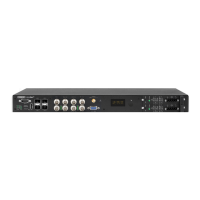

 To Next Page