REAR PANEL
(MAINS) FUSE
This is the Mains Fuse, and it is there to help protect your amplifier from spikes or power surges in the AC Line,
faulty or arcing power tube issues, and other forms of duress your amplifier might encounter within or from
the outside world. If the Fuse should blow, ALWAYS replace your Fuse with the same type and power rating
Fuse. In the Mark IIC+ Simul-Class model, the Fuse is a 4 Amp SLO-BLO type Fuse. If your amplifier should ever
fail to power up, after checking the AC Cable to be sure it is firmly and completely seated in the IEC Socket
on the underside of the chassis, and the power source to make sure it is live and supplying AC power to the
power strip or wall your amp is connected to, you can inspect the Fuse. To do so, push in and turn the Fuse
Cap counterclockwise to release the guide from the slot and remove the Fuse. If the tiny wire inside the fuse
is broken or there is a burnt discoloration in the glass, your Fuse is blown and will need replacing. Be sure to
use a SLO-BLO type fuse of the same Rating noted above.
NOTE: Important! NEVER put anything but a proper fuse in the Fuse Holder! Do Not use a Fuse with a higher
Rating! Do NOT put tin foil or any other conductive material in the Fuse Holder in an attempt to bypass the
Fuse!!! These things can put you at risk for an electric shock and can also cause damage to your amplifier that
will not be covered under the Warranty.
SLAVE OUT / SLAVE LEVEL
This 1/4” output and its associated Level control provide a signal comprised of the entire amplifier, both preamp
and power section, derived from the Speaker Output. The Level control provides a “pad” and a way to optimize
the signal level for feeding things like an input to an eects processing rig, an IR reader, or an additional power
amp and cabinets to further amplify the IIC+ for use in bigger venues.
Once a signal (derived from the Speaker outputs) is taken from the SLAVE output, it cannot be fed back into your
(the same) amplifier, as much like a microphone held up to a Monitor in the same sound system, feedback will
occur. The signal must be sent on to another destination, like an IR reader, external amplifier, or eects setup
sent on to another destination, like a satellite amplifier providing the other half of a stereo setup.
The level available at the SLAVE output ranges from near Instrument level up to Line Level and beyond at the
highest range of the SLAVE LEVEL control. ALWAYS start any session/application with the SLAVE LEVEL zeroed
out and increase it SLOWLY to the appropriate level for your destination.
In the IIC+’s first run in the mid-80s, this output was used by many to feed a Stereo Eects Rack and then feed
the outputs of each side (channel) of the last processor into a stereo power amp (often our MESA power amps,
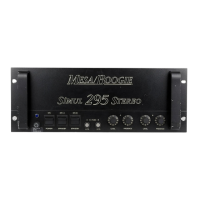
either two mono M-180/M-190 or later, a Stereo Strategy 400 or Simul-Class 295 Stereo) and two additional
cabinets to create the fabled Dry/Wet/Wet rigs of the 80s legendary studio and touring racks. The thinking
there being the main “Tone Generator” amp was not altered by anything in the Loop and the Eects Processing,
much like in a studio environment, was fed to the parallel “channels” (amps) to be “mixed in” alongside the dry
signal from the “Tone Generator” amp Head to a desired wet mix level.
The great thing about this setup, aside from sounding gigantic and being assured that any processing being
used won’t compromise your “pure Tone” coming from the “Dry” Head (or Combo), is that you can fine-tune the
volume ratio (percentage) of mix level of the processed signal for each venue or application with one MASTER/
volume control on each of the stereo “Slave amps,” along with any EQ and or PRESENCE settings you prefer...
assuming identically featured MESA or other equivalent guitar Heads or guitar-centric power amps were being
® MESA / Boogie Ltd.
SPEAKERS
4 OHM 4 OHM8 OHM
EFFECTS
SLAVE
SEND RETURN
REVERBPRESENCE
HAND-WIRED IN
PETALUMA, CALIFORNIA,
U.S.A.
MARK IIC
+
SIMUL-
CLASS
CLASS
A
WARNING:
Unplug power before replacing
fuse or removing bolts mounting chassis.
100V~
VOLTAGE
FUSE
120V~
220V~
230V~
240V~
120 V~
60Hz
4A
4A SLO
BLOW
AMPLIFIER
44YV
POWER
FUSE
100 V~
50/60Hz
4A
T4AL/
250V
POWER
FUSE
220-240 V~
50/60Hz
2A
T2AL/
250V
POWER
PAGE 23





 To Next Page