Another attribute of this new build is that it benefits from the 40 years of discoveries made since the original
IIC+s were produced. Some of our most treasured secrets unearthed through the years and now employed on
every amp we build, weren’t discovered until after the C+ was retired and superseded by the Mark III.
These secrets range across the entire amplifier and include both preamp and power section discoveries...Tone
tricks and constructional techniques we’ve confirmed time and again in our R&D, including in our latest Mark
VII, and they are all included in this IIC+ redux.
So, envy not those who’ve paid more for this inspirational model in its original form, for your amplifier IS the
real deal...and then some. And though only one of many attributes, the noise floor in this IIC+ is lower, which is
always appreciated in both studio and live performance environments.
Operationally, this Mark IIC+ delivers the sound and performance of its namesake, and being a Single Channel/
Dual Mode platform (not a full 2-Channel design), it has the same limitations in terms of (foot) switch-ability.
Unlike the 2 and 3-Channel platforms in our product line, the IIC+ has just one set of Tone controls that are
shared between its Rhythm and Lead Modes. That said, the C+ footswitches across Modes surprisingly well
considering its “handicap” by today’s footswitching standards. For surgical-level fine-tuning of the two sounds,
however, as would be expected, there is some level of compromise or tradeo required and that is where the
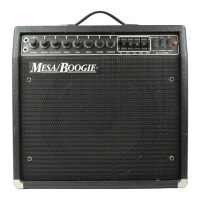
classic on-board Boogie 5-Band Graphic EQ becomes invaluable. Most C+ aficionados agree that the Lead
Mode is where the greatest need for additional shaping appears, likely because of the mid-focused nature of
its unaltered voice. Yet that is also where a large part of its strength and character lies, as it is this midrange
that makes possible the tight low end, focused attack, and voice-like quality on single notes.
Applying the EQ to scoop the midrange (for heavier sounds) or boosting the lows and highs for greater width
and size is very eective, along with any shaping needed for individual guitars. So eective in fact, that we
fitted an “EQ Auto” function on the original IIC+’s EQ Select switch that enables auto-engagement of the EQ
when the Lead Mode is selected on the Footswitch or activated via the Front Panel LEAD DRIVE control’s
“PULL LEAD” switch.
Regardless of how you choose to use the Modes, Tone Controls, and Graphic EQ, the IIC+ showcases how
much is possible with one set of controls. Anything from sparkling, bell-like clean sounds to the highest gain
metal sounds and everything between those extremes is possible, all dynamic, touch-sensitive, and packed
with expressive nuance.
HELPFUL HINTS
• Warm-Up! Always begin playing sessions with the following Cold Start Procedure at Power Up:
1. With the STANDBY in the OFF position, Flip POWER to ON
2. Wait at LEAST 30 Seconds.
3. Flip STANDBY to ON …and Enjoy!
Following this Cold Start Procedure will help ensure reliability and prolong the toneful life of your tubes,
especially the power tubes. Like an incandescent lightbulb that has a filament, much wear and stress on
your tubes occurs at the instant of power up from a cold state. Much like a dimmer on a light switch being
set low when you first flip it on, the STANDBY being OFF at the instant of power up – and for at least 30
seconds thereafter – allows for a warm-up period and minimizes the shock on tube filaments when they
are cold. If you follow this procedure every time you power up your amplifier the likelihood of experiencing
tube issues will be decreased while their longevity will be increased.
PAGE 4





 To Next Page