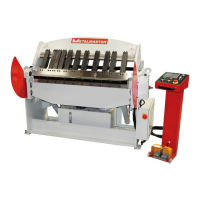
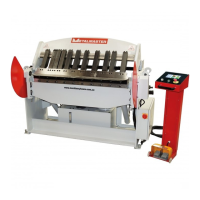
The provided document is an operation manual for the METALMASTER PB-GL Series Hydraulic Press Brake, specifically highlighting the PB-135 model with an E21 controller. This industrial machine is designed for bending sheet metal, utilizing hydraulic power to apply force between a top punch and a bottom die.
Function Description
The PB-GL Series Hydraulic Press Brake is a metalworking machine used for bending sheet metal. It operates by pressing a workpiece between a top die (punch) and a bottom die (V-block) using hydraulic power. The machine is equipped with an Estun E21 controller, which manages the bending parameters, including X-axis (backgauge position) and Y-axis (ram stroke depth) movements, hold time, and program steps. The machine features a laser guarding system for operator safety, which detects obstructions in the working area and controls beam travel speed.
Important Technical Specifications
The manual provides detailed specifications for various models within the PB-GL series, including S970GL, S902GL, S906GL, S908GL, S909GL, S910GL, and S912GL. Key specifications include:
- Control Unit: Estun NC-E21 for all listed models.
- Laser Guarding System: Yes, for all listed models.
- Nominal Pressure - Tonnage: Ranges from 44 Ton (S970GL) to 220 Ton (S912GL).
- Nominal Pressure - Kilo-newtons (kN): Ranges from 400 kN (S970GL) to 2000 kN (S912GL).
- Machine Axis (No): 2 for all models.
- Length of Work Table (mm): Ranges from 2000 mm (S970GL) to 4000 mm (S908GL, S910GL, S912GL).
- Distance Between Columns (mm): Ranges from 1615 mm (S970GL) to 3200 mm (S908GL, S910GL, S912GL).
- Maximum Open Height (mm): Ranges from 330 mm (S970GL) to 470 mm (S909GL, S910GL).
- Backgauge Travel (mm): Ranges from 520 mm (S970GL to S908GL) to 550 mm (S909GL to S912GL).
- Throat Depth (mm): Ranges from 200 mm (S970GL) to 420 mm (S906GL to S912GL).
- Ram Stroke (mm): Ranges from 100 mm (S970GL, S902GL) to 200 mm (S909GL to S912GL).
- Motor Power (kW/hp): Ranges from 4 kW (S970GL) to 15/20 kW (S912GL).
- Motor Voltage (v): 415V for all models.
- Dimensions (L x W) (cm): Varies by model, e.g., 270 x 180 cm (S970GL) to 470 x 230 cm (S912GL).
- Height (cm): Ranges from 240 cm (S970GL, S902GL) to 300 cm (S912GL).
- Nett Weight (kg): Ranges from 3800 kg (S970GL) to 16500 kg (S912GL).
Usage Features
The PB-GL series press brake is designed for ease of operation with several user-friendly features:
- Estun E21 Controller: This NC controller allows operators to program bending jobs, including X and Y positions, hold time (HT), delay retraction (DLY), and the number of pieces (PP). It supports both "SINGLE" mode for quick job re-writes and "PROG" mode for managing up to 40 saved programs with 25 steps each.
- Operating Modes: The laser safety controller offers three modes:
- Normal Mode: All three laser sensors (E1, E2, E3) are active, stopping the top beam if an obstruction is detected during fast speed.
- Boxing Mode: The front sensor (E1) is muted, allowing for pre-bent sides of components, while E2 and E3 remain active. This mode requires experienced operators and extreme caution.
- Muting Mode: All laser sensors are muted, and the top beam moves only at slow speed (less than 10mm/s), regardless of obstructions. This mode is for special bending operations like hemming and also requires experienced operators and extreme caution.
- Tooling Management: The manual details procedures for removing and replacing both the top punch and bottom die, emphasizing safe lifting practices and proper alignment. It also covers adjusting the backgauge height and position to ensure parallelism with the die.
- Bending Techniques: The machine supports two primary bending techniques:
- Air Bending: Requires lower forces and compensates for material elasticity (spring back effect). The die opening should be 6-12 times the sheet thickness.
- Coining: Requires 3-5 times higher forces than air bending, allowing the inside radius to be coined and eliminating material elasticity. This method requires special tooling.
- Tonnage Adjustment: The pressure adjusting regulator allows operators to set the pressure applied between the punches and dies, ensuring it does not exceed the maximum allowable tonnage for the tooling.
- Mobile Foot Pedal Control: Provides flexibility and control during operation.
- Front Sheet Supports: Standard equipment for supporting workpieces.
Maintenance Features
The manual outlines critical maintenance procedures to ensure the longevity and safe operation of the press brake:
- Hydraulic System Maintenance:
- Oil Change: Hydraulic oil should be changed after the first three months of operation, then annually or every 2000 hours. The filter in the hydraulic oil tank must also be changed with each oil change.
- Filter Replacement: Regular replacement of the hydraulic filter is crucial to prevent abnormal pump noise, decreased discharge capacity, and ram vibration caused by contamination.
- Draining and Refilling: Detailed steps are provided for draining old oil, cleaning the tank, replacing the filter, and refilling with new hydraulic oil to the middle of the sight gauge.
- Lubrication:
- Lubrication Chart: A comprehensive chart specifies lubricating points, quantity of points, frequency (e.g., 4 hours, 8 hours, 48 hours, 500 hours), and recommended oil/grease types (mechanical oil 46#, lubricating grease ZG-3).
- Critical Points: Includes backgauge, sliding house, guideway, ram support, connecting rod bearing, gearbox, and counter for upper trimming.
- Laser Safety Device Periodical Check:
- Schedule: Checks should be performed at press brake startup, after each tool change, after operator change, after scheduled operator breaks, after operator shift changes, and whenever the TX Emitter or RX Receiver has been moved.
- Setup and Stopping Tests: References sections 4.5 and 4.6 of the manual for detailed procedures on laser guarding setup, calibration, and stopping tests using aiming aids.
- Troubleshooting: A "System Error List" provides a guide to diagnose issues based on flashing light sequences on the operator pendant, covering errors such as E-Stop triggers, communication faults, and movement issues. A "General Troubleshooting" section addresses common problems like pump drive not working, slow ram cycle, noisy pump, and ram not returning to the up-limit, along with their causes and solutions.
- Calibration: The manual includes procedures for calibrating the X and Y axes of the Estun E21 controller, although factory calibration means this should not be frequently needed.
- Tool Holder Wedge Adjustment: While wedges are factory-set, the manual advises shimming the bottom die as a quicker alternative if adjustments are needed, recommending a service engineer for wedge adjustments.
The manual emphasizes safety throughout, with warnings about wearing appropriate PPE (safety glasses, footwear, respiratory protection, hearing protection), avoiding loose clothing, and ensuring all safety devices and guards are in place and functional. It also highlights the importance of proper training and understanding of the machine's operation to prevent injuries.

 Need help?
 General

 To Next Page