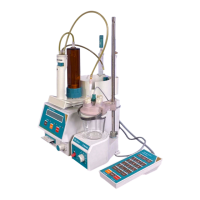
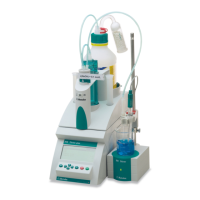
The Metrohm 785 DMP Titrino is a versatile all-purpose titrator designed for a wide range of potentiometric measurements, including pH, redox, and ISE titrations. It features a graphical LCD display (192 x 64 dots, 100 x 37 mm field, LED back-lit) for clear visualization of data and titration curves. The instrument is designed for both manual and automated operation, offering extensive remote control capabilities via its RS232 interface.
Function Description:
The 785 DMP Titrino supports several operating modes:
- DET (Dynamic Equivalence-point Titration): This mode is used for titrations where the volume increments are adjusted based on the curve's steepness, allowing for precise determination of equivalence points.
- MET (Monotonic Equivalence-point Titration): In this mode, constant volume increments are dispensed throughout the titration, suitable for various titration types.
- SET (Set Endpoint Titration): This mode allows for titrations to a predefined endpoint, useful for routine analyses where a specific target value is known.
- CAL (pH Calibration): Dedicated for pH electrode calibration, supporting n-point calibrations (up to 9 buffers) and temperature compensation.
- MEAS (Measuring): For general measurement of pH, U, Ipol, Upol, or T without titration.
- TIP (Titration Procedure): This is a programmable mode that links various commands and methods to create complex, automated titration sequences.
The instrument incorporates advanced algorithms for EP evaluation, including a special Metrohm procedure that is sensitive enough to detect weak equivalence points. It also supports fix EP's for standard methods like TAN/TBN determinations and pK/HNP evaluations for pH titrations and half-neutralization potentials.
Data management is a key feature, with internal method memory for up to 100 methods and a silo memory for sample data and results (up to 255 lines). The silo memory operates on a FIFO (First In, First Out) principle and can store method, identifications, and sample size. Results can be assigned to common variables (C30-C39) or temporary variables (C70-C79) for calculations.
Important Technical Specifications:
- Measuring Inputs: Two high-impedance inputs for pH, redox, and ISE electrodes (can be used separately or for differential potentiometry), one reference input for a separate reference electrode, one input for polarized electrodes (e.g., KF electrode), and one input for Pt100 or Pt1000 temperature sensors.
- Measuring Range:
- pH value (pX): 0...20.00, resolution 0.01
- Voltage: 0...±2000 mV, resolution 1 mV, error limit 0.1% fullscale
- Current: 0...±200 µA, resolution 1 µA
- Temperature: –150.0...+450.0 °C, resolution 1 °C
- Polarizer Ipol: 0...±127 µA, resolution 1 µA
- Polarizer Upol: 0...±1270 mV, in steps of 10 mV
- Measuring Amplifier: Input resistance >10^13 Ω, offset current <3 x 10^-13 A, deviation of offset voltage 15 µV/K.
- Dosification: Volume of buret cylinder 1, (2), 5, 10, 20 or 50 ml, resolution 10,000 steps per buret cylinder. Supports 2 additional auxiliary burets (776 or 765 Dosimat).
- Memory: 128 KB (256 KB maximum) SRAM memory card (battery supplied) or Flash (read-only with 55 Metrohm methods).
- Interfaces: Two separate RS232 interfaces for printer, balance, or computer connection. Remote input/output lines for Sample Changer, robot connection, and optional Remote Box (for barcode reader and PC keyboard).
- Stirrer Control: Automatic or manual ON/OFF switching, coordinated with the titration sequence.
- Mains Connection: 100...240 V, 50...60 Hz, 15 W, 2 x 1 ATH fuse.
- Dimensions (with Exchange Unit): Width 150 mm, Height 450 mm, Depth 275 mm.
- Weight (incl. keypad): Approx. 3.6 kg.
Usage Features:
- Keypad Operation: Intuitive keypad with dedicated keys for CONFIG, MODE, PARAM, USER, DEF, PRINT, REPORTS, CAL.DATA, SMPL DATA, SILO, STATISTICS, MEAS/HOLD, CARD, C-FMLA, CURVE, CLEAR, ENTER, STOP, QUIT, START. Third functions on keys are used for formula entry.
- Text Input: Supports alphanumeric input for method names, user names, and other identifiers, with character selection and error correction features.
- Configuration: Allows setting device-specific data such as monitoring functions (validation, pH calibration, service intervals), peripheral unit selections (printer, balance, stirrer control, COM ports), auxiliaries (dialog language, date, time, result display type), and RS232 settings.
- Method Management: Internal method memory and memory card support for storing, recalling, and deleting methods. Methods can be organized into directories on the memory card.
- Sample Data Management: Silo memory for storing sample data (method, identifications, sample size) for automated sequences or result overview. Supports data cycling and saving results to silo lines.
- Result Calculations: Up to 9 results per method can be calculated using formulas with operands (EPX, RSX, CXX) and mathematical operations. Results can be displayed with custom text, decimal places, and units.
- Statistics Calculation: Calculates mean values and standard deviations for up to 9 results from consecutive determinations.
- Data Output: Automatic report generation at the end of a determination (full, short, measuring point list, curve, parameter, calculation, calibration data, form feed). Reports can be printed or sent via RS232. Titration curves can be viewed on the display with cursor navigation.
- Remote Control: Comprehensive RS232 interface for external control, allowing for querying and modifying object values, initiating processes, and receiving status messages.
Maintenance Features:
- Diagnostic Tests: Built-in diagnostic routines for electronic components (RAM, real-time clock, timer, A/D converter, LCD, COM ports, EPROM), display, keypad, cylinder code, motor timer, analog input, Pt100/1000 connection, polarizer, external inputs/outputs, and RS232 interface. These tests help identify malfunctions and provide error codes for troubleshooting.
- Validation Monitoring: Monitors validation and pH calibration intervals, displaying messages if intervals are expired.
- Service Interval Monitoring: Tracks the service interval, alerting the user when maintenance is due.
- RAM Initialization: A procedure to reinitialize the RAM in case of system crashes, restoring default parameters and clearing user and silo memories.
- Spindle Release: Instructions for manually releasing a jammed burette spindle.
- Card Battery Change: Monitoring of memory card battery life with warnings when replacement is due.
- Error Messages: A comprehensive list of error messages (E8-E270) with descriptions and suggested remedies for troubleshooting.
- Technical Support: Metrohm service is available for optimal adjustment and maintenance.

 Need help?
 General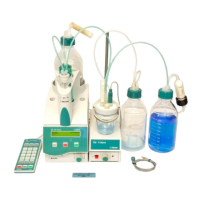




 To Next Page