The crystal may be natural or synthetic and may be salt, quartz, poly-
crystalline or ceramic. When this crystal is in resonance with the driving
oscillator, optimum conversion from electrical to mechanical energy is
achieved. A disadvantage of quartz is
that
it requires extremely high voltages
of the applicator (3000 - 4000V) to energize it for an intensity of 3
W/cm
2
•
Ceramic crystals require less (30 -40V), thus allowing use of longer, thinner,
and more flexible coaxial cables.
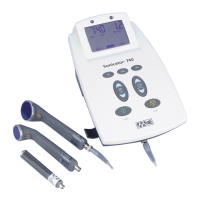
The
Sonicator
ME
706 uses a barium titanate
cobalt ceramic.
Ultrasonic energy is expressed in watts (W), or watts per square centimeter
(W/crn''). Average intensity is obtained by measuring the total output of the
applicator (in watts)
and
then dividing it by the size of the effective radiating
area
of the applicator. The effective radiating
area
is different from the overall
dimension of the applicator face.
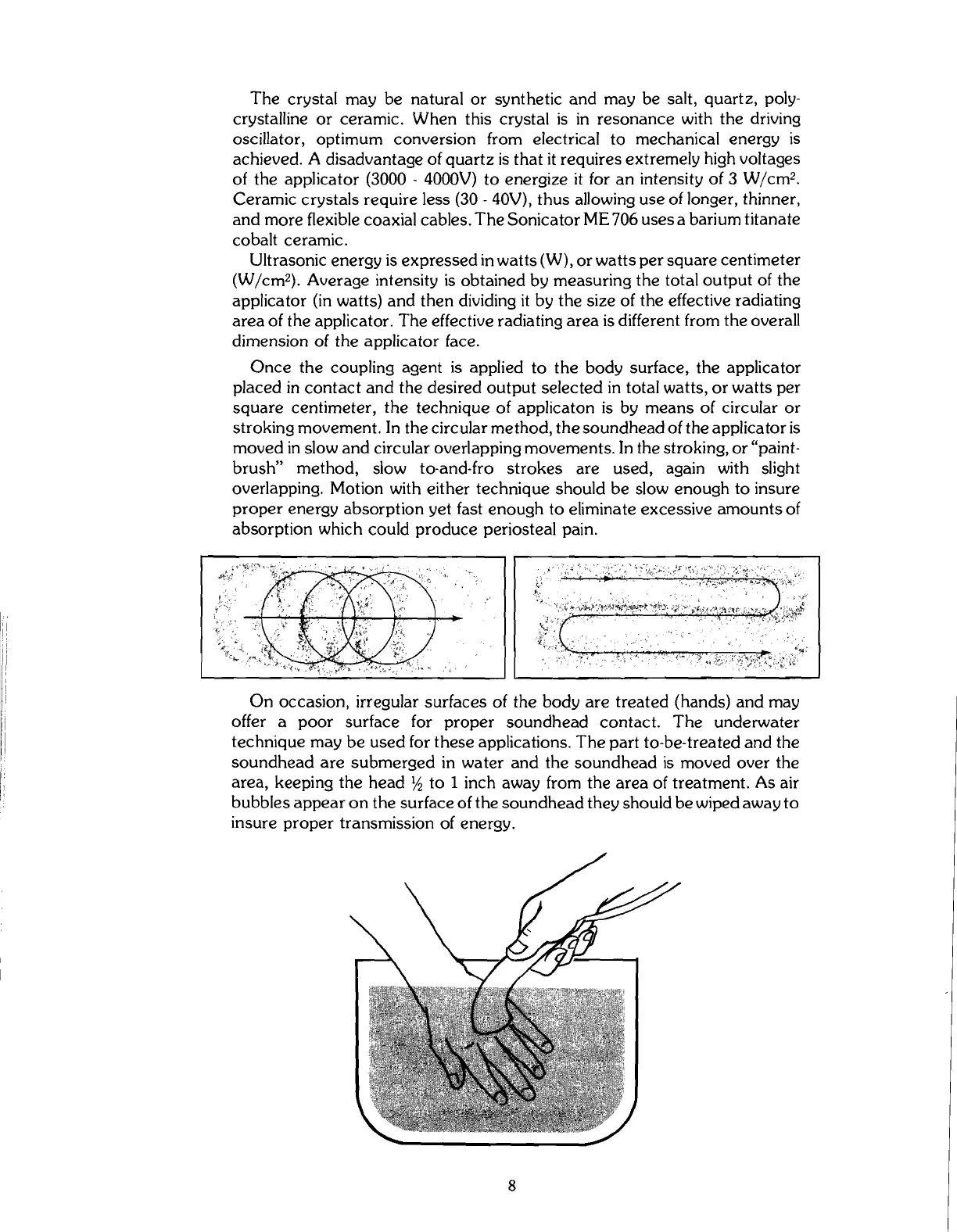
Once
the coupling agent is applied to the body surface, the applicator
placed in
contact
and
the desired output selected in total watts, or watts per
square centimeter,
the
technique of applicaton is by means of circular or
stroking movement.
In
the circular method,
the
soundhead of the applicator is
moved in slow
and
circular overlapping movements.
In
the stroking, or "paint-
brush" method, slow to-and-fro
strokes
are used, again with slight
overlapping. Motion with either technique should be slow enough to insure
proper energy absorption yet fast enough to eliminate excessive amounts of
absorption which could produce periosteal pain.
On occasion, irregular surfaces of the body
are
treated (hands)
and
may
offer a
poor
surface for proper soundhead contact.
The
underwater
technique may be used for these applications.
The
part to-be-treated and the
soundhead
are
submerged in water
and
the
soundhead
is moved over the
area, keeping the head
Y2
to 1 inch away from the
area
of treatment. As air
bubbles
appear
on the surface of the soundhead they should be wiped away to
insure proper transmission of energy.
8



 To Next Page