GENERAL
APPLICATION
INFORMATION
ABOUT
ULTRASOUND:
Ultrasound is a form of acoustical vibration occuring at frequencies too
high to be perceived by the human ear. The limit for the audible range is at
about 20 KHz. Frequencies above this level are considered ultrasound.
The
range from 700 KHz to 1.1 MHz appeared during early investigative work, to
be best suited to clinical applications. Most domestic units
operate
at
frequencies within this range.
The physics of ultrasound and audible
sound
bear
certain similarities with
frequency being the exception. Both travel as longitudinal compressed waves
through a conducting medium. Ultrasound waves
can
be propagated in a
gaseous, liquid, or solid medium, but not in air.
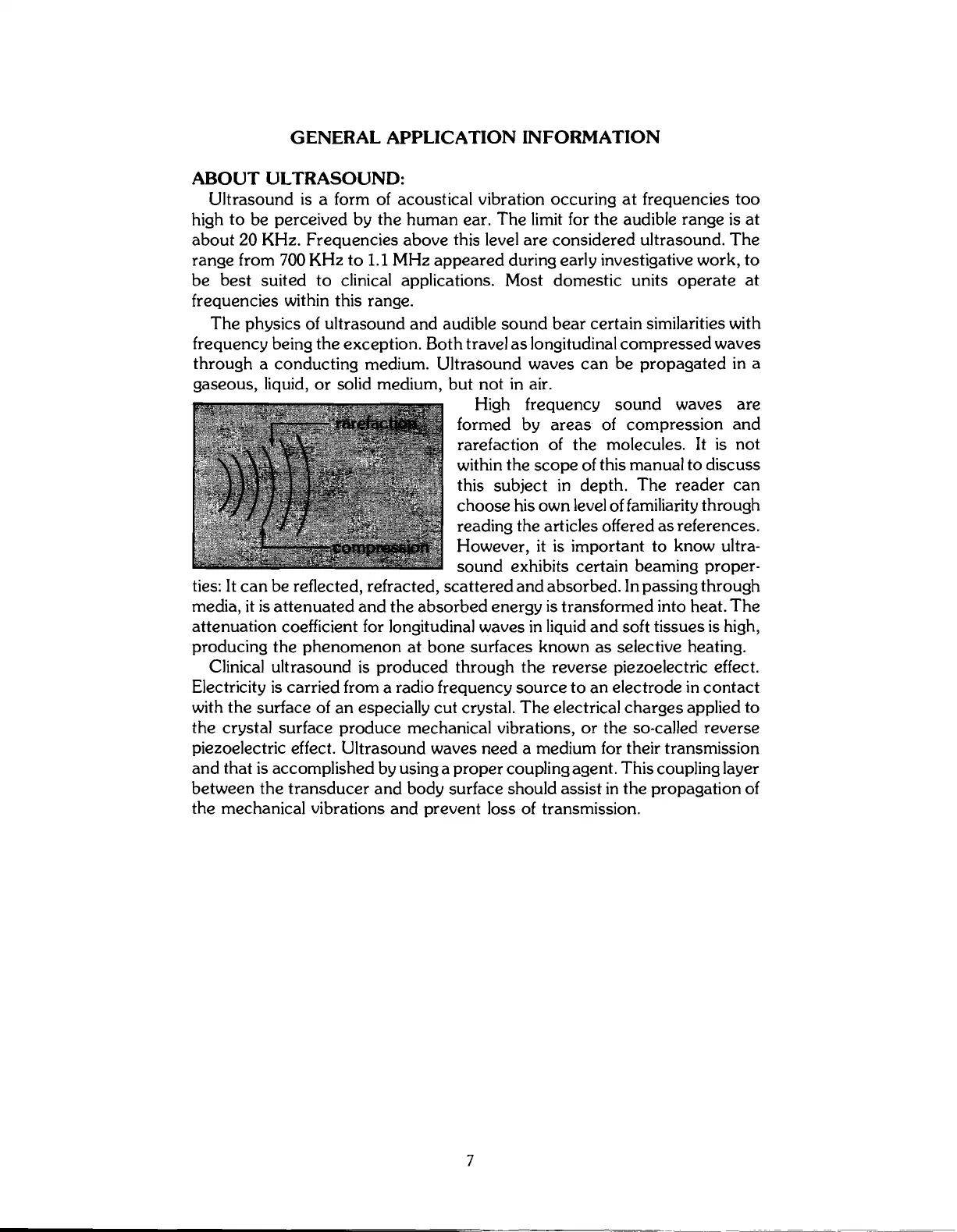
High frequency
sound
waves are
formed by
areas
of compression
and
rarefaction of the molecules. It is not
within the scope of this manual to discuss
this subject in depth. The
reader
can
choose his own leveloffamiliarity through
reading the articles offered as references.
However, it is important to know ultra-
sound exhibits certain beaming proper-
ties: It
can
be reflected, refracted, scattered and absorbed. In passing through
media, it is attenuated
and
the absorbed energy is transformed into heat.
The
attenuation coefficient for longitudinal waves in liquid
and
soft tissues is high,
producing the phenomenon at bone surfaces known as selective heating.
Clinical ultrasound is produced through the reverse piezoelectric effect.
Electricity is carried from a radio frequency
source
to an electrode in
contact
with the surface of an especially cut crystal. The electrical charges applied to
the crystal surface produce mechanical vibrations, or the so-called reverse
piezoelectric effect. Ultrasound waves need a medium for their transmission
and that is accomplished by using a proper coupling agent. This coupling layer
between the transducer
and
body surface should assist in the propagation of
the mechanical vibrations and prevent loss of transmission.
r
7



 To Next Page