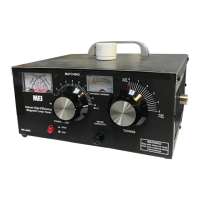
MFJ-936C Deluxe High-Efficiency Magnetic Loop Tuner Instruction & Technical Manual
WARNING
DO NOT touch or come into contact with Loop Connectors or Loop
Antenna while transmitting
YOU CAN BE SERIOUSLY INJURED
Step 1 Place the MFJ-936C Deluxe High-Efficiency Magnetic Loop Tuner™ at the chosen place
of operation, and connect either the wire loop to the wing nut terminals on the rear panel or the
coax loop to the SO-239 connectors on the side.
Step 2 Setup the MFJ-936C Deluxe High-Efficiency Magnetic Loop Tuner™ as illustrated in
Figure 6.
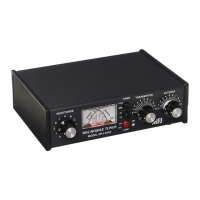
Step 3 Set the MFJ–936C controls to the following positions for the 14.2 MHz operation
(settings are approximate, but should be close):
• TUNING control to Position 3.0.
• MATCHING control to Position 9.0.
• METER SENSITIVITY control to the fully clockwise position.
Step 4 Tune the transceiver or receiver to the 20-meter band and frequency of interest and
adjust the MFJ-936C Deluxe High-Efficiency Magnetic Loop Tuner™ controls for maximum noise
and S-Meter reading. The tuner will produce a peak when the exact position for the controls and
switches is found.
Step 5 Apply 10 to 20 Watts of power to the MFJ–936C and adjust the TUNING control for
maximum RF current and the MATCHING control for minimum SWR on your external
SWR/Wattmeter. Readjust the TUNING control for maximum RF current. Repeat this sequence
until you see no further improvement in minimum SWR and maximum RF current. Be sure to
adjust the RF current meter to center scale using the METER SENSITIVITY control as you make
the other adjustments.
Step 6 Once you are satisfied that the adjustments and settings are correct for minimum SWR
and maximum antenna current, you can advance the power to 150 Watts if desired. Be sure that
MPE distance standard is met. Should any arcing be detected, stop transmitting and check
connections and proximity to objects that may be suspect. If arcing seems to be inside of the
MFJ-936C, lower the output power and re-check for arcing.
As a courtesy to our fellow hams, for safety and to keep within FCC regulations you should use the
minimum power needed for communications. 20 to 50 watts often provides very reliable
communications. The difference between 50 and 100 watts is less than half an of S-unit and is
generally not noticeable on the receiving end.
-13-


 To Next Page