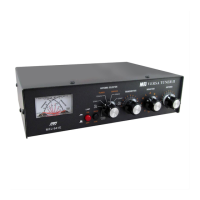
MFJ-945E Mobile Tuner
3
5.
After minimum SWR is achieved, transmitter power may be increased up to 300 Watts. Your
MFJ-945E will reduce the SWR of most feed systems to 1:1. In some cases, a 1:1 SWR is
not possible. Increase or decrease the length of your antenna to improve SWR.
6.
An SWR of 1:1 may occur at more than one set of control settings on your MFJ-945E. When
an SWR of 1:1 is obtained, check transmitter power. Ensure that transmitter power is
relatively high. If transmitter power has decreased substantially, try another
INDUCTOR
control setting and repeat Step 3.
In Case Of Difficulty:
If this tuner
fails to tune,
please
double check all connections
and follow the tuning procedures
again. Be sure you are using enough inductance (lowest letter usable for band) and have the
capacitors open far enough (highest front panel number).
If this tuner
arcs
at the rated power levels, please
double check all connections
and follow the
tuning procedures again. Be sure you are using the least amount of inductance and the
greatest capacitance possible to match the load on the operating frequency. If you are still
unsuccessful, please read the
Antenna
Matching Problems
text below.
Note
:
If this tuner
arcs
when operating on the
160 meter
band, it may be necessary to reduce
transmitter output power.
Antenna Matching Problems:
Most matching problems occur when the antenna system presents an extremely high impedance
to the tuner. When the antenna impedance is much
lower
than the feedline impedance, an odd
quarter-wavelength feedline converts the low antenna impedance to a
very high impedance at
the tuner
. A similar problem occurs if the antenna has an extremely high impedance and the
transmission line is a multiple of a half-wavelength. The half-wavelength line repeats the very high
antenna impedance at the tuner.
Incorrect feedline and antenna lengths can make an antenna
system very difficult or
impossible
to tune.
This problem often occurs on 80 meters if an odd quarter-wave (60 to 70 foot) open wire line is
used to feed a half-wave (100 to 140 foot) dipole. The odd quarter-wave line transforms the
dipole's low impedance to over three thousand ohms at the tuner. This is because the
mismatched feedline is an odd multiple of 1/4 wavelength long. The line inverts (or teeter-totters)
the antenna impedance.
A problem also occurs on 40 meters with this antenna example. The feedline is now a multiple of
a half-wave (60 to 70 foot) and connects to a full-wave high impedance antenna (100 to 140 foot).
The half-wave line repeats the high antenna impedance at the tuner. The antenna system looks
like several thousand ohms at the tuner on 40 meters.


 To Next Page