EasyManua.ls Logo

Micronta 22-214A - Making Measurements; AC Voltage Riding on a DC Source Bias; Measuring 3-Phase AC Voltages

Default Icon
20 pages
Print Icon
To Next Page IconTo Next Page
To Previous Page IconTo Previous Page
Loading...
Making
Measurements
AC
Voltage
Riding
on
a
DC
Source
Bias
Measurements
oil
Set
the
range
SW
to
ACV
aha
"0,
[ox
pret
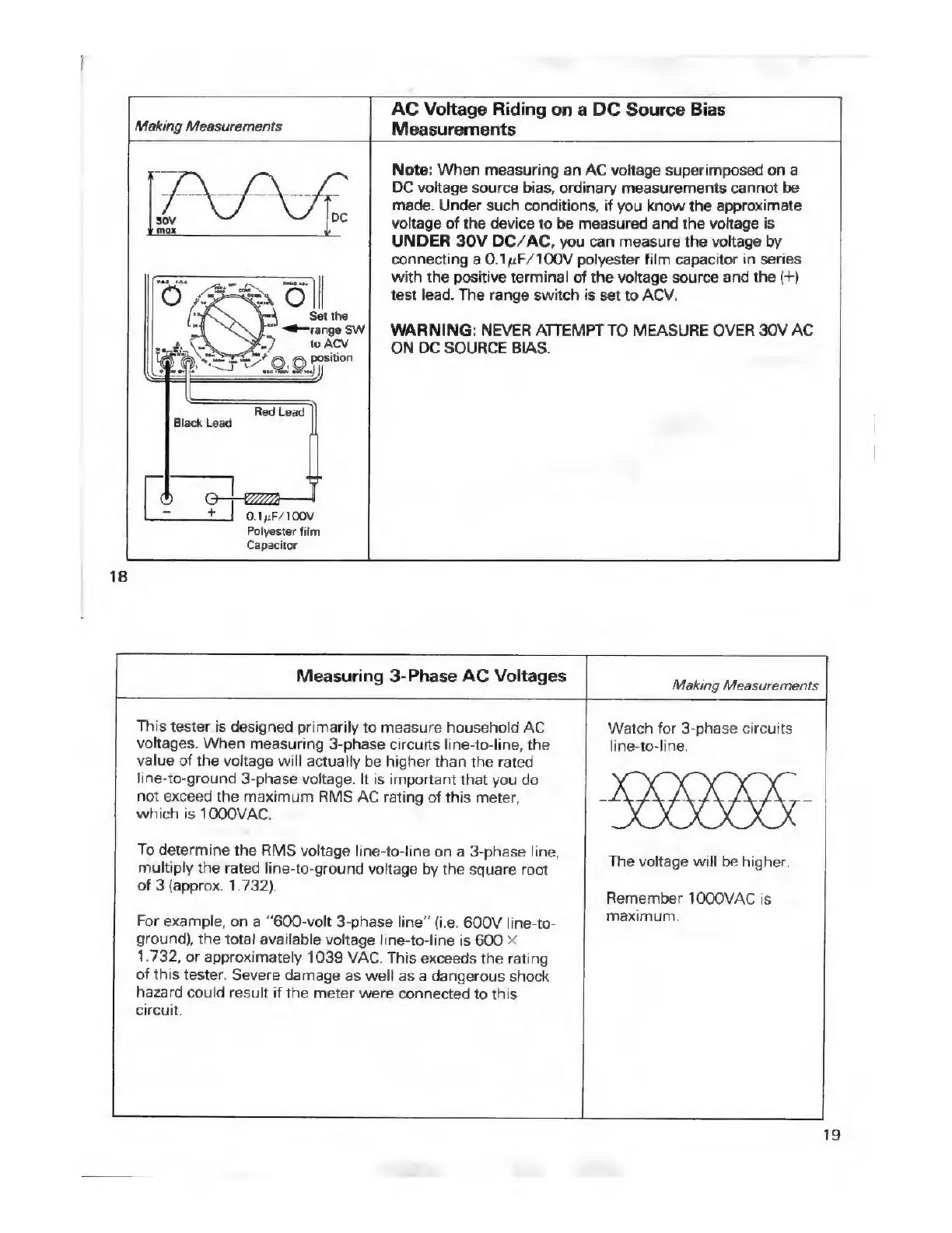
Note:
When
measuring
an
AC
voltage
superimposed
on
a
DC
voltage
source
bias,
ordinary
measurements
cannot
be
made.
Under
such
conditions,
if
you
know
the
approximate
voltage
of
the
device
to
be
measured
and
the
voltage
is
UNDER
30V
DC/AC,
you
can
measure
the
voltage
by
connecting
a
0.14F/100V
polyester
film
capacitor
in
series
with
the
positive
terminal
of
the
voltage
source
and
the
(+)
test
lead.
The
range
switch
is
set
to
ACV.
WARNING:
NEVER
ATTEMPT
TO
MEASURE
OVER
30V
AC
ON
DC
SOURCE
BIAS.
Red
Lead
Black
Lead
[se
0.1.F/100V
Polyester
film
Capacitor
18
a
Measuring
3-Phase
AC
Voltages
Making
Measurements
which
is
1000VAC.
of
3
(approx.
1.732)
circuit.
This
tester
is
designed
primarily
to
measure
household
AC
voltages.
When
measuring
3-phase
circuits
line-to-line,
the
value
of
the
voltage
will
actually
be
higher
than
the
rated
line-to-ground
3-phase
voltage.
It
is
important
that
you
do
not
exceed
the
maximum
RMS
AC
rating
of
this
meter,
=
=
To
determine
the
RMS
voltage
line-to-line
on
a
3-phase
line,
multiply
the
rated
line-to-ground
voltage
by
the
square
root
For
example,
on
a
““600-volt
3-phase
line”
(i.e.
GOOV
line-to-
ground),
the
total
available
voltage
line-to-line
is
600
=
1.732,
or
approximately
1039 VAC.
This
exceeds
the
rating
of
this
tester.
Severe
damage
as
well
as
a
dangerous
shock
hazard
could
result
if
the
meter
were
connected
to
this
Watch
for
3-phase
circuits
line-to-line.
The
voltage
will
be
higher
Remember
1000VAC
is
maximum
19

Related product manuals