Need help?
Do you have a question about the Midea 1025F0A and is the answer not in the manual?
Details specific measures to avoid excessive microwave energy exposure during operation.
Covers essential safety guidelines for using electrical appliances and the microwave oven.
Warns about superheated liquids and provides precautions to prevent scalding injuries.
Explains the importance and procedures for proper grounding of the appliance.
Provides methods to reduce or eliminate interference with radio or TV reception.
Lists specific safety rules for operating the microwave oven to prevent hazards.
Details materials safe and unsafe for microwave use, including a testing procedure.
Identifies the main components and accessories included with the microwave oven.
Provides instructions and clearance requirements for installing the oven on a countertop.
Explains the functions and layout of the microwave oven's control panel.
Guides on how to perform microwave cooking, including states and reminders.
Describes the oven's energy-saving mode and how it enters the waiting state.
Details how to clean the oven's window, control panel, and interior safely and effectively.
Lists common problems, their possible causes, and suggested remedies for the microwave oven.
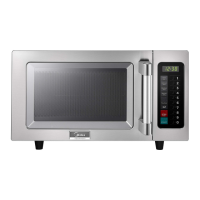
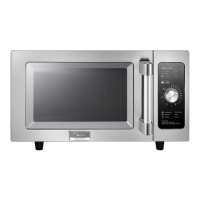
This document is an instruction manual for a Commercial Microwave Oven, Model: 1025FOA, manufactured by Midea. It provides comprehensive guidance on the safe and effective operation, installation, and maintenance of the appliance.
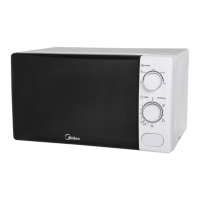
The Midea 1025FOA is a commercial microwave oven designed for heating, cooking, or drying food. It operates by generating microwave energy to rapidly heat food items. The oven is equipped with a control panel that allows users to select cooking times and features a simple knob-based interface for ease of use. It is specifically designed for commercial environments, implying robust construction and performance suitable for frequent use. The appliance is not intended for industrial or laboratory applications, nor for deep-frying or home canning.
The microwave oven offers straightforward operation with a focus on efficiency and safety.
Control Panel and Operation: The control panel features a "MENU GUIDE" with preset cooking times for common items like Cheese (30 seconds), Bread (15 seconds), and Hotdog (45 seconds). It also includes longer cooking suggestions for Hamburger (1:30-2:30 minutes), Popcorn (2 minutes), and Coffee (1-2 minutes). The primary method of operation involves a single knob, labeled "TIMER," which is rotated to set the desired cooking time.
Microwave Cooking: To initiate microwave cooking, the user turns the knob to adjust the cooking time. The time range starts from 0:15 to 3:00 minutes, then extends from 0:30 to 6:00 minutes. The oven operates at full power by default, with no other power levels available for selection. Once the cooking cycle is complete, the oven will emit five beeps and return to a waiting state.
Cooking Adjustments and Interruptions: During the cooking process, the user can adjust the cooking time by rotating the knob. Opening the oven door will interrupt cooking, turning off the LED light, and silencing any sounds. After closing the door, the time needs to be reset to resume cooking. Turning the knob to "0" will stop the oven, trigger five beeps, and return it to the waiting state. The knob's adjustment intervals are 0:15 seconds up to 3:00 minutes, and then 0:30 seconds up to 6:00 minutes.
Safety Interlocks: The oven incorporates multiple built-in safety switches to ensure that power remains off when the door is open, preventing exposure to microwave energy. Users are explicitly warned not to tamper with these interlocks.
Utensil Compatibility: The manual provides a detailed guide on materials suitable for use in the microwave oven, such as aluminum foil (for shielding), browning dishes, dinnerware, heat-resistant glassware, oven cooking bags, paper plates/cups, paper towels, parchment paper, plastic containers (microwave-safe), plastic wrap, thermometers (microwave-safe), and wax paper. It also lists materials to be avoided, including aluminum trays, food cartons with metal handles, metal or metal-trimmed utensils, metal twist ties, paper bags, plastic foam, and wood, as these can cause arcing, fire, or contamination. A "Utensil Test" procedure is provided to help users determine if a non-metallic utensil is microwave-safe.
Liquid Heating Precautions: Special attention is given to heating liquids like water, coffee, or tea, which can become superheated beyond their boiling point without visible bubbling. To prevent sudden boiling over and potential injury, users are advised not to overheat liquids, stir them before and halfway through heating, avoid straight-sided containers with narrow necks, allow the container to stand in the oven briefly after heating, and exercise extreme care when inserting utensils.
Installation Requirements: The oven requires a level surface with adequate open space for intake and outlet vents. A minimum clearance of 3.0 inches (7.5cm) is needed between the oven and adjacent walls, with one side remaining open. A minimum clearance of 12 inches (30cm) above the oven is also specified. The legs at the bottom of the oven should not be removed. Blocking the vents can damage the oven. It should be placed away from radios and TVs to prevent interference. The oven must be plugged into a standard household outlet matching the voltage and frequency on the rating label. Users are warned against installing the oven over heat-producing appliances, as this can cause damage and void the warranty.
Grounding Instructions: The appliance must be properly grounded to reduce the risk of electric shock. It comes with a 3-wire cord and a grounding plug, which should be connected to a properly grounded outlet. The manual provides a diagram of a 2-pole, 3-wire NEMA 5-15R receptacle and 5-15P plug. If an extension cord is necessary, it must be a 3-wire grounding type with a rating equal to or greater than the appliance's electrical rating, and arranged to prevent tripping or pulling by children.
Proper maintenance is crucial for the longevity and performance of the microwave oven.
Cleaning Instructions: The manual emphasizes the importance of keeping the oven clean.
Troubleshooting Guide: A troubleshooting chart is provided to help users diagnose and resolve common issues.
For problems not resolved by the troubleshooting guide, users are advised to contact an authorized service center or the help center.
Safety Maintenance: The manual also highlights general safety practices that contribute to maintenance, such as not covering or blocking oven openings, not storing the appliance outdoors or near water, keeping the cord away from heated surfaces, and ensuring the cord does not hang over edges. It also advises against overcooking food and to attend carefully when combustible materials are used. If materials inside the oven ignite, the door should be kept closed, the oven turned off, and the power cord disconnected. The cavity should not be used for storage.
 General
| Capacity | 1.0 cu. ft. |
|---|---|
| Wattage | 1000 Watts |
| Turntable | Yes |
| Display | Digital |
| Color | White |
| Number of Power Levels | 10 |
| Turntable Diameter | 12.4 inches |
| Control Type | Electronic |
| Cooking Modes | Popcorn, Potato, Pizza, Beverage, Reheat, Defrost |

 To Next Page