
 Need help?
Do you have a question about the Midea EM720CRM-P00C and is the answer not in the manual?
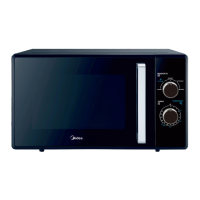
This document provides a comprehensive service manual for the Midea Microwave Oven, Model EM720CRM-P00C (700W 220V 50Hz), outlining its heating principles, installation guidelines, operational instructions, and detailed service procedures. The manual emphasizes safety precautions throughout, particularly concerning microwave energy exposure and high-voltage components.
The Midea Microwave Oven operates on the principle of microwave heating, utilizing ultrahigh frequency electromagnetic waves to heat food. This process primarily involves two mechanisms: dielectric loss of polar molecules and conductive loss of ions within the food. Food, being composed of various polar molecules (like water and protein) and salt ions, undergoes a phenomenon called "TORQUE POLARITY" when exposed to an outer electric field. The polar molecules align with the electric field, and as the field direction changes rapidly (tens of billions of times per second in a microwave oven), these molecules sway, generating frictional heat. Similarly, electric ions accelerate and collide within the changing electric field, producing heat, especially in high-salt molecules. Both mechanisms convert microwave energy into thermal energy, with the efficiency depending on factors like microwave field strength, frequency, and the material's dielectric properties.
The core components enabling this function include a magnetron, which generates the microwaves, a high-voltage transformer, a high-voltage capacitor, and a diode, which together provide the necessary power to the magnetron. The oven also features a turntable motor to ensure even heating, a fan motor for cooling the magnetron and exhausting vapor, and a control panel for setting cooking time and power levels. Safety interlock switches are crucial for preventing microwave emission when the door is open, ensuring user safety.
The Midea Microwave Oven is designed for straightforward operation, with clear instructions for installation and use.
Before use, the oven should be unpacked, and its interior cleaned. It must be placed on a sturdy, flat surface, at least 10 cm (4 inches) from the wall, to ensure proper air circulation and stability. The vent and air intake openings must not be blocked, as this can lead to damage and poor cooking results. The oven should be kept away from heat and steam-generating areas to protect its electronic and mechanical parts. It is also recommended to place it away from TVs, radios, and computers to prevent interference. The ambient temperature for operation should not exceed 104°F (40°C).
The appliance is designed to be fully earthed, and proper earthing is imperative for safety. The mains lead wires are color-coded: green-and-yellow for Earth, blue for Neutral, and brown for Live. These must be connected to the corresponding terminals in the plug (E or earth symbol for green-and-yellow, N or black for blue, and L or red for brown).
The oven's operation involves setting the microwave power level and cooking time via the control panel. When the door is closed, the monitor switch opens, and the primary and secondary interlock switches close, allowing power to flow to the high-voltage transformer. This transformer generates 3.2 volts AC for the magnetron filament and approximately 2100 volts AC in its secondary winding, which is then rectified and boosted by the diode and capacitor to power the magnetron. During cooking, the turntable rotates for even heating, and the fan motor cools the magnetron and exhausts vapor. The timer counts down the set cooking time.
The oven incorporates several safety mechanisms. If the door is opened during cooking, both primary and secondary switches open, cutting off power to the high-voltage transformer and stopping microwave oscillation, the timer, turntable, and fan motor. If the primary switch fails to open, the monitor switch activates, causing a large current surge that blows the fuse, thereby stopping the magnetron. Users are explicitly warned not to operate the oven with the door open.
The service manual provides detailed procedures for diagnosing and repairing common breakdowns, emphasizing safety at every step. Servicing should only be performed by properly qualified personnel.
Before any servicing, especially involving the magnetron or other microwave sources, several safety checks are mandatory: interlock operation, proper door closing, seal integrity, and condition of hinges and latches. Any defective components in these systems must be repaired or replaced before the oven is returned to the owner. A microwave leakage check must be performed on every oven prior to release. Technicians are warned about the high-voltage and high-current nature of the appliance. The power plug must always be removed from the outlet before touching any parts. A crucial step is to discharge the high-voltage capacitor by shorting its terminals with an insulated screwdriver, as it retains an electric charge for about 30 seconds after the oven stops. Watches should be removed when working near the magnetron, and control panel circuits should not be touched to avoid static discharge damage. The oven should never be operated without a load, and the door seal and front plate of the cavity must not be damaged. Iron tools should not be placed on the magnetron, and nothing should be inserted into the latch hole or interlock switch area.
Personnel must not be exposed to microwave energy. All microwave connections, waveguides, flanges, and gaskets must be secure, and the device should never be operated without a microwave energy-absorbing load. Looking into an open waveguide or antenna while the device is energized is strictly prohibited. The magnetron must always be properly installed with its gasket around the dome of the tube.
Standard tools like diagonal pliers, long-nose pliers, screwdrivers (Phillips and flat blade), wrenches, nutdrivers, soldering iron, and vinyl insulation tape are required. Specialized instruments include a multimeter (for DC/AC volts and ohms), a microwave survey meter (e.g., Holaday HI-1710(A) or Narda 8100/8200), an inch scale, a non-conductive beaker (600 cc, 8.5 cm diameter, 90 mm height) for water loads, and a glass thermometer (100°C/212°F scale).
This test is critical and must be performed before and after servicing. The procedure involves placing 275±15 cc of 20±5°C water in a beaker on the turntable, setting the energy leakage monitor to 2,450 MHz, and operating the oven at maximum output. The probe, with a 2-inch (5 cm) spacer, is held perpendicular to the surface and moved along shaded areas at a speed less than 2.5 cm/sec. The maximum permissible leakage is 5 mW/cm² with the outer case removed and 1.0 mW/cm² for a fully assembled oven. If leakage exceeds these limits, the unit must be repaired at no cost to the owner, and the cause investigated.
The manual outlines a systematic approach to troubleshooting, starting with visual inspection and listening for abnormal noises.
The manual includes specific tests for the fan motor and turntable motor. For the fan motor, measure resistance with an Ohm-meter scale R×100; normal is approximately 47Ω. For the turntable motor, use Ohm-meter scale R×1000; normal is approximately 3.2kΩ. Infinite or several ohms indicate abnormality.
A detailed table links common phenomena (e.g., oven not heating, lamp not on, turntable not rotating, oven stops after minutes, microwave leakage) to their causes and corresponding repair actions (e.g., changing fuse, transformer, capacitor, magnetron, switches, motors, adjusting door, cleaning connections).
This section reiterates the critical safety steps, including performing a microwave leakage test before servicing, informing authorities if leakage exceeds limits, repairing units at no cost, and investigating causes. For ovens operating with an open door, the user must be warned, and the unit held for investigation and repair. Interlock assembly replacement and adjustment procedures are detailed, including using an ohmmeter to check electrical continuity of primary, secondary, and monitor interlock switches. All monitored safety interlock switches and the monitor switch must be replaced if the oven was inoperative due to their failure. Door and hinge replacement and adjustment involve checking for warped or damaged areas, broken hinges, and other wear. Replacement parts must be ordered from the manufacturer. Magnetron replacement requires checking for the presence of the wire mesh gasket before installation and conducting a microwave leakage test at the magnetron area before installing the top cover.
After replacing mechanical or electrical parts, ensure correct wiring, adequate mechanical decrements, and firm connectors. Verify adequate grounding. Before turning on the oven, check proper door closing, seal/choke surfaces, hinges, and for any outer case damage. Confirm proper interlock and monitor operations. An insulation resistance test is required if the low-voltage power supply has been repaired. Using a 500V Mega ohmmeter, measure the resistance between the primary (Line and Neutral) of the power plug and operator-accessible metal parts; it should be no less than 2 Mega Ohms.
This comprehensive manual ensures that service personnel can effectively and safely maintain the Midea Microwave Oven, guaranteeing its continued safe operation and performance.
 General
| Type | Countertop |
|---|---|
| Capacity | 0.7 cu. ft. |
| Power | 700 Watts |
| Control Type | Mechanical |
| Turntable | Yes |
| Turntable Diameter | 10 inches |
| Voltage | 120 V |
| Frequency | 60 Hz |



 To Next Page