Installation
*INSTALLATION*
45
- If the ducting has flaps, these must
be opened when the rangehood is
switched on.
Any constriction of the airflow will
reduce extraction performance and
increase operating noise.
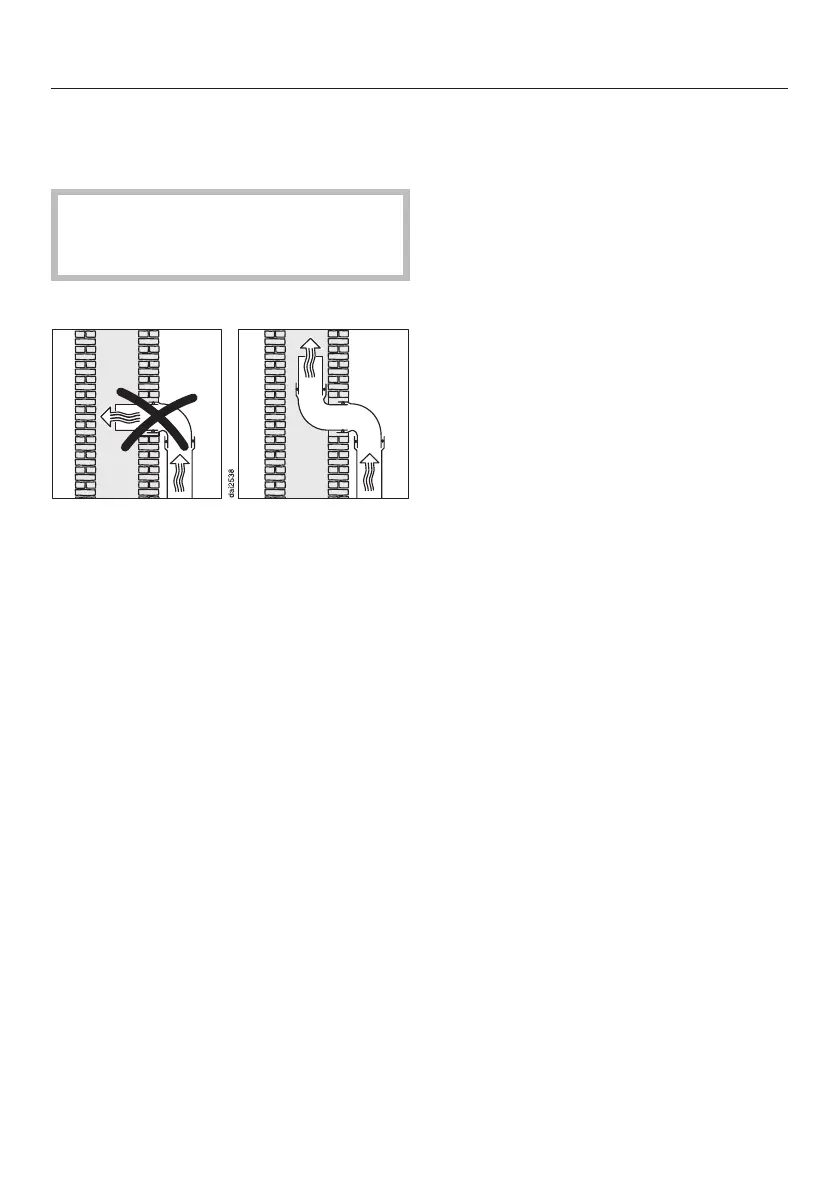
Vent flue
If the exhaust air is to be ducted into a
vent flue, the ducting must be directed
in the flow direction of the flue.
If the flue is used by several ventilation
units, the cross-section of the flue must
be large enough.
Non-return flap
Make sure you use a non-return flap
in the exhaust air system.
A non-return flap ensures that when the
rangehood is not in operation, the duct
is closed and no exchange of room and
outside air can take place.
If the exhaust air is ducted through an
outside wall, a Miele wall vent or a
Miele roof vent (available as an optional
accessory) is recommended. These are
fitted with an integrated non-return flap.
If the on-site exhaust air system does
not have a non-return flap, one is
supplied with the rangehood.
The non-return flap is fitted to the fan's
exhaust connection.
Condensed water
If the exhaust ducting is to run through
rooms, ceiling space etc., condensate
may form in the ducting due to
variations in temperature between the
different areas. To minimise temperature
variations, the exhaust ducting will need
to be suitably insulated.
Where ducting is horizontal, it must be
laid to slope away at at least 1 cm per
metre. The gradient ensures that
condensate cannot drain back into the
rangehood.


 To Next Page