16
17
| INSTRUCTIONS FOR USE INSTRUCTIONS FOR USE |
GB GB
proGAV 2.0 proGAV 2.0
INDICATION
The proGAV 2.0 is used for cerebrospinal fluid
(CSF) drainage in the treatment of hydrocepha-
lus.
TECHNICAL DESCRIPTION
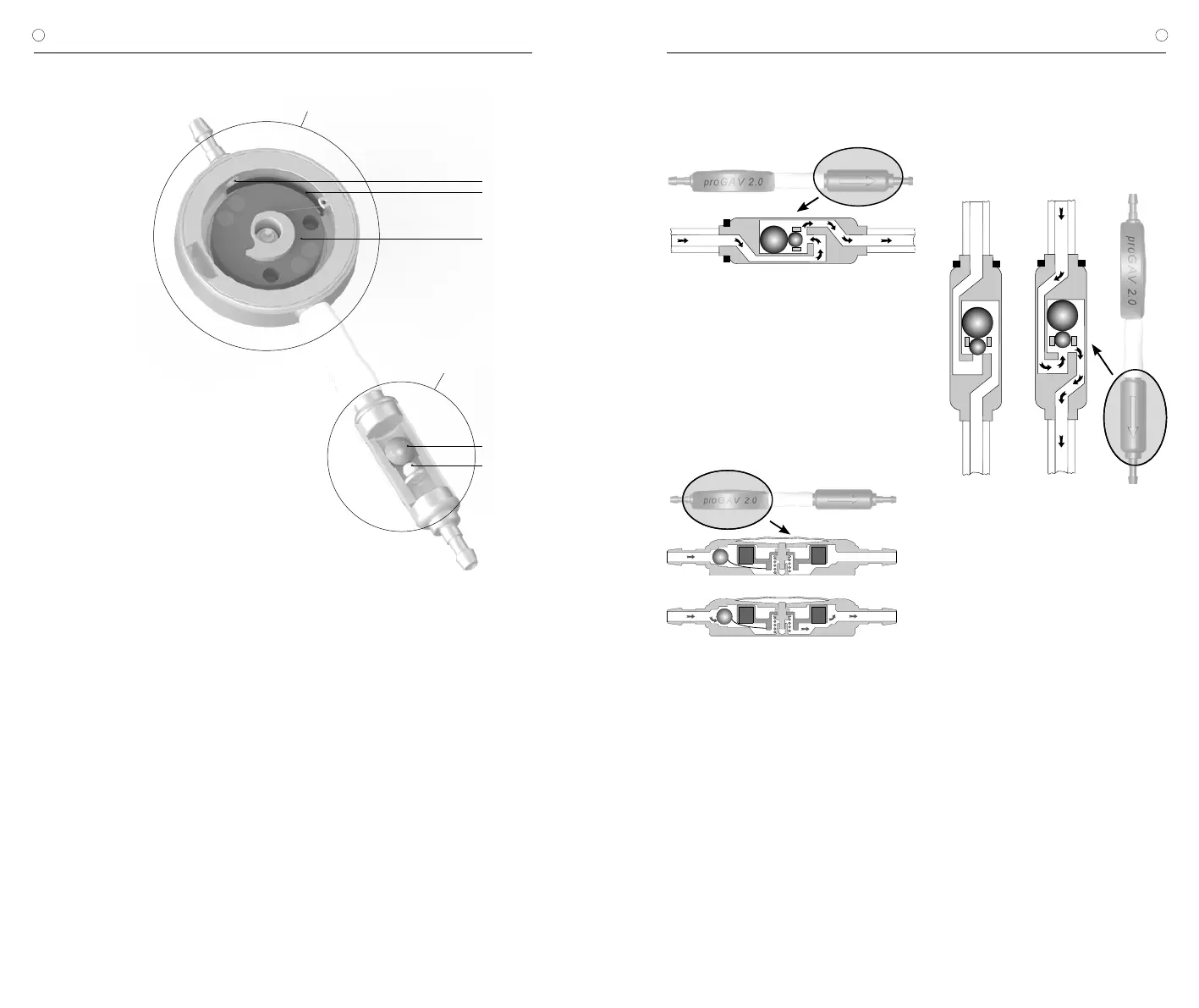
The proGAV 2.0 is a valve made from titanium.
It consists of an adjustable differential pressure
unit and a gravitational unit.
The adjustable differential pressure unit con-
sists of a stable titanium housing in which a
tried and tested ball cone valve (1) is integrated
in the proximal section. A torsion spring (2) de-
termines the opening pressure of this unit. The
pretension of the spring, and therefore the valve
opening pressure, can be adjusted through the
skin using a revolving rotor on a bearing (3).
Major components in the gravitational unit are
a tantalum ball (4), which defines the opening
pressure for this valve depending on the body
position and a sapphire ball (5), which ensures
precise closure.
FUNCTION OF THE VALVE
The proGAV 2.0 is a posture dependent hydro-
cephalus valve. The opening pressure for the
proGAV 2.0 is composed of the opening pres-
sures for the adjustable differential pressure unit
and the gravitational unit.
Horizontal position
In the horizontal position, the gravitational unit
is always open and does not present any re-
sistance.
Fig. 2: Gravitational unit in horizontal body position
Consequently, the opening pressure of the pro-
GAV 2.0 in the horizontal body position is cha-
racterised by the adjustable differential pressure
unit. The principal working method used by the
adjustable differential pressure unit is shown in
fig. 3a and b. In fig. 3 it is closed so that no
drainage is possible. In fig. 3b, the adjustable
differential pressure unit is shown in the open
state.
a)
b)
Fig. 3: Adjustable differential pressure unit in horizontal
body position
a) closed b) open
The intraventricular pressure (IVP) of the patient
is increased and the spring force which would
otherwise keep the differential pressure unit clo-
sed is overcome. Now, the sealing ball moves
out of the cone and a gap is sealing for liquor
drainage.
Vertical position
When the patient moves into an upright positi-
on, in that moment the gravitational unit closes
(fig. 4a). Now, additionally to the opening pres-
sure of the adjustable DP-unit, the weight of
the tantalum ball has to be exceeded (opening
pressure of the gravitational unit), thus the ope-
ning pressure of the proGAV 2.0 is significantly
increased. Only when the sum of the IVP and
the hydrostatic pressure exceeds the opening
pressure of the proGAV 2.0, drainage will be
possible again (fig. 4b).
a) b)
Fig. 4: Gravitational unit in vertical body position
a) closed b) open
During physical activity which is associated with
vibrations (for example jogging) the opening
pressure of the proGAV 2.0 can decrease tem-
porarily by 25 % to 35 % according to laborato-
ry results. This affects both the individual valve
and the combination with a gravitational unit. As
a basic principle, functionality is retained. At the
end of physical activity, the opening pressure
returns to its original level and remains stable.
SELECTION OF THE
APPROPRIATE PRESSURE LEVEL
Horizontal position
The opening pressure for the horizontal body
position is achieved using the adjustable diffe-
rential pressure unit. Here, the pressure stage
should be set in accordance with the clinical
picture and indications. Depending on the clini-
cal picture and age of the patient, the opening
pressure for this position can be selected bet-
ween pressure levels 0 and 20 cmH
2
O.
1 sapphire ball
2 torsion spring
3 rotor
4 tantalum ball
5 sapphire ball
Fig. 1: Schematic cross section of the proGAV 2.0
4
5
Adjustable differential pressure unit
(adjustable DP-unit)
Gravitational unit
1
2
3



 To Next Page
 Loading...