
 Need help?
Do you have a question about the MIL'S MVX 2 and is the answer not in the manual?
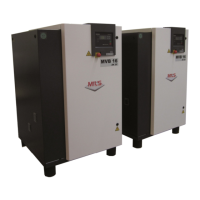
This document provides general installation and maintenance instructions for AIRMIL'S G screw compressors, which are regulated by a MILLENIUM control device.
The AIRMIL'S G screw compressors are designed for air production, with regulation managed by a MILLENIUM control device. These units are lubricated screw compressors available in three pressure levels: 8 bar, 11 bar, and 15 bar, each equipped with its own electric control panel. The system can operate with a single compressor or multiple compressors. When two or more compressors are present, the MILLENIUM control device ensures permutation between them and manages alarms. The air aspirated by the compressor is then compressed and directed to an air treatment unit, which is selected based on the desired air quality for the specific application. After treatment, the air is stored in a receiver. For 15 bar screw compressors, a pressure reducer is installed to regulate the network pressure between 8 and 10 bar. Final filtration removes residual particles from the network and receiver.
The manual provides a table of compressor types (MVX, MVA, MVB, MVC, MVD, MVE) with their respective power (kW), heart release (kcal/h), air inlet section (m²), exhaust fan capacity (m³/h), and exhaust air duct dimensions (mm). For instance, an MVX 2 has 2.2 kW power, 1892 kcal/h heart release, 0.10 m² air inlet section, 1000 m³/h exhaust fan, and no specified duct. An MVE 46 has 45 kW power, 38700 kcal/h heart release, 1.20 m² air inlet section, 16500 m³/h exhaust fan, and 700 x 700 mm duct. Room ventilation is crucial, and a formula is provided to size the fan: Q = P x 1000 x 3600 / (ΔT x 1250), where Q is ventilation volume (m³/h), P is compressor energy consumption (kW), ΔT is temperature difference, and 1250 is volumetric heat capacity. The air inlet area should be dimensioned so that the flow rate does not exceed 3 m/s (max. 5 m/s). The system supports various air treatment units:
The unit must be located in a clean, non-humid, non-saline, dustless, and ventilated room with temperatures between +5°C and +40°C. Forced ventilation controlled by a thermostat is required. The MILLENIUM control device implements a "FLEXO" regulation. When pressure reaches the first compressor's threshold, the priority compressor starts for a predetermined "FLEXO" time. During this time, the compressor runs, and if pressure exceeds the stop threshold, the discharge system activates to prevent overpressure. After the FLEXO time, if pressure is above the stop threshold, the compressor stops. If pressure is below the stop threshold, the compressor stops, and priorities invert for the next cycle. If pressure drops further to the second compressor's threshold, the standby compressor starts. Compressor alarms (motor disjunction, high oil temperature, power off, refusal to start) are connected to the MILLENIUM control device. A 90-second delay is applied to avoid fictitious alarms. A key-operated button in the electric box allows forced running of each compressor, bypassing the MILLENIUM control device for provisional breakdown service or testing. Pneumatic connections to the MILLENIUM system device involve dia.4x6 "rilsan" pipes for air treatment units and regulation sensors. Flexible connections are used between compressors, air treatment units, and the network. Condensates formed due to pressure and water content are trapped by filters (cyclone, PF, SUB) equipped with mechanical drainers. These effluents must be treated using an OWAMAT separator before discharge into the sewerage system. Receivers are designed to contain air or nitrogen and must be installed in a neutral, normal, and current atmosphere, connected to ground, and easily accessible for checks. They should not be installed near fragile devices or in areas prone to temperature rise.
All operations on the air plant must be performed with the plant switched off. Electrical connections should be checked for tightening before initial start-up. The installer and personnel must be qualified and trained in medical gases, brazing procedures (ISO 13585, EN 13134), and maintain records for at least 15 years. Work should not begin without a Work Authorization. Sub-contractors must verify the integrity and cleanliness of components before installation. Lock-out systems must be used for electrical control panels. Before commissioning, the entire facility must undergo a final verification according to NF EN ISO 7396-1. Traceability of production sources, storage tank, safety valves, and other components is required.
The manual provides a detailed maintenance schedule for various components:
The AIRMIL'S units networks with MILLENIUM automate require special EMC precautions. They comply with Group 1 Class B RF emissions, Class A harmonic emissions, and voltage fluctuations/flicker emissions. They are suitable for use in commercial and hospital environments. Immunity tests (ESD, electrical fast transient/burst, surge, voltage dips, power frequency magnetic field) are detailed with compliance levels and guidance for electromagnetic environment. Recommended separation distances from portable and mobile RF communications equipment are provided based on transmitter output power and frequency.
 General
| Brand | MIL'S |
|---|---|
| Model | MVX 2 |
| Category | Medical Equipment |
| Language | English |

 To Next Page