7
Return the white bishop from h4 to g5, pressing the squares as you do so. (Alternatively press RED and
simply move the piece – compare Section 3.3.)
3.6.2
Retracting a sequence of moves
After taking back one move, you may also take back the previous one or a longer sequence.
To do this, you can repeat the same procedure as before. However, in a long sequence you don’t need to
retract the moves one by one in a specific order. For example, to retract the last seven moves played, you can
simply press seven times and then proceed to reconstruct the position, pressing the squares that are
indicated in the bottom line. The ‘Verify’ function (see Section 5.9), as well as the red lights on the board, can
help you.
3.6.3
Replaying moves
A move that you have retracted can be
replayed
by pressing the
anticlockwise
arrow button and moving
the piece on the board as prompted by the lights and the screen.
To replay a sequence, you may repeat this same procedure to execute each individual move. Alternatively,
you may simply press the anticlockwise arrow button several times and then reconstruct the position at the
end of the sequence.
3.6.4
Continuing the game
At any time after retracting or replaying moves, you can resume the game from the current position on the
board. Carry out a move in the normal way, or give the ‘Move’ command (see Section 5.5) to make the
computer play next – you will then be playing for the opposing colour.
3.7
Result of the game
The final move is accompanied by three ‘beeps’, and the result is announced in the bottom line of the
display:
• Mate Checkmate
• Stale Stalemate
• Draw 3x Draw by threefold repetition
• Draw 50 Draw by 50-move rule
• NoMat Draw due to insufficient material (neither side can mate the opponent)
• TooLong The game cannot be continued, as it would exceed the available
memory space (maximum: 256 moves for each side).
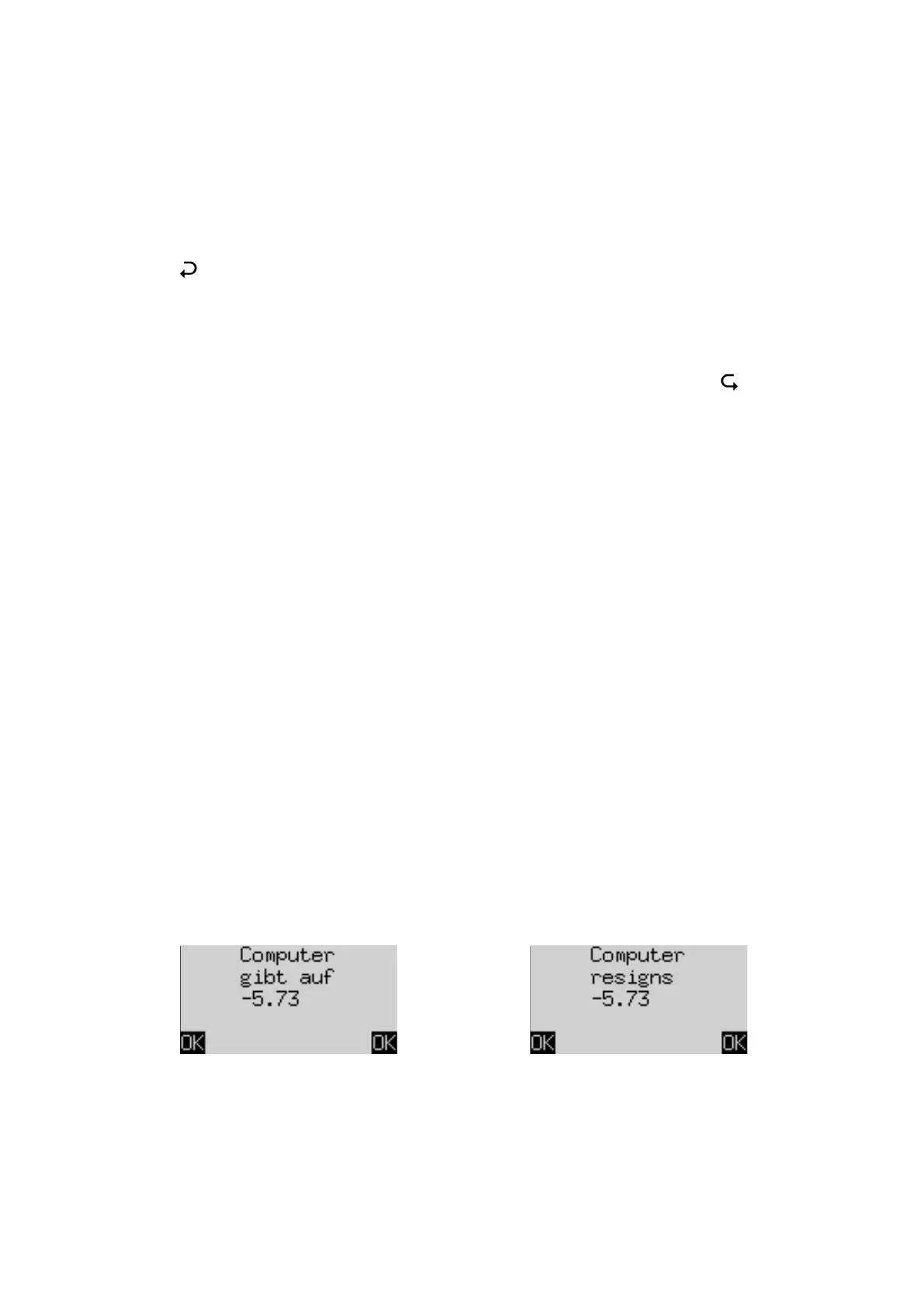
If the computer thinks its position is hopeless, it may offer its resignation. In the following example it thinks
it has a disadvantage equivalent to 5.73 pawns:
Or if it thinks the position is very drawish, you may see:


 To Next Page
 Loading...