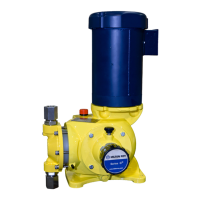
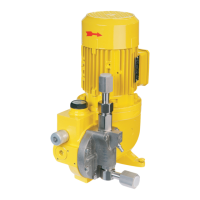
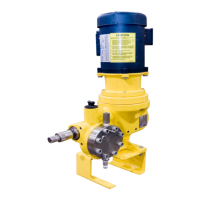
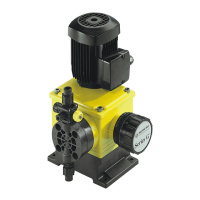
The MILTON ROY GTMA - GTMM SERIES PUMP is a compact electromechanical metering pump designed for precise dosing applications. This manual provides essential information for its start-up, commissioning, installation, and maintenance.
Function Description:
The pump is designed to accurately meter and dose liquids. It operates with a drive device comprising a motor, a mechanical assembly, and a liquid end. The tightness between the mechanical part and the liquid end is ensured by a diaphragm. The pump allows for capacity adjustment both during operation and when stopped, making it versatile for various dosing needs.
Important Technical Specifications:
- Noise Level: Less than 70 dB A.
- Ambient Running Temperature: -10°C to +40°C.
- Max Temperature of Pumped Liquids: -10°C to +40°C.
- Flow and Max Allowable Working Pressure: These are indicated on the pump nameplate. Running tests are conducted with water and a motor operating at 50Hz.
- GM Pump Series (e.g., GM2, GM5, GM10, GM25, GM50, GM90, GM120, GM170, GM240, GM330, GM400, GM500):
- Steady State Accuracy (flow rate between 10% and 100%): ±3% for GM2-GM25, ±1.5% for GM50-GM500.
- Max. Suction Pressure (Pasp): 5 bar for GM2-GM25, 4 bar for GM50-GM170, 3 bar for GM240-GM500.
- Suction Head (meters water head, Ha): 4 meters for GM2-GM170, 2.5 meters for GM240-GM500.
- GA Pump Series (e.g., GA2, GA5, GA10, GA25, GA45, GA90, GA120, GA170):
- Steady State Accuracy (flow rate between 10% and 100%): ±2%.
- Max. Suction Pressure (Pasp): 2 bar for GA25-GA170.
- Max. Suction Pressure (Pasp): 4 bar for GA2-GA10, 2.5 bar for GA25-GA170.
- Electrical Installation: The metering pump must be plugged into a properly grounded grounding-type receptacle with ratings conforming to the pump nameplate. All wiring must conform to local electrical codes. A Ground Fault Circuit Interrupter (GFCI) is recommended for electric shock protection.
- Weight: If the pump's weight exceeds 25kg, adequate means for manipulation/transport must be used.
Usage Features:
- Pre-priming: All pumps are factory pre-primed with water. If the pumped liquid is incompatible with water, the liquid end, check valves, and balls must be completely dried before reassembly. Filling the liquid end with the actual liquid before priming can ease start-up.
- Chemical Compatibility: It is crucial to verify that the liquid end material is chemically compatible with the liquid to be pumped. Users should consult the liquid provider and Chemical Resistance Chart, or contact their local distributor for guidance.
- Piping Connection: Suction and discharge piping connections should not be reduced, and discharge piping size should not be increased. Piping must be firmly fixed and protected from damage, especially if exposed to sunlight (black UV protective piping recommended). Regular checks for cracks are essential.
- Connectors: All connectors should be tightened by hand, with an additional 1/8 to 1/4 turn (45-90 degrees) for tightness. Excessive tightening or using tools can damage the connecting device, seals, or liquid end. G™™ series pumps use o-ring seals; Teflon® tape or sealing compound should NOT be used on these joints, but can be used on injection nozzles (1/2" NPT side) or stainless steel liquid end connections.
- Back Pressure/Anti-syphon Valve: If pumping downhill or into low/no pressure systems, a back pressure/anti-syphon device (such as a Four-Function Valve) should be installed to prevent over-pumping or siphoning.
- Line Depressurization: Installations should include line depressurization capability to reduce chemical splash risk during disassembly or maintenance. A Four-Function Valve (-FV) can provide this feature.
- Accessories: Standard accessories include a foot valve (with filter) to prevent unpriming and filter the fluid, and an injection nozzle to isolate the pumped liquid from the main flow and create necessary back pressure.
- Start-up Procedures: Before starting, ensure the pump is secured, pipe fittings are torqued, isolating valves are open, and the pump capacity adjustment is set to 0%. Verify the motor's direction of rotation. Gradually adjust capacity from 0% to 100% while monitoring liquid output or noise from the outlet check valve. Lock the stroke adjustment knob once the desired capacity is set.
- Troubleshooting Flow Rate Issues:
- Lower than desired flow: Check capacity adjustment, suction power (piping size, flooded suction), suction pipe leak-tightness, liquid viscosity compatibility, and filter blockage.
- Greater than desired flow: Check capacity adjustment and for siphoning (ensure discharge pressure is at least 1.5 bar higher than suction pressure, install a back pressure valve).
- Variable capacity: May be due to particles interfering with valve assemblies (clean piping and valves) or lack of back pressure (install a back pressure valve).
- Motor Problems: If the motor runs with difficulty or heats up, check electrical power supply characteristics, phase connections, discharge pressure compatibility, and for excessive flow pulsations (consider a pulsation dampener). If the motor's direction of rotation is incorrect, reverse it.
Maintenance Features:
- Life-lubricated: The pump is life-lubricated with oil. For oil replacement, refer to the specific manual on the CD-Rom.
- Cleanliness: The pump should be kept clean, and dust wiped off regularly.
- Drip Collection: Provide outlets for draining leaks or drips, especially for harmful liquids. A tray should be positioned under the plain hole at the bottom of the liquid end mounting assembly to collect leaks from diaphragm or boot rupture.
- Maintenance Schedule: The frequency of checks and maintenance depends on usage conditions. Refer to the instruction manual on the CD-Rom for detailed schedules, which can be adapted to specific operational needs.
- Servicing: Any servicing must be performed when the equipment is stopped, preventing accidental start-up by locking the switch or removing the fuse. A warning notice should be attached to the switch location. Power supply must be switched off immediately if any fault (abnormal heating, unusual noise) is detected. Special care is required when handling chemicals.

 Need help?
 General


 To Next Page