
 Need help?
Do you have a question about the Milwaukee 2447-20 and is the answer not in the manual?
Ensures a safe working environment by maintaining cleanliness and proper lighting, and avoiding hazardous atmospheres.
Guidelines to prevent electric shock hazards, including proper plug use, avoiding wet conditions, and using GFCI protection.
Precautions for safe operation, emphasizing alertness, PPE, preventing unintentional starting, and proper body positioning.
Instructions for correct tool application, maintenance, and safe storage to prevent accidents and ensure tool longevity.
Guidelines for safe charging and usage of battery packs, including avoiding damage, extreme temperatures, and incompatible chargers.
Step-by-step instructions for safely installing and removing fasteners, including essential safety warnings.
Identifies and describes the main parts and features of the power tool for user understanding and operation.
Explanation of various symbols used in the manual and on the tool, relating to safety, warnings, and direct current.
Procedure for safely removing and inserting the battery pack into the tool, with specific safety precautions.
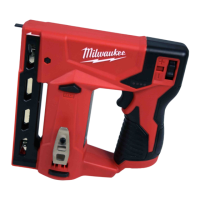
This device is a power tool designed for fastening applications, specifically using staples. It is a handheld, battery-operated tool, emphasizing portability and ease of use without the need for a power cord during operation.
The primary function of this power tool is to drive staples into various workpieces. It operates by actuating a mechanism that rapidly propels staples from a magazine into a target material. The tool is equipped with a workpiece contact bracket, which ensures that the tool is firmly placed against the material before a staple can be discharged, preventing accidental firing and ensuring accurate placement. A power adjustment feature allows the user to control the depth or force with which the staples are driven, adapting to different material types and desired fastening strengths. The tool is designed for efficient and consistent staple driving, making it suitable for tasks requiring repetitive fastening.
The device incorporates several features to enhance user experience and safety during operation. It is powered by a rechargeable battery pack, which offers cordless convenience. A battery gauge is integrated to display the remaining charge, allowing users to monitor power levels and plan for recharging. The trigger mechanism is designed for controlled actuation, ensuring that staples are only driven when intended. For user comfort and accessibility, the tool includes a belt clip, enabling it to be easily carried when not in active use. The magazine is designed for straightforward loading and unloading of staples. To install fasteners, the user first removes the battery pack, then pinches a magazine latch to pull the magazine out. Staples are then inserted into the magazine channel with their legs pointing outwards from the tool body. After loading, the magazine is pushed back in until it snaps closed. When removing fasteners, the battery pack is again removed, the magazine latch is pinched, and the magazine is pulled out to access and remove the staples. The tool is designed to be used with specific types and sizes of staples, and adherence to these recommendations is crucial for optimal performance and to prevent malfunction or injury. The tool's design emphasizes keeping hands and body away from the discharge area to prevent injury from discharged fasteners. It also advises against driving fasteners too close to the edge of a workpiece, as this can cause fasteners to slip or penetrate through thin materials, creating projectiles.
Proper maintenance is crucial for the longevity and safe operation of this power tool. Users are advised to keep the work area clean and well lit to prevent accidents. Regular checks for misalignment or binding of moving parts, breakage, or any other condition that might affect the tool's operation are essential. If any damage is found, the tool should be repaired by qualified personnel before further use. Keeping cutting tools sharp and clean is highlighted as a general power tool maintenance practice, which, while not directly applicable to the stapler's "cutting" function, implies maintaining the overall cleanliness and integrity of the tool's components. The handles and grasping surfaces should be kept dry, clean, and free from oil and grease to ensure safe handling and control.
For battery maintenance, it is critical to recharge the battery pack only with the charger specified by the manufacturer. Using an unsuitable charger can create a risk of fire. The battery pack should be stored away from other metal objects when not in use to prevent shorting of terminals, which can lead to burns or fire. Users are warned against exposing the battery pack or tool to fire or excessive temperatures (above 265°F or 130°C), as this can cause an explosion. Any damaged or modified battery packs or tools should not be used, as they may exhibit unpredictable behavior. If liquid is ejected from the battery under abusive conditions, contact should be avoided, and medical help should be sought if contact occurs.
The tool's labels and nameplates carry important information and should be maintained. If they become unreadable or missing, a replacement should be sought from a service facility. Servicing of the power tool, including repairs, should only be performed by qualified repair persons using identical replacement parts to ensure safety. Battery packs should only be serviced by the manufacturer or authorized providers. Users are also reminded to check the workpiece contact and trigger for correct operation prior to each use and to avoid disassembling or clamping parts of these mechanisms, as this can lead to unexpected actuation and injury. The tool should be disconnected from the power source (battery pack) when making adjustments, changing accessories, or storing it to prevent accidental starting. Storing idle power tools out of the reach of children and untrained users is also a key safety and maintenance practice.
 General
| Model | 2447-20 |
|---|---|
| Category | Power Tool |
| Voltage | 12V |
| Battery Platform | M12 |
| Battery Type | Lithium-Ion |
| Battery Included | No |
| Charger Included | No |


 To Next Page