Use MILWAUKEE core bits. Do not
use LHS (Large Hole System) Com-
ponents with these rotary hammers. The bits
could fail, breaking apart at the threaded stud
and causing injury and property damage.
Using Rotary Percussion Core Bits
Core bits are useful for drilling larger holes for con-
duit and pipe. MILWAUKEE Heavy-Duty Core Bits
have heat-treated steel bodies with durable carbide
tips. These core bits are specially designed for fast,
accurate drilling with combined hammering and
rotary action.
1. Clean and lubricate the threads on the adapter and
core bit to make later removal easier. Screw the
threaded end of the adapter into the rear of the core bit.
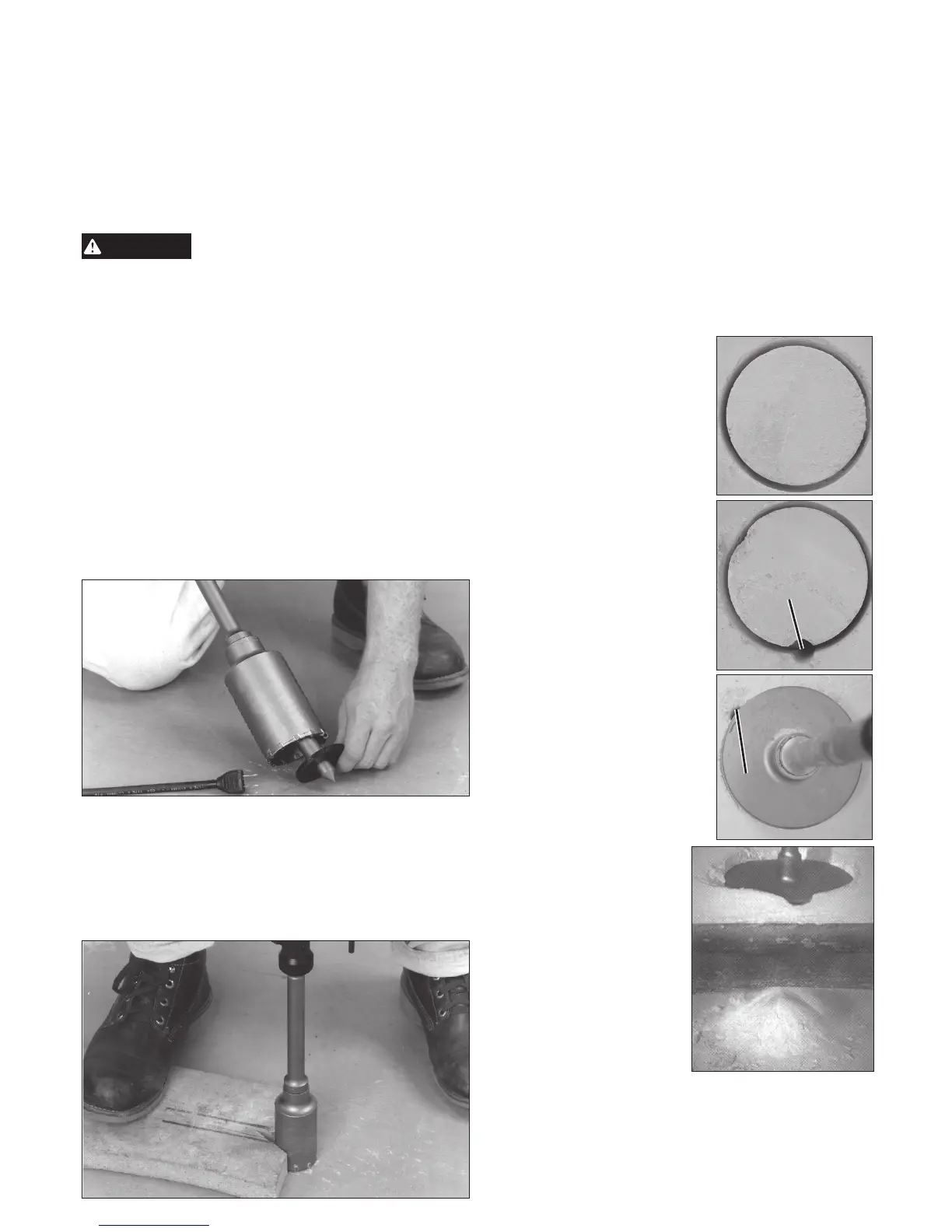
2. Push the guide plate onto the pointed end of the
center pin. Insert the center pin and guide plate
assembly into the core bit. Be sure the small end
of the center pin is securely placed into the hole
in the center of the core bit.
3. Insert the adapter into the nose of the tool. Set
the action selector to the hammering with rotation
setting.
4. Press the center pin rmly against your center
mark, hold the tool rmly and pull the trigger.
NOTE: If a center pin and guide plate are not avail-
able, use a template or notched board to start the
hole.
5. After drilling to about the depth of the core bit teeth,
remove the center pin and guide plate from the
core bit. Resume drilling.
6. To change the core bit, hold the tool upwards,
pointing it away from your body, and run the tool
allowing rotation and impacting for about five
seconds to loosen the core bit from the adapter
shank.
NOTE: To make deeper holes, remove the core
bit, break and remove the core. Resume drilling.
When drilling long or deep holes, after each inch
of penetration pull the bit partially out of the hole
while the tool is running, to help clear dust from
the bit utes. Dust can clog the bit utes and can
make the bit bind in the hole. If this occurs, stop
the tool, free the bit and begin again.
Drilling Large Diameter Holes with Core Bits
When drilling holes with large diameter core bits, dust
may build up in the cut and can
Cut
approximately
1/4" deep with
a core bit.
Drill a hole
through the
work.
Dust and debris
will fall through
the hole.
Top view
cause the tool to stall, bind, or
cut slowly. By creating an
opening for the dust to escape,
drilling time, bit stress, and tool
stress can be reduced.
1. Start the cut as normal.
2.Once the bit is rmly estab-
lished in the cut (about 1/4"
deep), remove the bit from
the cut.
3. Remove the bit from the tool.
4. Install a standard uted bit,
approximately 7/8" in diam-
eter, onto the tool.
5. Drill a perpendicular hole
through the kerf of the large
hole.
• Depending on the location
of the work, the hole should
either break through the
other side of the hole/oor
or extend 4"-5" past the end
of the workpiece (such as
into the dirt below a concrete
slab).
• If dust builds up in the hole,
vacuum it out and continue
drilling.
• If drilling through a wall, the
hole for dust should be dril-
Side view
of slab
led on the lowest part of
the large hole kerf as the
dust will fall there when
drilling and can be evacu-
ated more easily.
6. Reinstall the core bit
and continue drilling.
Dust and debris will fall
through the hole and op-
timize the cutting ability
of the bit.



 To Next Page