EasyManua.ls Logo

Milwaukee 5900-2 - Abrasive Belts and Selection; Changing the Abrasive Belt; Adjust the Alignment of the Belt; Operation

Milwaukee 5900-2
8 pages
Print Icon
To Next Page IconTo Next Page
To Previous Page IconTo Previous Page
Loading...
ABRASIVE
BELTS
AND
SELECTION
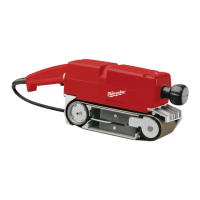
The 5900
and
5900-2
3"
MILWAUKEE
Belt
Sanders
are
furnished
with
a
49-37-3120,
1
20
grit,
Aluminum
Oxide
closed
coat
belt.
The 5910
and
5910-2 4
'
Ml LW
AUK
EE
Belt
Sanders
are
furnished
with
a
49-37-41
20,
1
20
grit.
Aluminum
Oxide
closed
coat
belt.
These
belts
are
recommended
for
finishing
work
only.
Refer
to
page 8
for
chart
on
complete
selection
of
MILWAUKEE
Sanding
Belts for
your
portable
Belt
Sander.
CHANGING
THE
ABRASIVE
BELT
Pull
the
belt
lock
button
lever
located
on
the
right
side
of
the
sander
to "OFF",
toward
the
rear
drum.
Stand
the
sander
on
its
front
drum
and
push
down
on
rear
handle
firmly
until
the
pulley
locks
into
position.
This
releases
tension
on
the
abrasive
belt
for
easy
removal.
Hold
the
new
belt
so
the
arrow
which is
printed
on
the
inside
of
the
belt is
on
top
of
the
drums
and is
facing
to
the
front
of
the
sander.
Arrows
are
indicated
on
the
belt
tension
bracket
plate
to
indicate
the
direction
the
belt
travels.
Be
sure
belt is
pushed
completely
on
to
the
drums.
Move
the
belt
lock
button
lever
to
the
"ON"
position.
The
front
drum
will snap
into
position
with
the
proper
tension
on
the
abrasive
belt.
Adjust
the
belt
for
proper
alignment.
ADJUST
THE
ALIGNMENT
OF
THE
BELT
Turn
the
sander
over so
the
belt can
run
free.
While
holding
it
firmly
with
one
hand,
start
the
motor by
squeezing
the
trigger
switch
to
its
"ON"
position.
Adjust
the
belt
aligning
knob
located
on
your
right,
(the
left
side
of
the
Belt
Sander),
by
turning
it
in
either
direction.
Movement
of
this
knob
changes
the
angle
of the
front
drum
assembly
and
alters the
alignment
of
the
belt.
Move
the
nut
until
the
edge
of
the
belt
is
running
flush
with the
rear drum.
The
edge
of
the belt
will
extend
beyond
the
edge
of
the
front drum.
DO
NOT
LET
THE
BELT*
RUB
ON
THE
FRAME
OF
THE
SANDER.
OPERATION
Hold
the Sander
off the
work
with
one
hand
holding
the
front
handle
and the
other
holding
the
rear
handle.
Always
start
and
stop
the
Sander
off the
work. A
locking
button
is
provided
on the
switch
for
extended
use.
To use
the
lock
button,
depress
the
trigger
switch,
push
the
lock
button
in
and
release
the
trigger.
To
release
the
lock
button,
depress
the
trigger
and
release.
With
the
motor
running
full
speed,
apply
the
Sander
to
the
work
with a
forward
motion.
The
Sander
should
be
fed
back
and
forth
parallel to
the
grain
of
the
wood. DO
NOT
APPLY
HEAVY
PRESSURE.
The
weight
of the
Sander
is
sufficient
for
horizontal
sanding.
As
the
Sander
is
fed
back
and
forth
over
the surface,
guide
the
Sander
sideways.
Overlap
strokes
keeping
parallel
to
the
grain
and
cover
the
entire
surface
to
be
sanded.
Work
the
entire
surface
down
evenly
and
do
not
allow the
Sander
to stop
moving
or
stay
too
long
in one
small
area.
Short
overlapping
strokes
produce
the
best
results.
Avoid
tilting
the
machine
when
feeding
as
belt
will
make
a
gash in
the
work.
To
obtain a
very
fine
surface,
change
belts
two
or
three
times,
using
a
finer
grit
for each
change
and
working
the
entire
surface
with
each
grit.
Do
not use
an
abrasive
belt
after
it
has
become
worn
or
clogged.

Related product manuals