
 Need help?
Do you have a question about the Milwaukee M18 FUEL 2782-20 and is the answer not in the manual?
Maintain a clean and well-lit work area to prevent accidents and ensure proper tool control.
Guidelines for safe electrical connections and avoiding shock hazards during power tool operation.
Essential precautions for operator safety, including alertness, PPE, and preventing unintentional starts.
Instructions for correct tool usage, maintenance, and handling to ensure safety and longevity.
Guidelines for safe charging, handling, and usage of battery packs to prevent injury and fire risks.
Explains kickback, its causes like blade binding, and precautions to prevent sudden, uncontrolled saw reactions.
Details on checking and ensuring the proper operation of the lower guard for blade protection.
Step-by-step instructions for safely removing and inserting the battery pack into the tool.
Guidance on choosing the correct blade for the application, emphasizing sharpness and type.
Procedure to verify the lower guard moves freely and closes properly for safety.
Instructions for starting cuts, maintaining grip, and controlling the saw during operation.
Explanation of the overload protector and how to respond if the tool automatically shuts off.
Common issues like blade not following a straight line or blade binding, and their solutions.
Information on the electric brake feature that stops the blade quickly after the trigger is released.
Technique for cutting angled materials to avoid the lower guard resting on the angle.
Precautions for cutting thin materials to prevent injury or tool damage from pulled metal strips.
Guidance on supporting large sheets to minimize blade pinching, binding, and kickback.
Instructions and warnings for making pocket cuts in the middle of a workpiece safely.
Program for keeping the tool, battery, and charger in good repair and seeking professional service.
Instructions for cleaning the tool, emphasizing mild soap and water, avoiding solvents.
Information on returning the tool, battery pack, and charger to the nearest service center for repairs.
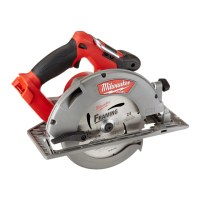
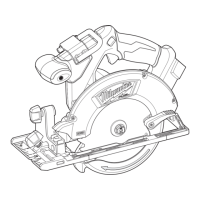
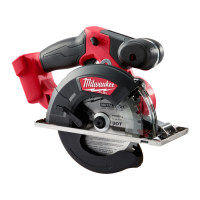
The Milwaukee M18 FUEL™ 5-3/8" / 5-7/8" Metal Saw is a cordless power tool designed for cutting unhardened ferrous and non-ferrous metals. It is part of the M18™ battery system, offering portability and freedom from cords. The saw features a front handle, an upper guard, a lock-off button, a trigger, a main handle, a shoe, a lower guard lever, a lower guard, a blade bolt, a blade flange, the blade itself, an LED light, a transparent front guard, a hanger, a spindle lock button, a depth adjusting lever, and a wrench for blade changes.
The primary function of this tool is to make precise cuts in various metal materials. The M18 FUEL™ technology ensures efficient power delivery and extended run time, making it suitable for demanding tasks. The saw operates by means of a rotating blade, which is driven by a motor when the trigger is pulled. The lock-off button prevents unintentional starting, enhancing safety. The LED light illuminates the cutting area, improving visibility, especially in dimly lit conditions. The transparent front guard allows the user to easily view the cutting line, aiding in accuracy.
Before operation, users must ensure the battery pack is properly inserted and secured. The tool requires a specific type of battery pack and charger, and users should refer to their respective manuals for charging instructions. Selecting the correct blade for the application is crucial; only sharp, thin-kerf blades with a safe operating speed greater than the tool's no-load RPM should be used. Abrasive cut-off wheels or dry diamond cutting blades are not recommended.
Blade installation involves removing the battery pack, placing the saw on a flat surface with the blade facing upwards, and using the provided wrench and spindle lock button to remove the blade bolt and outer flange. The lower guard lever is used to raise the lower guard for blade removal and installation. When installing a new blade, ensure the teeth point in the same direction as the arrow on the lower guard. The inner blade flange should face the blade, and the bolt should be hand-tightened before final tightening with the wrench while holding the spindle lock button.
Adjusting the depth of cut is another key feature. After removing the battery pack, the depth adjusting lever is pulled up to loosen the shoe. The shoe can then be raised or lowered to the desired position, ensuring the blade extends no more than 1/4" below the material being cut for optimal performance and safety. The lever is then pushed down to secure the shoe position.
The transparent front guard is essential for safe operation. If it becomes cracked or damaged, it must be replaced by a MILWAUKEE service facility. Never operate the tool with a damaged or missing transparent guard.
When starting the saw, the lock-off button must be pushed down while pulling the trigger. The motor should be allowed to reach full speed before beginning a cut. During cutting, the shoe must be kept flat against the workpiece, and a firm grip maintained on both handles. The saw should not be forced through the material; light, continuous pressure should be applied while following the cut line.
The saw is equipped with an overload protector that automatically turns off the tool if the motor is overloaded, which can happen with dull blades or when cutting too quickly. If this occurs, the user should release the trigger, remove the blade from the workpiece, allow the tool to run under no load to cool, and then resume the cut.
The electric brake engages when the trigger is released, stopping the blade within a few seconds. This allows for quicker progression of work. However, the brake is not a substitute for the guard, and users must always wait for the blade to stop completely before removing the saw from the workpiece. If the brake frequently misses, the saw requires servicing by an authorized MILWAUKEE service facility.
For general operation, the workpiece should always be clamped securely. When making a cut, the sight line on the shoe should be aligned with the cutting line. The user's arms and body should be positioned to resist kickback. For partial cuts or correcting direction, the blade should be allowed to come to a complete stop before restarting. If the saw binds or stalls, a firm grip should be maintained, and the trigger released immediately, holding the saw motionless until the blade stops.
When cutting angled materials, the tool should be tilted back to prevent the lower guard from resting on the angle. For thin or corrugated materials, cuts should be made at least 1" from the edge to avoid damage from metal strips. Large sheets require proper support to prevent binding and kickback. For widths greater than 4", clamping 1" lumber to the workpiece and using the inside edge of the shoe as a guide is recommended.
Pocket cutting, which involves cutting in the middle of a workpiece, requires extreme caution. The saw should be tilted forward with the front of the shoe firmly fixed on the workpiece, just above the cutting line. The lower guard is raised with the lever, and the saw is started. Gradually lower the back end of the saw into the workpiece, then release the lower guard lever and grasp the front handle. Once the shoe rests flat, advance the saw to the corner. The trigger is released, and the blade allowed to stop before removal. For finishing corners, a reciprocating saw or jig saw is recommended.
Regular maintenance is crucial for the tool's longevity and safe operation. This includes keeping the tool, battery pack, and charger in good repair. Users should inspect the tool for unusual noise, misalignment, binding of moving parts, breakage, or any other condition that might affect its operation. Any such issues warrant returning the tool, battery pack, and charger to a MILWAUKEE service facility for repair. Annual inspection by a service facility is also recommended, depending on usage.
If the tool does not start or operate at full power with a fully charged battery pack, the contacts on the battery pack should be cleaned. If the problem persists, the tool, charger, and battery pack should be returned to a MILWAUKEE service facility for repairs.
Cleaning involves removing dust and debris from vents and keeping handles clean, dry, and free of oil or grease. Only mild soap and a damp cloth should be used for cleaning, as certain cleaning agents and solvents can harm plastics and insulated parts. Flammable or combustible solvents should never be used around tools. To reduce the risk of personal injury and damage, the tool, battery pack, or charger should never be immersed in liquid or allowed to have liquid flow inside them.
For any repairs, the tool, battery pack, and charger should be returned to the nearest service center.
 General
| Type | Circular Saw |
|---|---|
| Voltage | 18V |
| Battery Compatibility | M18 |
| Arbor Size | 5/8 inches |
| No Load Speed / Max RPM | 5, 800 RPM |
| Electric Brake | Yes |
| Dust Port | Yes |
| Max Cutting Depth at 45° | 1-7/8 in |
| Bevel Capacity | 50° |



 To Next Page