This document is a manual for the MIMA MBC Series Electric Pallet Stacker, a material handling equipment designed and manufactured by Banyitong Science & Technology Developing Co., Ltd.
Function Description
The MBC series electric pallet stacker is an electrically driven machine designed for loading, unloading, stacking, and handling goods, particularly those on pallets. It is suitable for use in warehouses, freight yards, supermarkets, and general factory floors. The stacker features a compact structure, convenient operation, and flexible use.
The pallet stacker operates on a 24V electronic system with integrated circuit controllers for stepless speed adjustment, ensuring stable speed and acceleration. The fork lifting mechanism is powered by an advanced electric hydraulic pump, with lifting and lowering controlled by dedicated buttons. Steering is controlled by a handle with a maximum steering angle of 180 degrees. The brake function is activated when the handle is in its uppermost or lowermost position, and it automatically brakes when the power is turned off. An anti-accident safety switch is included, which promptly brakes the forklift if the operator's body interferes with the handle, preventing accidents.
The stacker is not intended for use in environments with flammable or explosive dust or gas, as a tractor for other stackers, for transporting personnel, or for working on grass or sand.
Important Technical Specifications
The manual provides a table of parameters for the MBC series pallet stacker, including:
- Model: MBC
- Rated capacity: 1600/2000 kg
- Lift height: 1600~5000 mm
- Travel speed without load: 6 km/h
- Travel speed with full load: 5 km/h
- Gradeability with full load: 6%
- Turning radius: 1490 mm
- Overall width: 820 mm
- Service weight (including battery): 1300 kg
- Drive wheel material: PU
- Drive motor (power): 1.5KW
The battery is fixed in a battery box with a voltage of 24V and a standard capacity of 210Ah. The charger's most electric current for a 210Ah battery is 30A.
The manual also includes capacity charts for MBC16 and MBC20 models, indicating load capacity based on lift height and load center. For a standard fork spread of 680mm, the charts show varying load capacities at different load centers and lifting heights. For a 570mm fork spread, the MBC16 has no load loss for 1600-2500mm lifting height but a 150kg reduction for 2500-5000mm. The MBC20 has a 200kg load reduction for 1600-4500mm lifting height with a 570mm fork spread. Customized wide legs can be obtained for higher load capacity with a 570mm fork spread.
Usage Features
Starting and Driving:
To start, ensure the outlet is firmly inserted, the key switch is in the "on" position, and the battery has sufficient electricity. Operating the forklift with low electricity for extended periods can damage the battery life. The handle should be positioned correctly (between the uppermost and lowermost ends) for operation. The driving direction is selected, and speed is controlled by slowly accelerating to the desired speed.
Braking:
Electromagnetic braking occurs when the handle moves to its uppermost or lowermost position. Electric braking can also be performed by switching the direction during normal running. To park, loosen the driving direction switch, return it to the empty position, lower the forks to the lowest point to release hydraulic system pressure, loosen the handle (it will return to the braking position automatically), and turn the key switch to the "off" position.
Safety Precautions:
- Daily checks of safety switches and equipment are mandatory.
- Warning signs and design parameters must be intact.
- The battery must be securely fastened.
- Do not use if damaged or malfunctioning.
- Maintenance and adjustments should be performed by professionals.
- Avoid sudden braking or high-speed turns.
- Decelerate on slopes, keeping cargo at the lowest position, and ascend/descend straight.
- Do not turn or lift forks on slopes.
- Decelerate on slippery surfaces to prevent idling or overturning.
- If the line of sight is blocked, place goods behind and seek guidance if necessary.
- Maintain a safe distance from other stackers, people, and objects.
- Sound the horn when exceeding speed limits.
- Before entering an elevator, ensure it can withstand the total weight (forklift, goods, operator).
- Forks should only be lifted when unloading or forking goods, and away from personnel.
- Goods must be equally distributed on the forks; unstable loads are not allowed.
- Use a shelf for high and heavy cargo.
- After stopping, forks must be at the lowest point, and the forklift stopped.
- Parking on slopes or at emergency exits is forbidden.
- Always power off the stacker after parking.
- Wear protective glasses when replacing or charging the battery.
- Do not drive without authorization; take the key when leaving.
- When transporting irregular objects, pay attention to reserving space.
- If goods obstruct sight, drive in reverse.
- Reduce speed when going up and down slopes; turning on slopes is dangerous.
- Before passing a bridge, reduce speed and maintain distance from edges; verify the bridge's loading capacity.
Control Devices:
- Lifting Control: Emergency stop button on, key switch on, then use handle buttons to lift or lower forks.
- Driving Direction and Speed Control: Rotate the handle head to control direction and adjust speed/acceleration.
- Anti-accident Safety Switch: If the operator's body interferes with the handle when moving backward, the forklift brakes. Resume the direction selection switch to the middle position to continue.
- Horn: Activated by pressing a button.
- Battery Connector Assembly: Pull out the socket and turn off power during accidents, urgent/dangerous situations, or welding.
- Key Switch: Controls circuit on/off.
- Electricity Meter: Displays remaining battery capacity (ten lattices). Flashing leftmost diodes indicate low battery, requiring charge.
Maintenance Features
General Maintenance:
Routine maintenance is recommended every 500 hours to ensure efficiency, life, and safety. Replacement parts must be company-approved. Contact the product agent or after-sales service for repairs.
Safe Regulation of Maintenance:
- Repair work requires systematic study.
- Keep the maintenance site clean and hygienic.
- Avoid loose items or valuables on the body during repairs.
- When repairing electrical systems, remove watches, earrings, or other accessories to prevent short circuits or combustion.
- Before repairs, unplug the power outlet and disconnect the power supply.
- Turn off the key switch before opening lids or electrical systems.
- Lower forks to release hydraulic system pressure before checking it.
- Wipe oil leaks with paper/cardboard; avoid direct hand contact to prevent burns.
- Allow the forklift to cool before replacing gear or hydraulic oil to prevent burns.
- Fill the hydraulic system with new, clean oil of a uniform grade to avoid damaging precision components.
- Dispose of oil according to environmental regulations; do not discharge into sewers.
- Disconnect battery power during body welding to prevent welding current from damaging the battery.
- When working under the forklift, it must be supported by a bracket to prevent tipping.
User-Performable Maintenance (Daily, Weekly, Monthly):
- Joystick: Check for proper function.
- Emergency Reverse Switch: Check for proper function.
- Horn: Check for proper function.
- Steering: Check for proper function.
- Hydraulic Device: Check for proper function.
- Electricity Meter: Check for proper function.
- Hydraulic System: Check oil level and for leaks.
- Drive Unit: Check for abnormal noise and oil leakage.
- Electromagnetic Clutch: Check for proper function and contact.
- Transmission: Check for proper function.
- Wheel: Check for damage, remove oil, metal debris.
- Frame: Check for damage and remove oil.
- Battery: Check electrolyte level.
- Fork: Check for deformation or cracks.
- Lifting Device: Check for damage and remove oil.
- Hydraulic Cylinder: Check for damage and oil leakage.
Cleaning:
- Regular weekly cleaning is important.
- Remove the battery connector before cleaning to avoid electrical system damage.
- External Cleaning: Remove attachments from wheels daily. After cleaning, lubricate parts as specified.
- Electrical Components: Use compressed air to blow dust from motor lines; do not wipe with a wet cloth. Do not flush with high-pressure devices. Avoid damaging circuit board components and ensure they remain in position to prevent short circuits.
Maintenance List (Intervals: 1 day, 1 week, 1 month, 3 months, 6 months, 12 months, 36 months):
The manual provides a detailed table indicating specific checks and maintenance tasks for various parts of the forklift at different intervals, including:
- Body System: Check cover plates, battery box fixture, frame for cracks, and body security.
- Motor: Check for loose joints, clean the motor, check installation bolts, and check for abnormal bearing noise.
- Drive System: Check for leaks, oil level, and noise.
- Wheel Parts: Remove cords and debris, check drive wear and bolts, check universal wheel and axle flexibility/tightness, check universal wheel wear, check support wheel rotation/joint tightness, check supporting wheel wear, and remove/lubricate wheel body bearings.
- Brake Parts: Clean brake, check brake friction disc wear, and check brake condition under loose brake condition.
- Electric Control Board: Cleaning and installation inspection, secure cable connector, check contactor contacts, and check contactor action.
- Battery: Check connection tightness between battery, forklift, and charger; check each battery and its insulation sheath for displacement; clean battery.
- Hydraulic: Check piping/joints for leaks, line wear, fuel tank for oil leakage, oil quantity, and oil change.
- Oil Cylinder: Check for oil leak and installation.
- Operating Arm: Check installation tightness, brake switch, fastening screw falls, and safety.
- Shock Absorbing Spring: Check and adjust.
Lubrication:
A lubrication parts table specifies lubrication intervals (500h, 1000h, 3000h) and types of lubricating oil and grease for:
- Wheel bearing (including steering)
- Hydraulic system
- Driving gearbox
- Lifting chain
- Lifting system bearing
Grease specifications are provided for different temperature ranges (-20℃~0℃ and 0℃~40℃), including 3#Drop point of lithium base grease170 for bearings and bushing, L-HV 32 Arctic hydraulic fluids or L-HM 46 Antiwear hydraulic oil for hydraulic systems, 70W/75 (abroadSAE75W) or 85W/90 (abroadSAE80W/90) for transmission gear cases, and Drop point of lithium base grease170 for lifting system bearings.
Battery Maintenance:
- Only replace batteries with equal weight to original ones to maintain stability and braking.
- Do not change battery weight or size randomly.
- Removing Battery: Pull out plug, open case cover, cut connection between plug and cable, take out battery group with a proper hook.
- Installing Battery: Use hanging device to place battery group, connect plug with cable (ensure correct positive/negative connection), insert outlet, close case cover, key switch off.
- Charging: Forbid smoking/flame. Use automatic charger; avoid insufficient or overcharging.
- Charging Preparation: Key switch off, pull out key. Open battery case cover for ventilation. Pull out outlet, connect charger plug. Open single battery cover for ventilation. Turn on charger.
- During Charge: Ensure good ventilation. Oxygen and hydrogen can cause explosion if exposed to flame/electric spark. Shut off charge power before pulling out outlet. Judge sufficient electricity by stable electrolyte proportion for 2-3 hours, strong bubbling, and clear electrolyte.
- After Charge: Shut off power/charger. Pull out charger plug. Insert battery outlet into battery plug, key switch off. Close battery cover.
- Adjust electrolyte proportion with acid liquid or distilled water if it deviates from the specified temperature-proportion table.
- Fully charge batteries before use; do not use if not fully charged.
- Avoid overcharging and over-discharging.
- Keep battery liquid plug and venting cover clean; remove/open during charging.
- After charging, check battery level and add distilled water; do not add dilute sulfuric acid.
- Charge batteries within 24 hours after use.
- Maintain good ventilation during charging; no fireworks.
- Balanced Charging: Every 3 months for normally used batteries, for unused batteries for a long time, or for "backward batteries" (lower voltage during charging/discharging). Perform normal charging, then stop for 1 hour, then charge at 0.25I5 for 1 hour, repeating until bubbling.
- Recharge unused batteries once a month.
- Protect from direct sunlight; keep at least 2M from heat sources.
- Avoid contact with liquids/hazardous materials; no metal impurities in the battery.
Electromagnetic Brake Maintenance:
- Prevent rust in high-humidity environments.
- Friction surface must be clean and oil-free to achieve maximum torque.
- Install in a ventilated place if ambient temperature is high.
- Initial torque may be low; use for a period to stabilize.
- Regularly check for normal switch action, noise, abnormal fever, foreign matter/oil stains in friction/rotating parts, appropriate friction part clearance, and normal voltage.
Faults Diagnosis:
Chapter 8 provides a table of LED display codes, programmer display, description, and failure causes for various issues, such as hardware failure, M-output short circuit, SRO fault, accelerator fault, emergency reverse wiring failure, HPD order fault, potentiometer low cut/short circuit, drive output over current, commutator contactor adhesion, missing contactor, low battery voltage, over voltage, and thermal cutback. The LED display code sample (2,4) indicates two flashes, a pause, then four flashes. Customers can use this information to troubleshoot or contact after-sales service.
Transporting and Preserving the Forklift:
- Towing Faulty Forklift: If towing with a rope, the towed forklift must be steered by a drive to release brakes. If the brake function is perfect, pull the control handle to the operating position and push the truck to the destination or maintenance point. If the drive wheel falls, tow with a traveler or tractor.
- Attention: The deicing wheel must be lifted off the ground to prevent damage to the wheel and motor.
- If the electromagnetic brake fails, place wedge blocks on the wheel to prevent movement.
- Preservation (for long-term storage):
- Battery: Recharge, then follow daily maintenance. Charge maintenance and check electrolyte level every 3 months.
- Hydraulic System: Replace hydraulic fluid if stored for over a year.
- Driving System: If stored for more than a week, fix the drive wheel firmly and support it to prevent movement; unload cargo.
- Re-use after Storage:
- Perform routine maintenance and safety inspection.
- If stored for more than 3 months, perform preventive maintenance according to the 500-hour interval requirements.

 Need help?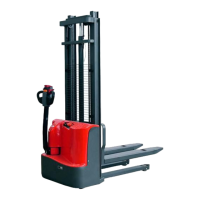

 To Next Page
 General