EasyManua.ls Logo

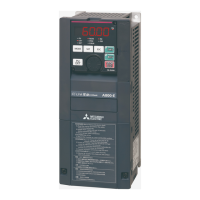
Mitsubishi FR-E540-0.4K-EC - User Manual

Mitsubishi FR-E540-0.4K-EC
217 pages
Print Icon
To Next Page IconTo Next Page
Loading...
TRANSISTORIZED INVERTER
INSTRUCTION MANUAL
FR-E500
-EC
HIGH PERFORMANCE
&
HIGH FUNCTION
TRANSISTORIZED INVERTER
FR-E500
FR-E540-0.4K to 7.5K-EC
FR-E520S-0.4K to 2.2K-EC
INSTRUCTION MANUAL
OUTLINE
PARAMETERS
SPECIFICATIONS
INSTALLATION
AND WIRING
PROTECTIVE
FUNCTIONS
Chapter 6
Chapter 5
Chapter 4
Chapter 3
Chapter 2
Chapter 1
OPERATION/
CONTROL

Table of Contents

Question and Answer IconNeed help?

Do you have a question about the Mitsubishi FR-E540-0.4K-EC and is the answer not in the manual?

Overview

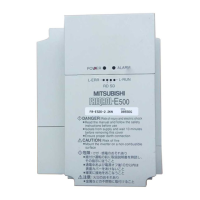
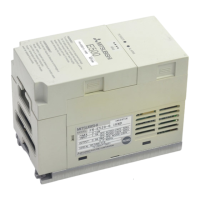
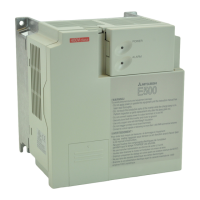
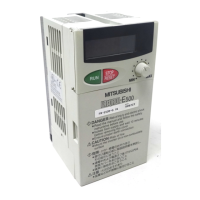
The Mitsubishi Transistorized Inverter FR-E500 series, including models FR-E540-0.4K to 7.5K-EC and FR-E520S-0.4K to 2.2K-EC, is a high-performance and high-function device designed for variable-speed operation of three-phase induction motors. This instruction manual provides comprehensive guidance for its installation, operation, maintenance, and troubleshooting.

Function Description

The FR-E500 inverter controls the speed of a three-phase induction motor by adjusting the output frequency and voltage. It supports various operation modes:

  • PU Operation Mode: Operation using the optional control panel (FR-PA02-02) or parameter unit (FR-PU04) for frequency setting and start/stop commands.
  • External Operation Mode: Operation controlled by external start signals and frequency setting signals (potentiometer, 0-5V, 0-10V, or 4-20mA DC signals).
  • Combined Operation Mode: Utilizes a mix of external start signals and control panel/parameter unit frequency settings, or vice versa.
  • Communication Operation Mode: Allows control and monitoring via a personal computer using RS-485 communication.

Key functions include:

  • Torque Boost (Pr. 0, Pr. 46): Adjusts motor torque in the low-speed range, useful for long inverter-to-motor distances or insufficient starting torque. Two starting torque boosts can be selected via RT terminal switching.
  • Output Frequency Range (Pr. 1, Pr. 2, Pr. 18): Sets maximum and minimum output frequencies, allowing for high-speed operation beyond 120Hz.
  • Base Frequency and Voltage (Pr. 3, Pr. 19, Pr. 47): Adjusts inverter output to match motor ratings, crucial for optimal performance and preventing overload.
  • Multi-speed Operation (Pr. 4-6, Pr. 24-27, Pr. 232-239): Allows selection of up to 17 predetermined running speeds by switching contact signals (RH, RM, RL, REX).
  • Acceleration/Deceleration Time (Pr. 7, Pr. 8, Pr. 20, Pr. 21, Pr. 44, Pr. 45): Sets the time for motor speed increase/decrease, with options for linear or S-pattern acceleration/deceleration.
  • Electronic Overcurrent Protection (Pr. 9, Pr. 48): Protects the motor from overheating by setting a rated motor current, offering optimal protective characteristics at low speeds.
  • DC Injection Brake (Pr. 10-12): Adjusts brake voltage, operation time, and starting frequency for precise stopping and positioning.
  • Stall Prevention (Pr. 22, Pr. 23, Pr. 66): Prevents alarm stops due to overcurrent by adjusting output frequency when current exceeds a set level.
  • Frequency Jump (Pr. 31-36): Avoids mechanical resonance by allowing up to three frequency areas to be jumped.
  • Speed Display (Pr. 37): Changes the control panel display from frequency to motor or machine speed.
  • Frequency Setting Voltage/Current Input (Pr. 38, Pr. 39): Configures the input signal range for external frequency setting (5V/10V or 20mA).
  • Up-to-Frequency Sensitivity (Pr. 41): Adjusts the ON range of the up-to-frequency signal for related equipment.
  • Output Frequency Detection (Pr. 42, Pr. 43): Outputs a signal when the output frequency reaches or exceeds a set value, useful for electromagnetic brake operation.
  • Automatic Restart after Instantaneous Power Failure (Pr. 57, Pr. 58): Enables the inverter to restart without stopping the motor after a power interruption.
  • Remote Setting Function (Pr. 59): Allows continuous variable-speed operation using contact signals without analog inputs.
  • Shortest Acceleration/Deceleration Mode (Pr. 60-63): Automatically sets parameters for the shortest possible acceleration/deceleration time.
  • Retry Function (Pr. 65, Pr. 67-69): Enables automatic resetting and retries after a major fault.
  • Applied Motor (Pr. 71): Configures thermal characteristics for electronic overcurrent protection based on the motor type (standard, constant-torque, Mitsubishi SF-JR4P).
  • PWM Carrier Frequency (Pr. 72, Pr. 240): Changes motor tone and reduces noise through Soft-PWM control.
  • Voltage Input (Pr. 73, Pr. 254): Changes input specifications for frequency setting voltage signals and allows polarity reversible operation.
  • Input Filter Time Constant (Pr. 74): Eliminates noise in the frequency setting circuit.
  • Reset Selection/Disconnected PU Detection/PU Stop Selection (Pr. 75): Configures reset input acceptance, PU disconnection detection, and PU stop functions.
  • Parameter Write Inhibit Selection (Pr. 77): Prevents accidental parameter changes.
  • Reverse Rotation Prevention Selection (Pr. 78): Prevents reverse rotation faults.
  • General-Purpose Magnetic Flux Vector Control (Pr. 80): Provides large starting and low-speed torque without specific motor constant tuning.
  • Offline Auto Tuning (Pr. 82-84, Pr. 90, Pr. 96): Automatically measures and sets motor constants for optimal performance, especially with non-Mitsubishi motors or long wiring.
  • Computer Link Operation (Pr. 117-124, Pr. 338-340, Pr. 342): Settings for RS-485 communication with a personal computer.
  • PID Control (Pr. 128-134): Enables process control (e.g., flow rate, air volume) using feedback signals.
  • Output Current Detection (Pr. 150, Pr. 151): Outputs a signal if the output current remains above a set level for a specified period.
  • Zero Current Detection (Pr. 152, Pr. 153): Outputs a signal when the output current falls to "0," useful for mechanical brake control in vertical lift applications.
  • Cooling Fan Operation Selection (Pr. 244): Controls the operation of the built-in cooling fan.
  • Slip Compensation (Pr. 245-247): Keeps motor speed constant by compensating for motor slip based on output current.
  • Stop Selection (Pr. 250): Selects the stopping method (deceleration to a stop or coasting) when the start signal is switched off.
  • Output Phase Failure Protection (Pr. 251): Disables protection if one of the output phases becomes open, useful for motors smaller than inverter capacity.
  • Meter (Frequency Meter) Calibration (Pr. 901): Calibrates a meter connected to the AM terminal for full-scale deflection.
  • Biases and Gains of Frequency Setting Voltage/Current (Pr. 902-905): Adjusts the relationship between external input signals and output frequency.

Important Technical Specifications

  • Voltage Class: FR-E540 series for three-phase 400V, FR-E520S series for single-phase 200V.
  • Output Frequency Range: 0.2 to 400Hz (starting frequency variable between 0 and 60Hz).
  • Frequency Setting Resolution: 0.01Hz (digital, <100Hz), 0.1Hz (digital, ≥100Hz), 1/500 (analog, 5VDC input), 1/1000 (analog, 10VDC/4-20mADC input).
  • Frequency Accuracy: ±0.5% (analog, 25°C ±10°C), ±0.01% (digital).
  • Starting Torque: 150% or more (at 1Hz), 200% or more (at 3Hz) with magnetic flux vector control or slip compensation.
  • Overload Capacity: 150% for 60s, 200% for 0.5s (inverse-time characteristics).
  • Braking Torque: 0.4K, 0.75K... 100%, 1.5K... 50%, 2.2K, 3.7K, 5.5K, 7.5K... 20% (regenerative).
  • Protective Structure: Enclosed type (IP20).
  • Cooling System: Self-cooling or forced air cooling, depending on model.
  • Ambient Temperature: -10°C to +50°C (non-freezing) for constant torque, -20°C to +65°C for storage.
  • Ambient Humidity: 90% RH or less (non-condensing).
  • Ambience: Indoors, free from corrosive/flammable gas, oil mist, dust, and dirt.
  • Altitude: Maximum 1000m for standard operation; derate by 3% for every extra 500m up to 2500m.
  • Vibration: 5.9m/s² or less (conforming to JIS C 0040).
  • Communication: RS-485 protocol, EIA Standard RS-485, multi-drop link, max 19200bps, max 500m overall length.
  • Terminal Screw Size: M4 for main circuit, M2.5 for control circuit.
  • Control Circuit Wiring: Recommended 0.3mm² to 0.75mm² gauge, 0.9mm max diameter for bar terminals/solid wires.
  • Earth Cable Gauge: 2 (2.5) mm² for 2.2kW or less (200V/400V class), 2 (4) mm² for 3.7kW (400V class), 3.5 (6) mm² for 5.5kW, 7.5kW (400V class).

Usage Features

  • Easy Operation: The optional control panel (FR-PA02-02) allows users to run the inverter, set frequency, monitor operation, set parameters, and display errors.
  • Flexible Control: Multiple operation modes and extensive parameter settings provide high adaptability to various applications and load characteristics.
  • Safety Features: Includes electric shock prevention (earthing, power-off wait times), fire prevention (incombustible mounting, brake resistor use), and injury prevention (correct wiring, voltage application).
  • Noise Reduction: Measures against inverter-generated noise and power supply harmonics are detailed, including the use of EMC filters, reactors, shielded cables, and specific wiring practices.
  • Motor Protection: Electronic overcurrent protection, stall prevention, and output phase failure protection ensure motor longevity and safe operation.
  • Automatic Functions: Automatic restart after instantaneous power failure and offline auto tuning simplify setup and enhance reliability.
  • Communication Capability: RS-485 communication allows for remote control and monitoring, integrating the inverter into larger automation systems.

Maintenance Features

  • Daily Inspection: Regular checks for motor operation faults, installation environment, cooling system, unusual vibration/noise, overheating/discoloration, and input voltages.
  • Periodic Inspection: Includes cleaning air filters, checking and retightening screws/bolts, inspecting conductors and insulating materials for corrosion/damage, measuring insulation resistance, and checking/changing cooling fans and smoothing capacitors.
  • Part Replacement Guidelines: Provides recommended replacement intervals for cooling fans (2-3 years) and smoothing capacitors (5 years) to ensure preventive maintenance and extended inverter life.
  • Troubleshooting Guide: Comprehensive guide for diagnosing common issues such as motor remaining stopped, rotating in the opposite direction, speed variations, large motor current, and parameter write failures.
  • Error (Alarm) Definitions: Detailed explanations of major and minor faults, warnings, and corresponding corrective actions.
  • Insulation Resistance Test: Specific instructions for conducting insulation resistance tests on the main circuit, emphasizing not to test the control circuit.
  • No Pressure Test: Highlights that pressure tests should not be conducted on the inverter due to potential damage to semiconductors.
  • Clearance Requirements: Specifies necessary clearances around the inverter for adequate ventilation, crucial for maintaining optimal ambient temperature and inverter life.
  • Wiring Instructions: Detailed guidance on using appropriate cables, crimping terminals, and tightening torques for both main and control circuits to prevent damage and misoperation.

Mitsubishi FR-E540-0.4K-EC Specifications

General IconGeneral
BrandMitsubishi
ModelFR-E540-0.4K-EC
CategoryInverter
LanguageEnglish

Related product manuals