8
5-564
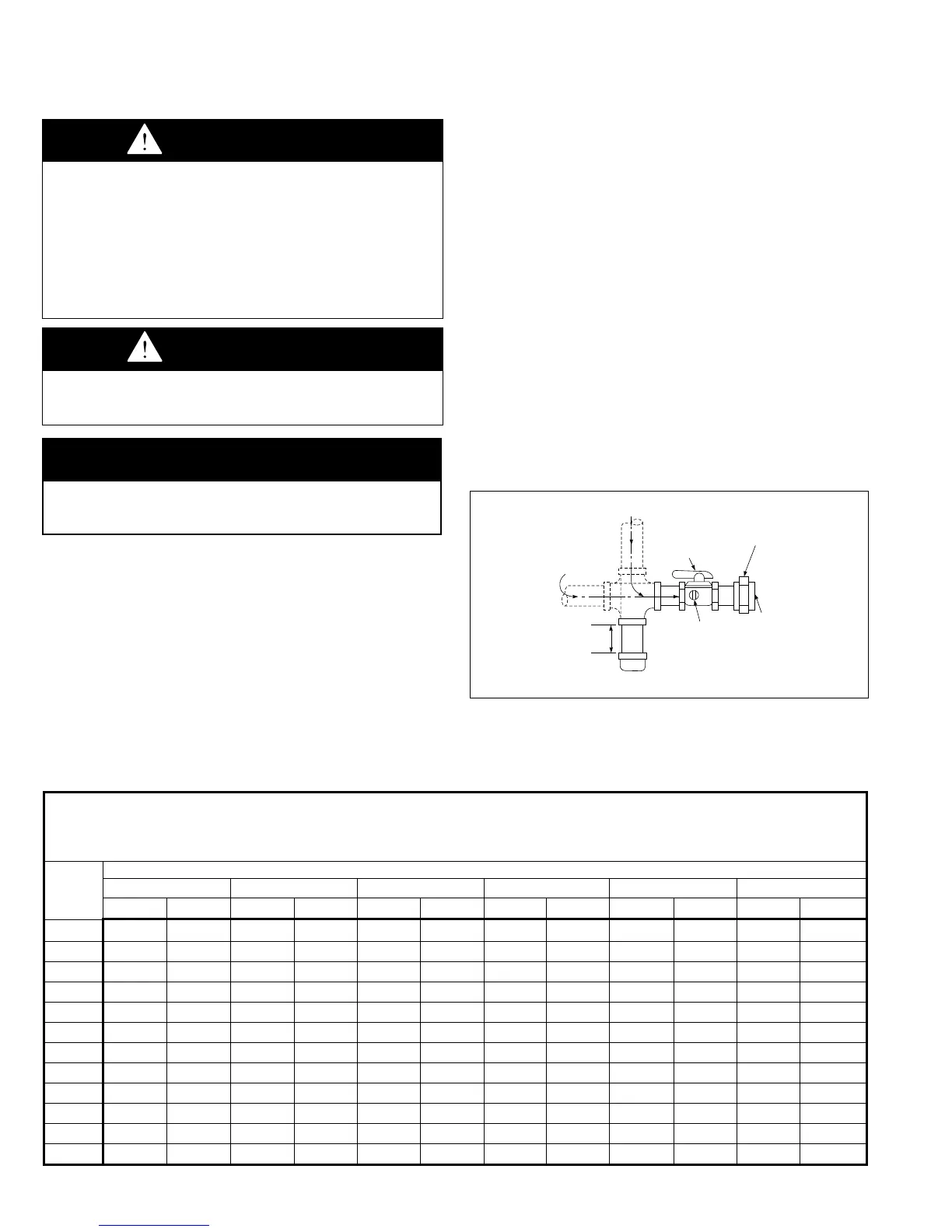
Gas Pipe Capacities (Up to 14” W.C. Gas Pressure through Schedule 40 Pipe)
Cubic Feet per Hour with Pressure Drop of 0.3” W.C.
Natural Gas - Specific Gravity - 0.60
Propane Gas - Specific Gravity - 1.50
Length Pipe Diameter
Of Pipe 1/2" 3/4" 1" 1-1/4" 1-1/2" 2"
(feet) Natural Propane Natural Propane Natural Propane Natural Propane Natural Propane Natural Propane
10 132 83 278 175 520 328 1050 662 1600 1008 3050 1922
20 92 58 190 120 350 221 730 460 1100 693 2100 1323
30 73 46 152 96 285 180 590 372 890 561 1650 1040
40 63 40 130 82 245 154 500 315 760 479 1450 914
50 56 35 115 72 215 135 440 277 670 422 1270 800
60 50 32 105 66 195 123 400 252 610 384 1150 725
70 46 29 96 60 180 113 370 233 560 353 1050 662
80 43 27 90 57 170 107 350 221 530 334 990 624
90 40 25 84 53 160 101 320 202 490 309 930 586
100 38 24 79 50 150 95 305 192 460 290 870 548
125 34 21 72 45 130 82 275 173 410 258 780 491
150 31 20 64 40 120 76 250 158 380 239 710 447
Gas Connections
1. Installation of piping must conform with local building codes,
or in the absence of local codes, with the National Fuel Gas
Code, ANSI Z223.1 (NFPA 54) - Latest Edition. In Canada,
installation must be in accordance with CAN/CGA-B149.1 for
natural gas units and CAN/CGA-B149.2 for propane units.
2. Piping to units should conform with local and national
requirements for type and volume of gas handled, and
pressure drop allowed in the line. Refer to Table 10.1 to
determine the cubic feet per hour (cfh) for the type of gas
and size of unit to be installed. Using this cfh value and the
length of pipe necessary, determine the pipe diameter from
Table 8.1. Where several units are served by the same main,
the total capacity, cfh and length of main must be considered.
Avoid pipe sizes smaller than 1/2". Table 8.1 allows for a 0.3"
W.C. pressure drop in the supply pressure from the building
main to the unit. The inlet pressure to the unit must be 6-7"
W.C. for natural gas and 11-14" W.C. for propane gas. When
sizing the inlet gas pipe diameter, make sure that the unit
supply pressure can be met after the 0.3" W.C. has been
subtracted. If the 0.3" W.C. pressure drop is too high, refer to
the Gas Engineer’s Handbook for other gas pipe capacities.
3. The gas piping to the unit can enter the unit from the side of
the unit or from below. Install a ground joint union with brass
seat and a manual shut-off valve external of the unit casing,
and adjacent to the unit for emergency shut-off and easy
servicing of controls, including a 1/8" NPT plugged tapping
accessible for test gauge connection (See Figure 8.1).
4. Provide a sediment trap before each unit in the line where low
spots cannot be avoided. (See Figure 8.1).
5. When Pressure/Leak testing, pressures above 14" W.C. (1/2
psi), close the field installed shut-off valve, disconnect the
appliance and its combination gas control from the gas supply
line, and plug the supply line before testing. When testing
pressures 14" W.C. (1/2 psi) or below, close the manual shut-
off valve on the appliance before testing.
Table 8.1 - Gas Pipe Capacities
WARNING
1. All field gas piping must be pressure/leak tested prior to
operation. Never use an open flame. Use a soap solution or
equivalent for testing.
2. Gas pressure to appliance controls must never exceed 14"
W.C. (1/2 psi).
3. To reduce the opportunity for condensation, the minimum sea
level input to the appliance, as indicated on the serial plate,
must not be less than 5% below the rated input, or 5% below
the minimum rated input of duel rated units.
GAS
SUPPLY LINE
GAS
SUPPLY LINE
GROUND
JOINT
UNION
W/ BRASS
SEAT
MANUAL GAS
SHUT-OFF VALVE
3"
MIN.
SEDIMENT
TRAP
PLUGGED
1/8" NPT TEST
GAGE CONNECTION
TO
CONTROLS
➀
➀ Manual shut-off valve is in the “OFF” position when handle is perpendicular to
pipe.
IMPORTANT
To prevent premature heat exchanger failure, the input to the
appliance, as indicated on the serial plate, must not exceed
the rated input by more than 5%.
CAUTION
Purging of air from gas lines should be performed as
described in ANSI Z223.1 - latest edition “National Fuel Gas
Code”, or in Canada in CAN/CGA-B149 codes.
INSTALLATION
Figure 8.1 - Recommended Sediment Trap/Manual
Shut-off Valve Installation - Side or Bottom Gas
Connection


 To Next Page