9
NECK ADJUSTMENT (all models)
Caution! Improper truss rod adjustment can result in damage to your guitar,
including breaking the neck! Take great care when adjusting the truss rod
and make only minor adjustments. If you are unsure of any step, you should
have the truss rod adjusted by a professional luthier.
The neck is constantly bearing the tension of the strings, and its curvature
will be subtly affected not only by the state of tuning and the string gauge,
but also by changes in temperature and humidity. If you experience
problems such as string buzz or muted notes even after the action and
tuning are adjusted correctly, you should check and adjust the curvature of
the neck. Perform the following steps to check and adjust the curvature of
the neck.
1. Tune your guitar.
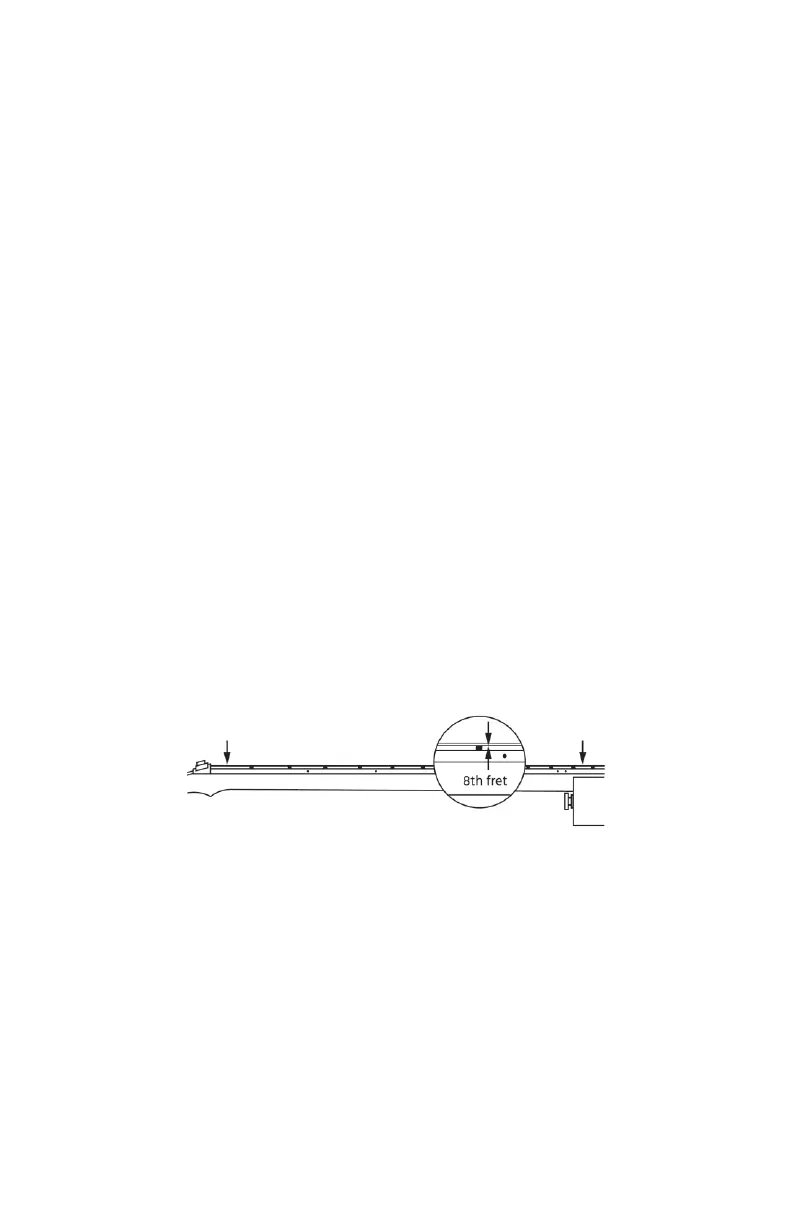
2. Use a capo to fret all strings at the 1st fret.
3. With the guitar in normal playing position, fret the 6th string (low
E) at the last fret, then use a feeler gauge to check the gap
between the bottom of the 6th string and the top of the 8th fret.
The gap should be about 0.010" (0.25mm).
If there is not enough gap, you will need to increase the neck
relief by loosening the truss rod by turning it counterclockwise
(towards the high E string).
If there is too large of a gap, you will need to reduce relief by
tightening the truss rod by turning it clockwise (towards the
low E string).
If the gap is correct, no adjustment is necessary.



 To Next Page