FUNCTIONAL
ATTRIBUTES
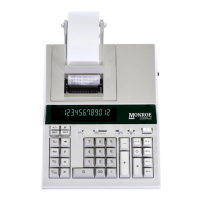
Separate Adding Machine/Calculator
Earlier in our discussion, we touched upon the
basis and importance of having the adding
machine controls on the right. Similarly it is
important to have the calculator controls on the
left (times, divide, equals etc). The separation
physically between the adding machine and
calculator again pertains to the intended
use of the calculator, i.e. most of the work
performed on the calculator will be addition
and subtraction. It is also extremely important
that separation exist functionally. Certain
calculators use the +, -, and/or total keys as an
equals key. This means that users may not add
a column of figures and interrupt the addition to
perform any other operation (multiplication and
division for example). Inadvertent depression
of the times or divide keys could clear the
contents of the adding machine, thereby
necessitating reentry of the column of figures.
Repeat Addition and Subtraction
This feature is standard on most calculators. It
permits a user to press the plus key again (for
example) to add the same number more than
once. It also permits a user to touch the minus
key following a depression of the plus key to
correct an entry error. This feature eliminates
the need to reenter like amounts when they
follow each other in addition and subtraction.
Add Mode
Add mode is typically denoted on the decimal
selectors of calculators as a + symbol or with
an A. In Add mode, the user need not pr
ess the
decimal point key when entering dollars and
cents. The calculator will place the decimal
point automatically, i.e., if one were to enter
1, 2, 3, then press the plus key, the calculator
would accept the entry as $1.23. The feature
add mode was first developed by Monroe
and was based upon the fact that mechanical
adding machines did not have decimal point
keys, therefore entries were accepted as
dollars and cents. Add Mode on the Ultimate
goes far beyond simplifying the entry of figures
for addition and subtraction. Since these
products are no longer simply adding machines,
what happens when one performs multiplication
or division when the decimal selector is in Add
Mode (+) position.
• Units/Price Mode
One of the most common applications per-
formed on a calculator is checking an invoice.
Invoices typically are formatted in much the
same way. That is, one is multiplying the
number of units by a price in dollars and
cents. If the decimal selector is in Add Mode,
and one enters 12 touches the times key then
enters 123, then equals, the calculator will
automatically treat the entry of 12 as whole
units and treat the second entry 123 as $1.23.
This treatment is referred to as units price
mode.
• Units/Units Mode
Monroe Ultimate provides the default position
with the other formats optional when the
decimal selector is in the Add Mode position
and one is performing multiplication or
division. Units/Units Mode, treats both
entries in multiplication or division as whole
numbers, if no decimal point is entered.
• Price/Units Mode
As much as one wants to generalize, there
ar
e invoices wher
e price appears first then
the number of units. To facilitate this type
of invoice, again the Monr
oe Ultimate
138
Monro-Manual-1-50 1/26/10 6:08 PM Page 138


 To Next Page