12
MORDAX : DATA
User Guide
SYS V. 01.00.00
BOOT V. 01.00.00
Updated: 161229
Trigger Level & Edge
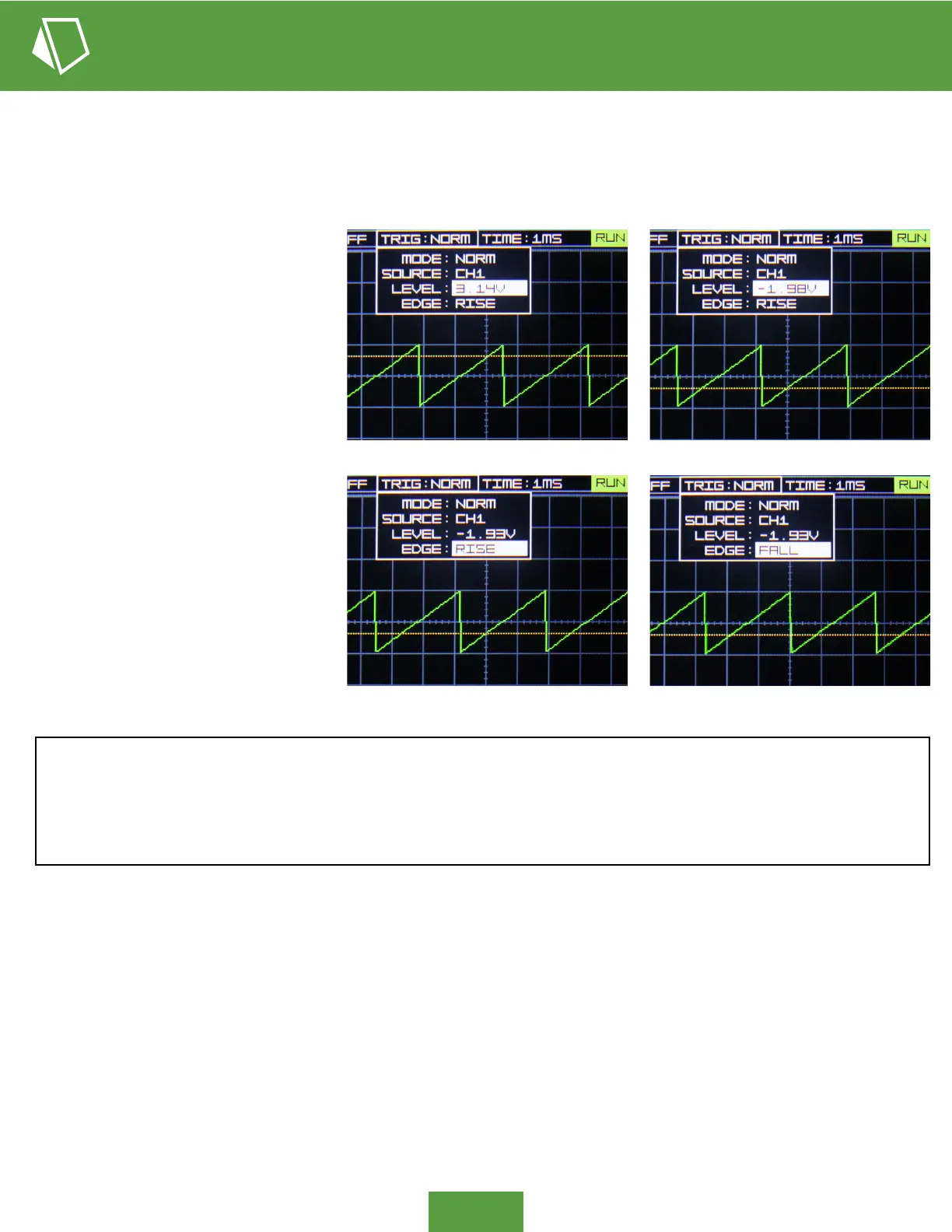
When triggering from a singal in NORM mode, the trigger event occurs when the incoming signal crosses the trigger threshold,
or LEVEL (orange dotted line). When a trigger occurs the signal display is centered at the trigger point - the intersection of
the orange trigger line, the grey center grid Y-axis, and the incoming signal.
Images 1 and 2 to the right show the
trigger LEVEL changed from 3.14V to
-1.98V. This results in the trigger point
moving down; in image 1 the trigger is
towards the top of the saw wave, while in
image 2 it’s towards the bottom, and the
wave appears to have shifted to the right.
The Trigger EDGE parameter selects
whether a trigger event occurs when the
signal crosses the LEVEL from below, low
to high (RISE), or from above, high to low
(FALL).
Images 3 and 4 to the right show the
trigger EDGE changing from RISE to FALL.
With RISE, the signal display is centered
around the left slope of the saw wave,
while with FALL the signal is centered at
the right edge of the saw wave. Similar to
changing the LEVEL previously, the wave
appears to have shifted, this time to the
left.
1
3
2
4
Pro-tip: if your oscillator’s waveform is complex and contains non-repeating elements (e.g., wavefolding modulation or
scanning wavetables with lots of jagged edges), it might cross the trigger LEVEL many times per cycle, causing the display to
center the wave at different places, seeming to shift the wave left and right as it modulates. Try setting the trigger source to
another channel that’s monitoring a squarewave oscillator set to the same frequency as your complex waveform (or use the
SYNC output of your complex oscillator if it has one). This will keep a stable sync window for viewing your complex oscillator’s
waveform, even while it’s changing shape.


 To Next Page