70258-a.11-HELIO A7 USER MANUAL PLUS
27
User
Manual
The seated head height (HHT) ranges from about 47 in.
(120 cm) for a small adult female to about 61 in. (155 cm)
for a tall adult male.
See figure 3.
WARNING
Allow as much clearance as possible around the
wheelchair occupant to reduce the possibility
of contact with vehicle components and other
passengers in the event of a crash.
WARNING
Ensure all vehicle components that are in close
proximity to the wheelchair occupant are removed
or covered with dense padding.
Motion Composites
Transit Tie-Down Package
Rear Tie Down Front Tie Down
Figure 3. Tie Down Location
FRONT OF VEHICLE
The Motion Composites
Transit Tie-Down Package
includes belt restraint anchor
points in conformance with
ANSI/RESNA WC/Vol. 4,
Section 19/ISO 7176-19.
8. SECURING THE
WHEELCHAIR OCCUPANT
Once the wheelchair has been properly secured, it is
essential that the wheelchair occupant be protected for
transport.
WARNING
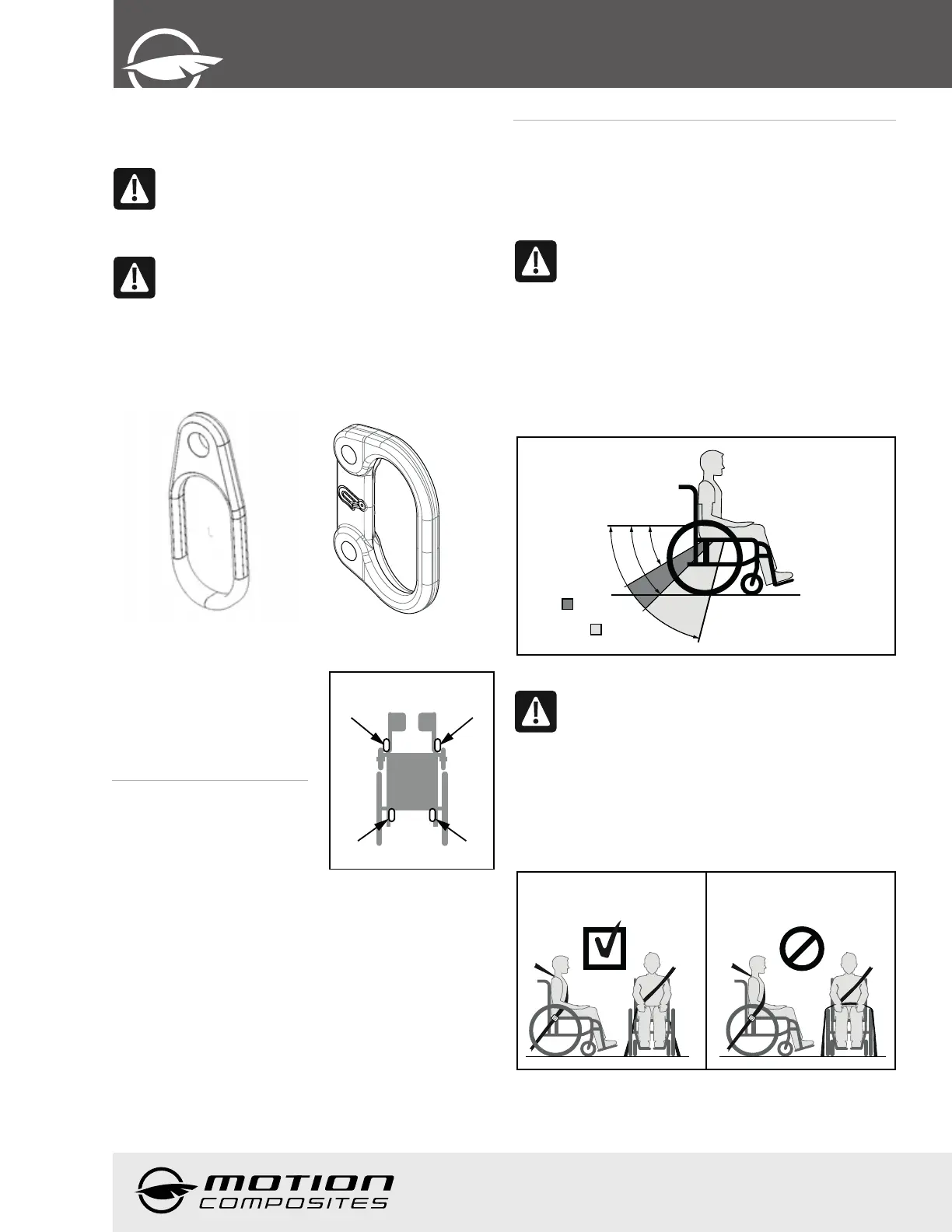
The pelvic belt should be angled between 45 and
75 degrees to the horizontal when viewed from
the side. However, if the user cannot achieve this
standard, an optional zone of 30 to 45 degrees can
be utilized safely. Some wheelchair components, like
armrests and wheels, can interfere with proper belt
fit. It may be necessary to insert the belt between
the armrest and the seatback or through openings
between the backrest and seat in order to avoid
placing the pelvic belt over the armrest.
See figure 5.
30˚
45˚
75˚
Prefered Zone
Optimal Zone
igure 5. Recommended Pelvic Belt Placement Angles
WARNING
The wheelchair occupant must be secured with
dynamically crash-tested and approved pelvic and
upper-torso belts or with a five point child restraint
harness as part of WTORS. Place the pelvic belt
across the front of the pelvis near the upper thighs,
not high over the abdomen. Place the upper-torso
belt across the middle of the shoulder and the
center of the chest, and connect to the pelvic belt
near the hip of the wheelchair occupant.
See figure 6.
igure 6. Proper Pelvic Belt Placement
Pelvic restraints should make full contact
accross the front of the body near
the junction of the tigh and pelvis.
Belt restraints must not be held away from
the body by wheelchair components such
as armrests or wheels.


 To Next Page